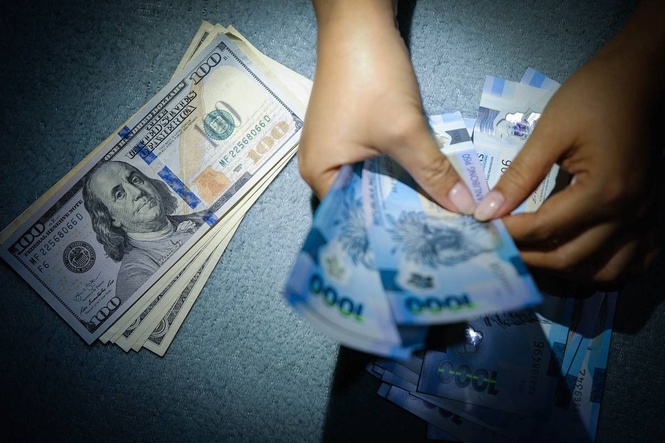
THE Philippine peso recovered against the US dollar on Friday after hitting a record low during the session, while local stocks rallied on bargain hunting and easing global bond yields.
The peso closed at P62.985 per dollar, strengthening by 7.5 centavos from Thursday’s P63.06 finish, data from the Bankers Association of the Philippines showed.
It opened at P63.03 and weakened to an intraday low of P63.23 before recovering to P62.97.
Despite the recovery, the peso’s weighted average exchange rate rose to P63.068 from P63.049 a day earlier. Total trading volume increased to $1.598 billion from $1.502 billion.
Inflationary pressures
“A series of unfortunate events has kept the peso elevated,” Reyes Tacandong & Co. senior adviser Jonathan Ravelas said.
Ravelas cited the higher probability of a US interest rate hike following elevated inflation readings in the United States and the Philippines, geopolitical risks, declining gross international reserves and cash remittances as probable causes of the peso’s weakness.
Ravelas expects the peso to trade between P62.90 and P63.30 against the dollar next week.
John Paolo Rivera, a senior fellow at the Philippine Institute for Development Studies, warned that prolonged peso weakness could add to inflationary pressures as imported goods become more expensive.
Imported petroleum products such as gasoline, diesel and liquefied petroleum gas could feel the immediate impact.
Imported food items including wheat-based products and dairy, as well as certain medicines and consumer goods, could also face higher costs, Rivera added.
He said the effects could spread to food, electricity and transportation prices as production and logistics expenses rise.
“While price adjustments may not be immediate, sustained currency weakness could eventually push up prices more broadly,” Rivera said.
Michael Ricafort, chief economist at Rizal Commercial Banking Corp., said the peso corrected “after market sentiment locally and globally improved.”
“Possible future BSP rate hikes, especially on the next rate-setting meeting on Oct. 22, 2026, and on Dec. 17, 2026, may somewhat help stabilize the peso exchange rate, importation costs, and, in turn, also better manage inflation and inflation expectations,” Ricafort said
Bargain hunting
At the stock market, the benchmark Philippine Stock Exchange index (PSEi) rose 2.11 percent, or 119.47 points, to close at 5,782.70 as investors continued bargain hunting.
Philstocks FInancial Inc. research manager Japhet Tantiangco said lower global bond yields, led by US Treasury yields, and a pullback in global oil prices helped support the market’s advance.
“Trading remained tepid, however, with net value turnover at P5.26 billion, implying that the rise had weak conviction,” Tantiangco said.
Foreign investors were net buyers, recording inflows of P148.21 million.
Services led the sectoral advance, gaining 4.09 percent, while conglomerates were the only sector to finish lower, slipping 0.12 percent.
RL Commercial REIT Inc. led the index gainers, rising 9.05 percent to P6.75, while DMCI Holdings Inc. was the biggest index decliner, falling 1.36 percent to P7.27.
Regina Capital Development Corp. head of sales Luis Limlingan said buying interest emerged across the market, led by index heavyweights.
He said sentiment may also have benefited from the possibility that funds could be redirected to other emerging markets, including the Philippines, following MSCI’s downgrade warning on Indonesia.
However, Limlingan said investors remained cautious about geopolitical developments and domestic economic conditions.
Market breadth was positive, with 106 stocks advancing, 78 declining and 69 ending unchanged. Turnover reached P5.24 billion, excluding extraordinary block sales.