Malaysia’s PISA 2025 results show gains in science and reading, but an 11-point drop in maths prompts a new transformation plan.
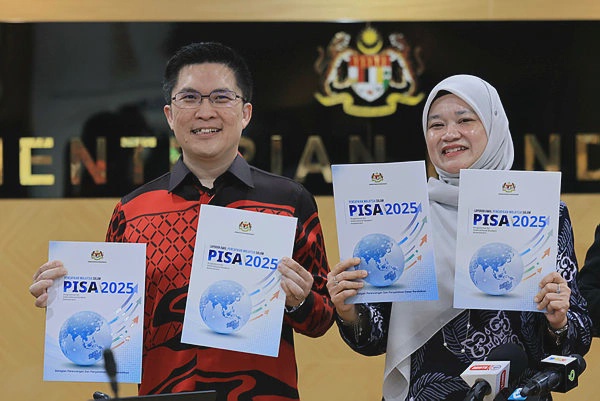
PUTRAJAYA: The Programme for International Student Assessment (PISA) 2025 results indicate that Malaysia’s education system has a solid foundation, particularly in science, reading and computational problem-solving, as well as teacher support.
Education Minister Datuk Seri Fadhlina Sidek said Malaysian students’ performance in science improved by three points to 419 compared with 2022, while reading performance rose by five points to 393, even as the average performance among Organisation for Economic Co-operation and Development (OECD) countries declined.
She said PISA 2025 also found Malaysian students to be highly curious and resilient, with an increasing ability to manage their own learning.
“Another strength of Malaysian students is evident in computational problem-solving, where Malaysia scored 484 points and was among six countries whose performance exceeded expectations,” she said at a press conference on the PISA 2025 results here today.
Fadhlina said Malaysian students’ readiness to seek help when needed ranked highest globally, while their learning resilience ranked third highest in the world.
However, she acknowledged an 11-point decline in mathematics performance, bringing Malaysia’s score to 397, and stressed that the issue must be addressed more seriously and intensively rather than defensively.
She said the Ministry of Education (MOE) had initiated the Mathematics Education Transformation Plan, which places greater emphasis on conceptual understanding, reasoning and problem-solving as interventions to address the decline.
“We do not want mathematics to become a race to find the answer. We want mathematics to train children to find the path to the answer,” she said.
Fadhlina also highlighted the need to strengthen family support for children’s learning, noting that PISA 2025 findings showed only 34 per cent of students reported discussing school issues with their parents weekly, down from 46 per cent in 2022.
Meanwhile, only 51 per cent said they discussed school activities with their parents at least once a week, compared with 57 per cent in 2022.
“PISA tells us that the potential already exists within our children, and now is the time for us to work towards ensuring that all our children receive quality educational opportunities and the chance to learn in schools across the board, without exception,” she said.
She also identified cyberbullying as a major concern requiring attention, as five per cent of Malaysian students reported experiencing cyberbullying, a rate higher than the OECD average.
Fadhlina said cyberbullying was also associated with lower academic achievement, making student safety and well-being an important component of the education agenda.
Meanwhile, Educational Policy Planning and Research Division director Datin Rosliza Rosli said two key domains had shown improvement, while mathematics required serious attention as its decline was part of a global crisis affecting other countries.
She said PISA survey findings showed that Malaysian students felt their teachers provided continuous support and instruction until they understood a subject, with the feedback exceeding the OECD average.
“The OECD average reflects the performance of the 38 OECD member countries, which are advanced economies, out of the 91 nations participating in PISA. Malaysia aims to reach the OECD average in the next cycle,” she said.
Rosliza congratulated teachers on the achievements while urging parents to “go back to basics” by putting aside phones and other devices to spend quality time with their children.
She stressed that future education strategies must involve the entire community through a “whole-nation approach”, with parents and other stakeholders working together to support schools and students.