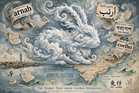
Exploring curious, border-defying origins of words
Language is fascinating precisely because it is confusing. There is no logical reason why the world cannot use one language. Yet the fact that languages belong to different cultures and peoples is exactly what turned a rabbit into global news.
In English, nobody knows what an arnab is.
In some countries, rabbits are pests, the bane of farmers. Elsewhere, they are pets or dinner. Fortunately, rabbits are not generally hated in Malaysia, although the poor rabbit can never seem to please everyone.
But back to arnab, which means rabbit in Malay. The word comes from Arabic, where arnab can mean both rabbit and hare. Malay has borrowed from many languages over the centuries, reflecting the different peoples with whom its speakers traded, worshipped, worked and lived.
The cyclone, meanwhile, was named by Bangladesh. In Bengali, Arnab is a male name derived from Sanskrit, meaning ocean or sea.
Cyclone Arnab developed over the Bay of Bengal before making landfall near Narsapur on India’s Andhra Pradesh coast on Oct 28, packing sustained winds of 125–135 km/h with gusts of up to 150 km/h. It was strong enough to force the evacuation of more than 180,000 people in Andhra Pradesh and Odisha before weakening inland.

Fortunately, Arnab was not heading for Malaysia, and Penang was never in its projected path.
While the big rabbit will not be visiting, its anak buah has been here on tour and probably hopped on the AirAsia budget airline. Penang just saw some landslides, sinkholes, flash floods and fallen trees.
There was a time when cyclones in some parts of the world were named exclusively after women. The Atlantic system began using women’s names in 1953, before adding male names in 1979. Australia introduced both in 1975. Had Arnab been an Atlantic hurricane in 1975, it would have been quite the thorn among the roses.
Then there is Paulo Coelho, the Brazilian author, whose surname coincidentally means rabbit in Portuguese.
The Portuguese word for rabbit is coelho. In his 1852 Malay dictionary, the 19th-century scholar John Crawfurd suggested that the older Malay terms tarwelu and kuwelu, today spelt terwelu and kuilu, were most probably corruptions of coelho. He also believed that the Portuguese had most likely brought the rabbit itself into the Archipelago, so the name may well have arrived together with the animal.
Domestic rabbits descend from European rabbits and are not native to Malaysia. Hares are a slightly different matter. The Handbook of the Mammals of the World places the Burmese hare across mainland Southeast Asia down to the northern Malay Peninsula, and even notes that it occurs in sandy coastal areas of Malaya, although the American Society of Mammalogists’ Mammal Diversity Database lists it only in Myanmar, Thailand, Laos, Cambodia and Vietnam. Even in Crawfurd’s time, the hare in Java was described as having been brought over from continental India.

Surprisingly, older Malay also had a word for the animal that points neither to Arabic nor to Portuguese. Wilkinson’s Malay-English dictionary records kucing tapai as a dated term for rabbit, and in Terengganu, tapai on its own was once used for the animal.
This tapai has nothing to do with the fermented rice we know by the same name. In his 1999 study From Ancient Cham to Modern Dialects, the linguist Graham Thurgood lists the Terengganu tapai alongside tapay in Cham, pai in Jarai and Rade, and tarapai in Roglai, all descended from a reconstructed Proto-Chamic word for rabbit, tarapay. He also lists similar forms in Mnong and other Mon-Khmer languages of the highlands of Vietnam and Cambodia, which suggests the word itself came from the mainland.
Indeed, the Cham were the people of Champa, an old kingdom on the coast of what is now central Vietnam, and the Terengganu tapai is one small trace of the ties that once ran across the South China Sea. How exactly the word made the journey remains to be established.
In Penang, Hokkien can be just as confusing to an English speaker. There is a local joke that goes something like this, although I filled up some of the parts which I have forgotten:
We say ee, they call it him.
We say heem, they call it bear.
We say beh, they call it horse.
We say hor, they call it tiger.
But Thai girls are in Thailand!
We say hoe, they call it good.
We say gu, they call it cow.
We say kau, they call it dog.
We say lok, they call it deer, though to an English ear, it sounds more like a log of wood.
And finally, here is one which is definitely my own. We say thor, they call it rabbit, although again, to an English ear, it sounds very much like Thor, the god of thunder, which seems fitting given the storm that started all this.
Now that we have cleared up the confusion about Arnab, at least we do not need to go chasing answers down the rabbit hole.
And perhaps, along the way, we may discover more similarities than differences.