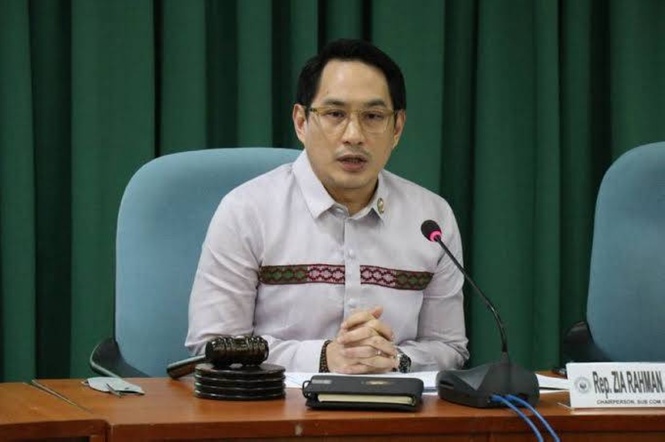
THE Senate impeachment court can vote on the impeachment of Vice President Sara Duterte even if the conviction threshold is challenged before the Supreme Court, a member of the House prosecution team said on Sunday.
Panel spokesman and Lanao del Sur 1st District Rep. Zia Alonzo Adiong said only a temporary restraining order (TRO) from the Supreme Court can stop the voting.
Adiong made the remarks on Sunday as senators debated whether the constitutional requirement of a two-thirds vote of 16 out of the 24 senators applies for the Duterte trial.
“My understanding would be, unless and until the Supreme Court issues a TRO, then the Senate could proceed with the voting,” Adiong said.
“If it’s about constitutionality, I guess, the only institution that can actually define and clarify some confusion as to how do we interpret the Constitution is the Supreme Court,” he said.
Under Article XI, Section 3 of the Constitution, no person may be convicted in an impeachment trial without the concurrence of two-thirds of all Senate members.
The provision has traditionally been understood to require 16 votes in a 24-member Senate.
The issue has resurfaced because several senator-judges have been unable to participate regularly in the proceedings for varying reasons.
Sen. Juan Miguel Zubiri has said discussions are under way on whether the voting requirement should take into account the Senate’s actual situation when judgment is rendered.
Adiong said any challenge over the constitutional interpretation of the threshold would ultimately be for the Supreme Court to resolve. He acknowledged that the limits between the Senate’s exclusive power to try impeachment cases and the court’s authority to settle constitutional questions have yet to be tested.
A definitive Supreme Court ruling could eventually establish guidance extending well beyond Duterte’s case and settle how the constitutional voting provision should be enforced when similar circumstances arise.
The court can “give us a concrete and tangible understanding on how future impeachment proceedings with similar circumstance” would proceed, Adiong said.
No double jeopardy
Meanwhile, the Senate impeachment court on Sunday said that the constitutional principle of double jeopardy does not apply to the impeachment trial of Duterte, saying that the impeachment and criminal proceedings she is facing in a lower court are different in nature.
Impeachment court spokesman Reginald Tongol issued the statement after the Quezon City Regional Trial Court issued an arrest warrant against Duterte for three counts of grave threats, the same issue involving the vice president’s livestreamed statement that she had hired an assassin to kill President Ferdinand Marcos Jr., first lady Liza Araneta-Marcos and former speaker Martin Romualdez.
“To clarify on behalf of the Impeachment Court: The principle of ‘double jeopardy’ does not apply. Double jeopardy strictly applies to successive criminal proceedings,” Tongol said in a statement.
“While you noted we are distinct from regular courts, the Impeachment Court is a sui generis (unique) constitutional tribunal with the supreme mandate to determine political accountability and fitness for office, not penal liability,” he added.
Tongol cited Article XI, Section 3, Paragraph 7 of the 1987 Constitution, which he said “explicitly allows for an official to face an impeachment trial and a regular criminal prosecution simultaneously on entirely separate tracks.”
“Therefore, the issuance of a warrant and posting of bail at the regular courts for grave threats have absolutely zero legal implication on the ongoing impeachment trial. They do not legally alter, pause or dictate the Impeachment Court’s timeline,” Tongol said.
“The senator-judges remain completely focused on fulfilling their exclusive constitutional mandate independently, fairly and with absolute impartiality,” he added.