Taipei Mayor Chiang Wan-an on November 3 rejected a claim by an Nvidia insider that his city government stalled the US chipmaker's Taiwan headquarters deal for political reasons, insisting that Taipei "was not an obstacle" but had instead "removed the obstacles" that stood in Nvidia's way.
The dispute strikes at one of the achievements Chiang has highlighted most as he seeks a second term in the 2026 Taiwan local elections. Chiang, of the opposition Kuomintang (KMT), faces Democratic Progressive Party (DPP) challenger Puma Shen in the November 28 vote, and has cited Nvidia's decision to build its headquarters at the Beitou-Shilin Science Park in northern Taipei as evidence of his record.
Nvidia Insider Says The Deal Was Ready In 2025
The challenge came in a report by the Liberty Times, a Taipei daily. Citing an Nvidia insider familiar with the matter, the newspaper reported that Nvidia and Shin Kong Life Insurance, which held the development rights to the site, had reached a consensus in 2025 and could have signed an agreement as early as July or August that year. According to the source, the Taipei City Government stepped in for political reasons, creating a dispute that delayed the deal until February 2026.
The insider also took aim at a story told by Chiang's wife, Shih Fang-hsuan. In a recent interview with veteran television producer Wang Wei-chung, Shih said contact with Nvidia CEO Jensen Huang had been made through an Nvidia engineer she knew, whom she had met in the United States.
The insider said Nvidia's negotiations were led throughout by two of its global vice presidents, identified as Mr. Linetsky and Mr. Ekman, who reported to Huang. "To us, that sounds simply bizarre," the source said of Shih's account. "This candidate clearly has no understanding of how Nvidia works internally."
Chiang Says A Contract Tied The City's Hands
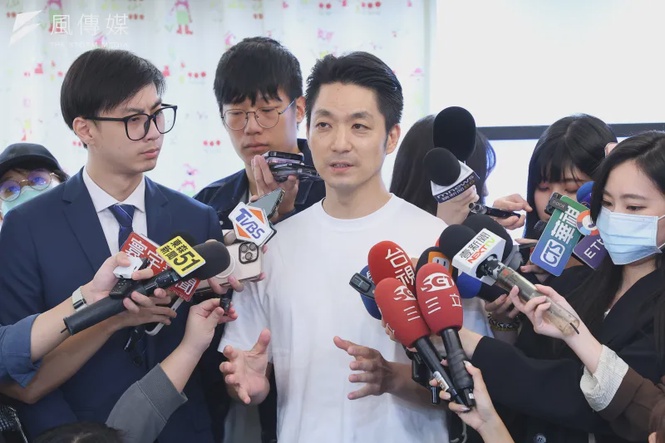
Speaking to reporters on November 3 at a press event marking the 145th anniversary of the Taipei City God Temple, Chiang said the issue had already been debated at length in the Taipei City Council last year.
He said the contract between the city and Shin Kong Life spelled out that the insurer's development rights, known in Taiwan as superficies rights, could be transferred only after Shin Kong Life finished construction, obtained a use permit, and received the city's approval. At the time, Chiang said, councilors from all parties, DPP members included, agreed that the city had to honor the contract and could not transfer the rights in breach of its terms.
Instead, the city negotiated with Shin Kong Life, worked through a series of difficulties, and reached an agreement to terminate the contract and take back the land, Chiang said. It then granted the development rights to Nvidia through a dedicated arrangement, which allowed the company to settle in Taipei. "The Taipei City Government was not an obstacle," he said. "We removed the obstacles."
Mayor Thanks Friends But Credits City Hall
Asked about the insider's rebuttal of his wife's account, Chiang did not address the engineer story directly. He said many friends had helped during the effort to win Nvidia over and that he was grateful to all of them.
What mattered more, he said, was that the city government had overcome the difficulties and cleared the way for Nvidia to settle at the Beitou-Shilin Science Park, laying a long-term foundation for Taipei's development in artificial intelligence.
With less than four weeks to go before the 2026 Taiwan local elections, the Nvidia headquarters has become a talking point in the Taipei mayoral race.
Chiang Defends His Old Protest Over Infrastructure Spending
Chiang also faced questions about his own past opposition to government spending that critics link to Nvidia. As a legislator, he jumped onto a meeting table to protest the budget for the Forward-Looking Infrastructure Development Program, a large public spending package that critics say included funding for the A+ industrial innovation program from which Nvidia later benefited. Critics say he now presents Nvidia's arrival as one of his own achievements.
Chiang said his protest was about procedure. He accused the Executive Yuan, Taiwan's Cabinet, of approving and drawing up the budget illegally, and said it was then sent to committee in the Legislative Yuan in violation of procedure, with lawmakers given no chance to debate it before an attempt to force it through by a vote.
As a lawmaker, Chiang said, his duty was to exercise strong oversight and guard the budget on behalf of the public. He said he could not look the other way when the procedure was illegal.
You've read it. Now join the conversation — follow us on X, Facebook and IG. Editor: Penny Wang