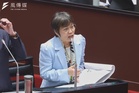
A former Taiwan vice premier has branded Taipei Mayor Chiang Wan-an's plan to close the capital's downtown Songshan Airport and build an artificial intelligence park on the site a "bogus issue," arguing that Taiwan's entire AI software sector could fit into a few office towers.
Shih Jun-ji, an economist who served as vice premier from 2017 to 2019 under then-Premier William Lai, now Taiwan's president, made the case in a Facebook post that Storm Media is publishing with his permission. He did not spare Lai's own Cabinet, the Executive Yuan, faulting it for fighting the airport closure while staying vague on whether Taipei needs an AI park at all.
Neither side understands AI, Shih wrote. "Chiang talks about AI to chase traffic and win applause, and the Executive Yuan echoes AI to ride the trend and curry favor," he said. "Neither of them is talking about the future of AI."
Airport Pledge Becomes A Flashpoint In Taipei's Mayoral Race
Chiang, of the opposition Kuomintang (KMT), unveiled the proposal on October 8 as he seeks a second term in the November 28 vote, part of the 2026 Taiwan local elections. His blueprint would redevelop a 300-hectare site, reserving 100 hectares for an AI industry cluster that he says could host about 200 domestic companies, generate NT$12 trillion in output, and create 65,000 jobs, alongside a 110-hectare central park and a residential district.
The central government, run by the Democratic Progressive Party (DPP), was caught off guard. Cabinet spokeswoman Michelle Lee said the Executive Yuan learned of the plan only on the day it was announced. Defense Minister Wellington Koo told lawmakers on October 14 that "Songshan airport is an important facility for Taiwan's defense resilience in peacetime or at war." Digital Affairs Minister Lin Yi-ching said the same day that the site could suit AI company headquarters and software firms, but not chip factories or data centers.
Voters have yet to warm to the idea. A TVBS poll of 1,131 Taipei residents, conducted October 12 to 15, found 41% opposed relocating the airport and 31% supported it, with 28% undecided. The margin of error was 2.9 percentage points.
With less than a month to go in the 2026 Taiwan local elections, the Taipei mayoral contest itself has tightened. A United Daily News poll conducted October 20 to 22 and on October 25 put Chiang's DPP challenger, legislator Puma Shen, at 45% against Chiang's 41%, within the survey's margin of error of 3 percentage points.
Business leaders have also weighed in. Pegatron Chairman T.H. Tung, whose company Shih lists among Taiwan's AI server assemblers, said on October 14 that he does not support moving the airport and that a major capital should keep a small or midsize air hub, according to the Central News Agency.
Taiwan Leads Only The Bottom Layer Of The AI Economy
Shih built his argument on a five-layer map of the AI supply chain set out by the Bank for International Settlements in a 2025 paper: specialized hardware, cloud infrastructure, training data, foundation models, and AI applications. Before planning a park, he wrote, a government has to know which of those layers it is building for and how many companies would move in.
He compared the structure to a smartphone. Chips and memory are the hardware. Foundation models such as Anthropic's Claude or Google's Gemini play the role of iOS or Android, and AI applications are the apps. The cloud and training data layers have no smartphone equivalent, which is what makes AI a different kind of industry.
Taiwan dominates the bottom layer. Apart from chip designers such as Arm and Nvidia, equipment maker ASML, and materials suppliers such as Shin-Etsu Chemical and Merck, most of the key players in foundry, packaging, and server assembly are Taiwanese. America's appetite for computing power has extended Taiwan's export growth streak to 35 straight months, Shih noted. Official figures show September exports hit a record US$87.22 billion, up 60.9% from a year earlier.
"Taiwan's role in the AI industry is to 'make the shovels,'" Shih wrote. The most serious misconception at home, he said, is that the AI industry simply is advanced chipmaking. Without the four layers above hardware, "it is not a complete AI industry."
Shih Finds Taiwan Thin In Cloud, Data, And Models
In the United States, cloud infrastructure is where the money goes. Shih put US spending on the layer at more than US$750 billion this year on a conservative estimate, rising to US$1.2 trillion next year. In Taiwan, homegrown AI cloud providers and local resellers of US cloud services, including Taiwan AI Cloud, Chief Telecom, SYSTEX, and eCloudvalley, have a combined market value of only about NT$78 billion, he wrote, while the island's three big telecom carriers have never invested heavily in data centers.
Training data suppliers are mostly unlisted startups or subsidiaries of larger groups, with no independent listed player. At the model layer, Taiwanese developers are deliberately avoiding trillion-parameter giants and building smaller "sovereign AI" models in traditional Chinese. Examples include Taiwan AI Cloud's Formosa Foundation Model, MediaTek's BreeXe model, and Project TAME, a 70-billion-parameter model trained by National Taiwan University's computer science department with partners including Pegatron, Chang Chun Group, Unimicron, and Chang Gung Memorial Hospital on Nvidia's Taipei-1 supercomputer. Shih said such efforts remain academic and experimental rather than commercial.
The application layer is livelier, with firms such as Tokyo-listed Appier, medical AI developers EverFortune.AI and aetherAI, and cybersecurity company CyCraft. But business models are still taking shape, Shih said, and Taiwan's home market is small.
Data Centers Would Need Tenants Taiwan Does Not Have
Chipmaking does not need Taipei land either, Shih argued. Under pressure from US President Donald Trump, TSMC plans 12 advanced fabs, packaging plants, and a research center in Arizona and has reportedly considered a second site in Texas. Under the Taiwan-US trade agreement, Taipei has also pledged US$250 billion in credit guarantees for Taiwanese companies investing in America, which Shih expects will pull many suppliers and server makers abroad. "Where is the need for a science park in downtown Taipei?" he asked.
Data centers need abundant power and land, both scarce in Taiwan, and they draw local protests. Taiwan also has no domestic cloud provider to fill them, Shih said, raising the prospect that space would end up leased to foreign tech giants, as Malaysia has done with Chinese firms such as Alibaba, Tencent, ByteDance, and Moonshot AI.
"How could Taiwan, the world's dominant force in advanced chips, sink to closing Songshan airport to free up land for Chinese or American companies to rent?" Shih wrote. "Foolish!"
A national traditional Chinese data bank, which he called the real gap in the data layer, would not need a park either. Collecting and cleaning text "is not recycling," he wrote, and does not require a yard to process mountains of material.
Another Nangang Software Park Would Be Enough
Only the application layer might want a cluster, Shih concluded, and what it needs is office space, not factory floors. Software engineers, data scientists, and marketers need a desk, a computer, and fast internet, which makes high-rise offices a far better fit than the sprawling, single-story halls that house data center racks.
He pointed to Nangang Software Park in eastern Taipei. Its three phases cover about 10 hectares, but high-density towers give it roughly 793,000 square meters of floor space, housing more than 300 companies, including AMD's Taiwan branch and Yahoo Taiwan, and between 24,000 and 28,000 employees.
By Shih's count, listed and high-potential Taiwanese firms in the upper AI layers, together with foreign research teams, employ 15,000 to 20,000 people in Taiwan. That workforce would need just 5 to 8 hectares, he wrote, and three or four modern 20-story office buildings could house every leading AI software, medical AI, cybersecurity, and data labeling company in the country, with room to grow for 20 years.
"To develop AI, at most we need to build another Nangang Software Park," he wrote. Songshan Airport covers 213 hectares, by his figures, and even carving out 100 hectares for an AI park would be "way too much" for Taiwan.
"Whether you call for closing Songshan in the name of AI, or wave the AI banner to justify closing Songshan," Shih wrote, "both are bogus issues that have nothing to do with Taiwan's AI development."
This article is based on a Facebook post by Shih Jun-ji, an adjunct research fellow at Academia Sinica, Taiwan's top research institution, and a former vice premier. It is published with the author's authorization. Read the original post (in Chinese).
You've read it. Now join the conversation — follow us on X, Facebook and IG. Editor: Penny Wang