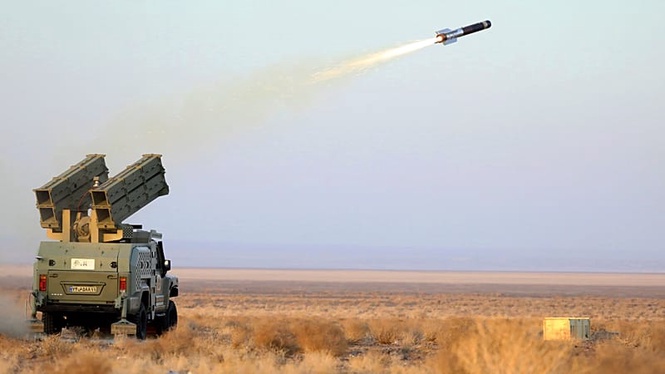
Iran launched a missile attack on Jordan, Bahrain and Kuwait on Wednesday morning in the latest salvo in tit-for-tat strikes with the United States after the downing of a US helicopter over the Strait of Hormuz.
The IRGC said in a statement that Iranian forces fired "long-range missiles," claiming they "targeted and destroyed four major targets" in Jordan, including F35 fighter nests at an air base and the US command centre in Al-Azraq, state-run IRNA news agency said.
Jordan stated on Wednesday that it shot down incoming missiles which it said were aimed at its important historical town of Azraq, some 100 kilometres from the capital Amman.
A major Jordanian airbase, Muwaffaq Salti, is located in its vicinity, hosting the Jordanian Air Force's 1st, 2nd, and 6th Fighter Squadrons.
"We intercepted and shot down five missiles launched from Iran towards Azraq. The interception resulted in debris falling, but there were no casualties or material damage," the Jordanian Armed Forces said in a statement.
The US and other NATO allies have used the air base in the past, including to launch strikes on the so-called Islamic State group during the war in Syria.
Jordan’s state-run Petra news agency carried the statement from its military, which added that there were no injuries in the attack and that explosives experts had examined the debris from the interceptions.
The Kuwaiti military said its air defences were engaging "hostile aerial targets", without immediately mentioning the aggressor, although Iran has recently carried out deadly attacks on the country.
The General Command of the Bahrain Defence Force said it had successfully intercepted an undeclared number of missiles, adding that Tehran continued what it said was a "systematic hostile approach" through "unlawful attacks using missiles and drones targeting civilians in the Kingdom".
US strikes sparked by Apache crash
The incidents came after the US Central Command (CENTCOM) said it had "completed self-defence strikes against Iran."
"CENTCOM forces struck Iranian air defence, ground control stations, and surveillance radar sites near the Strait of Hormuz with precision munitions from US Air Force and Navy fighter jets," the post said.
“The operation was a proportional response to recent attacks on US forces and international commercial ships transiting regional waters,” CENTCOM said.
Iranian state-run media earlier reported at least two series of explosions along Iran's southern coast near the Strait of Hormuz. Tehran threatened it would respond.
Iranian forces “will leave no attack or threat unanswered,” Iranian Foreign Minister Abbas Araghchi said on X. “Leave our region if you want to be safe.”
The US Army AH-64 Apache attack helicopter went down near the Strait of Hormuz after colliding with an Iranian drone, according to a US official who spoke on condition of anonymity to discuss an ongoing investigation.
It was not clear whether the collision was intentional, and official statements only said the crash remained under investigation.
US President Donald Trump said earlier in a social media post that Iran had shot down the aircraft while it was on patrol over the strait and declared that the US “must, of necessity, respond to this attack.”
The downing of the Apache attack helicopter and the strikes by the US military further strained a two-month ceasefire, a day after Iran and Israel exchanged fire for the first time since the fragile truce took effect.
Before he accused Iran of downing the US helicopter, Trump had expressed renewed optimism over negotiations with Tehran, without discussing the specifics.