There is a hidden cost to every decision we postpone.
When we think about achieving a goal, we often focus on what it will take to move forward: the money we need to invest, the skills we need to develop, the risks we need to take, or the difficult decisions we need to make.
But there is another question that is just as important:
What will it cost us if we do nothing?
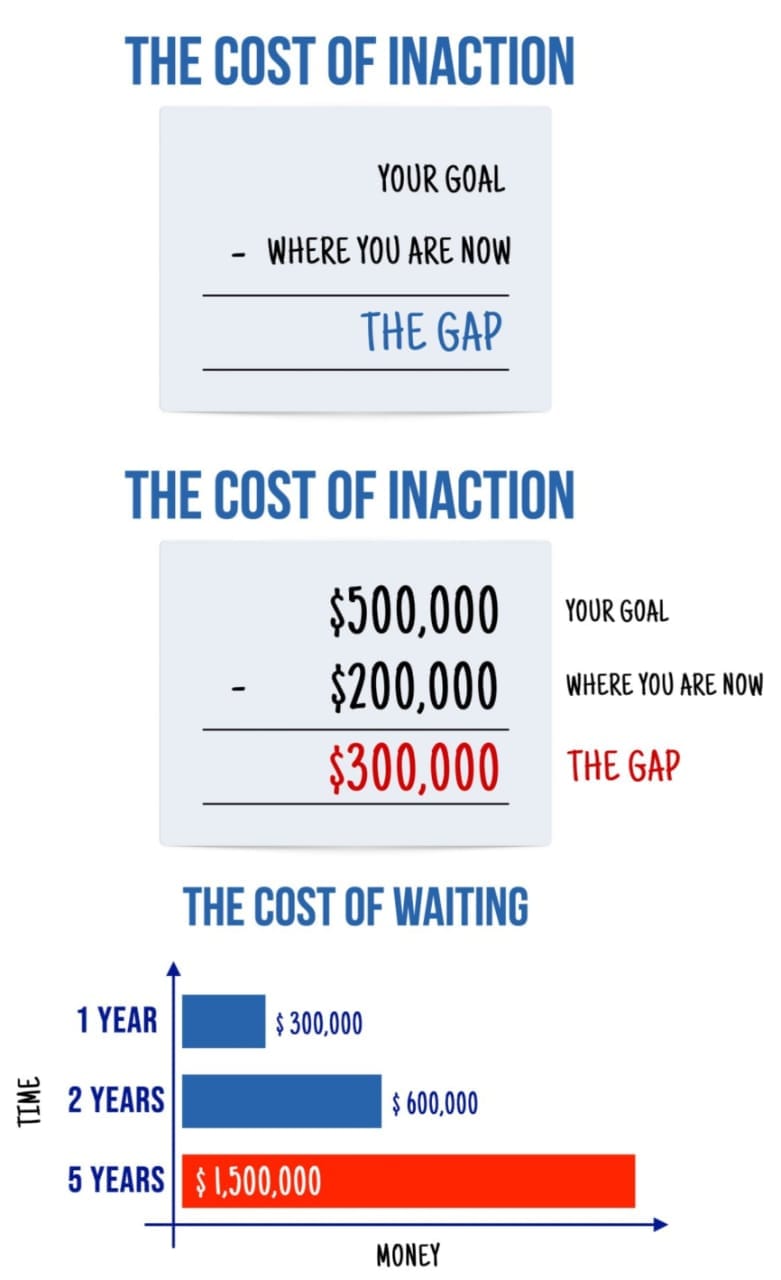
The image above captures this idea with a simple calculation.
Imagine your goal is $500,000, but you currently have $200,000. The difference is a $300,000 gap.
At first, that gap may seem manageable. You might tell yourself that you have plenty of time. You can start next year. You can invest later. You can work harder when things settle down.
But time doesn't stand still.
And while you are waiting, the cost of reaching your goal can continue to grow.
The Gap Between Where You Are and Where You Want to Be
Every meaningful goal has a gap.
Perhaps your goal is financial freedom, and you currently have $200,000 but want $500,000.
Perhaps your goal is to build a successful business, but today you have only a handful of customers.
Maybe you want to become healthier, but your current lifestyle is far from where you want it to be.
Or perhaps you want to develop a new career, but you haven't yet acquired the skills required to make the transition.
In every case, there is a distance between where you are now and where you want to be.
That distance is the gap.
The mistake many people make is assuming that the gap will remain constant.
It won't.
The world changes. Opportunities change. Costs change. Your circumstances change. And most importantly, time passes whether you take action or not.
The Cost of Waiting
Consider the example from the image.
Your goal is $500,000.
You currently have $200,000.
That leaves a gap of:
$500,000 − $200,000 = $300,000
Now imagine that the $300,000 represents the amount of additional wealth you need to create.
If you delay taking meaningful action, the consequences can compound.
The illustration presents the potential cost of waiting like this:
1 year: $300,000
2 years: $600,000
5 years: $1,500,000
These numbers should not be interpreted as a universal financial formula. They are a visual way of demonstrating a powerful principle:
Waiting rarely means standing still.
It often means falling further behind.
Why Time Is So Valuable
Time is one of the few resources you can never recover.
If you lose money, you may be able to earn it again.
If you make a mistake, you may be able to correct it.
If you miss an opportunity, another opportunity may eventually appear.
But yesterday is gone forever.
This is particularly important when your goals involve investing, business, career development, or personal growth.
Starting early gives your efforts more time to produce results.
A small investment made consistently over many years can become significant. A skill developed today can create opportunities years from now. A business decision made early can influence the trajectory of an entire company.
The opposite is also true.
A year spent procrastinating is a year in which you could have been learning.
A year without investing is a year in which your capital could have been compounding.
A year spent tolerating a problem is a year in which that problem could have been solved.
Inaction Has a Price
We tend to think of action as having a cost.
Starting a business costs money.
Changing careers costs time and effort.
Learning a new skill requires discipline.
Investing involves risk.
Improving your health requires consistency.
Because the cost of action is visible, we often focus on it.
The cost of inaction is less obvious.
There is no invoice for procrastination.
Nobody sends you a bill for the opportunity you didn't pursue.
You don't receive a notification telling you how much money you lost by delaying an investment decision.
But that doesn't mean the cost isn't real.
Sometimes the greatest cost is the opportunity cost—the value of what could have happened if you had acted.
The Danger of "I'll Start Later"
One of the most expensive phrases in life is:
Later feels safe.
It allows us to avoid uncertainty and discomfort today.
We tell ourselves:
"I'll start saving next month."
"I'll launch the business next year."
"I'll learn the skill when I have more time."
"I'll get serious about my finances when I earn more."
"I'll make the change when things are less complicated."
The problem is that "later" has a habit of becoming "never."
And even when we eventually act, we may discover that the circumstances have changed.
The goal that seemed achievable five years ago may now require substantially more effort.
The investment we could have made earlier may now require more capital.
The skills we could have developed gradually may now need to be learned under pressure.
The longer we postpone, the fewer options we may have.
Small Actions Can Close Large Gaps
The solution isn't necessarily to make one enormous move.
In fact, large goals are often achieved through relatively small actions repeated consistently.
If your financial goal is $500,000, you don't necessarily need to find $300,000 tomorrow.
You need a strategy for closing the gap over time.
That might involve:
- Increasing your income
- Reducing unnecessary expenses
- Investing consistently
- Building additional income streams
- Developing valuable skills
- Starting or expanding a business
- Avoiding unnecessary debt
- Improving your financial decision-making
The specific strategy will depend on your circumstances.
The important thing is to begin closing the gap.
A gap of $300,000 can feel overwhelming when viewed as one giant number.
But when you turn it into a series of actions, it becomes a problem you can work on.
Progress Changes the Equation
Imagine you take action today.
You don't immediately reach $500,000.
Maybe you move from $200,000 to $220,000.
Then $250,000.
Then $300,000.
You are still below your goal, but something important has changed.
You are no longer simply looking at the gap.
You are reducing it.
Progress creates momentum.
Momentum creates confidence.
Confidence makes it easier to continue.
This is why action is often more valuable than waiting for the perfect plan.
You can improve a plan once you are moving.
It is much harder to improve a plan when you are standing still.
The Compounding Effect Works Both Ways
We often hear about the power of compound growth.
Money can compound.
Knowledge can compound.
Relationships can compound.
Experience can compound.
Reputation can compound.
But there is another side to compounding.
Problems can compound too.
Debt can grow.
Bad financial habits can become deeply established.
Skills can become outdated.
Health problems can become more difficult to address.
Business weaknesses can become structural problems.
Missed opportunities can accumulate.
This is why taking action early matters.
You aren't simply giving your positive actions more time to compound.
You are also preventing negative situations from having more time to compound.
Ask Yourself a Different Question
Instead of asking only:
Ask:
This simple change in perspective can completely alter how you evaluate decisions.
If you invest in yourself, what could happen?
But if you don't invest in yourself for another five years, where will you be?
If you start building your business today, what could it become?
But if you wait five years, what might you have missed?
If you begin saving and investing today, how much time will your money have to work?
And if you wait, how much harder might it be to reach the same destination?
These questions force you to recognize something we often overlook:
Doing nothing is still a decision.
You Don't Need to Have Everything Figured Out
One of the biggest reasons people delay is the belief that they need certainty before taking action.
They don't.
You rarely get complete certainty.
You get information.
You make a decision.
You take a step.
You learn.
Then you adjust.
The goal isn't to predict the future perfectly.
The goal is to make decisions today that increase the probability of creating a better future.
That may mean starting with a small step.
Read the book.
Take the course.
Make the first investment.
Have the difficult conversation.
Create the business plan.
Apply for the opportunity.
Talk to the expert.
Start exercising.
Review your finances.
Whatever the goal is, identify the smallest meaningful action you can take today.
Then take it.
The Real Cost of Inaction
The most important lesson from the image isn't simply about money.
It's about time.
The gap between where you are and where you want to be may be measured in dollars, skills, customers, opportunities, or personal growth.
But underneath all of those measurements is time.
Every day gives you an opportunity to either move closer to your goal or remain where you are.
And remaining where you are may not actually mean staying in the same place.
If your target continues moving while you stand still, the distance between you and the target can become larger.
That is the true cost of inaction.
Don't Wait for the Perfect Time
There may never be a perfect time.
There will always be reasons to wait.
You may not have enough money.
You may not have enough experience.
You may be too busy.
The economy may be uncertain.
You may be afraid of making the wrong decision.
Those concerns are understandable.
But waiting has consequences too.
The answer isn't to take reckless action.
The answer is to take thoughtful action.
Understand the risks.
Make a plan.
Start at a level appropriate for your situation.
Measure your progress.
Adjust when necessary.
But don't confuse caution with paralysis.
Close the Gap
Your current situation is simply your starting point.
It doesn't have to be your destination.
If there is a gap between where you are and where you want to be, identify it.
Put a number on it if possible.
Then ask yourself three questions:
Where am I now?
Where do I want to go?
What is one action I can take today to reduce the gap?
You may not be able to close the entire gap immediately.
You don't have to.
You simply need to start moving in the right direction.
Because the cost of action is usually visible.
The cost of inaction often isn't.
And sometimes, the decision that feels safest today can become the most expensive decision of all.
Don't just calculate the cost of reaching your goal. Calculate the cost of waiting to pursue it.
William Lee (kokwei67@gmail.com) is a content creator under the Newswav Creator programme, where you get to express yourself, be a citizen journalist, and at the same time monetize your content & reach millions of users on Newswav. Log in to creator.newswav.com and become a Newswav Creator now!
The User Content (as defined on Newswav Terms of Use) above including the views expressed and media (pictures, videos, citations etc) were submitted & posted by the author. Newswav is solely an aggregation platform that hosts the User Content. If you have any questions about the content, copyright or other issues of the work, please contact creator@newswav.com.