.jpg)
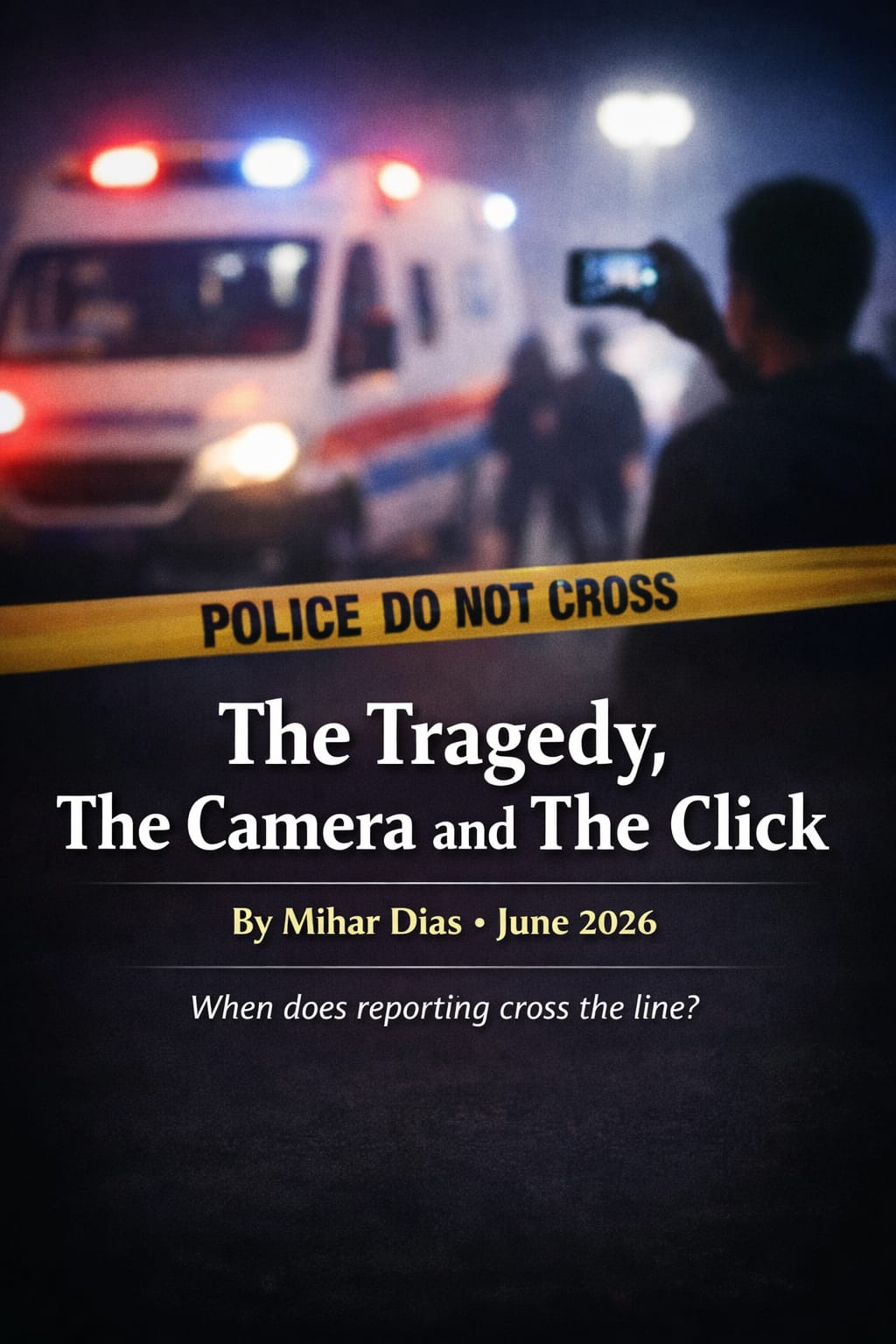
The Tragedy, The Camera and The Click
By Mihar Dias June 2026
Before the arrival of social media. tragedy in Malaysia travelled slowly.
A death in a village would arrive in town as a whisper. By evening it became a conversation. By the next day it was news.
Today tragedy travels at the speed of a thumb.
Before the ambulance arrives, the video is already online. Before the family is informed, strangers have watched the final moments hundreds of thousands of times. Before investigators complete their work, amateur detectives have delivered their verdicts.
The Communications Minister, Datuk Fahmi Fadzil, is therefore not wrong when he calls for the swifter removal of videos depicting suicides and graphic violence. https://www.freemalaysiatoday.com/category/nation/2026/06/08/fahmi-calls-for-swifter-removal-of-suicide-violent-videos
Recent viral footage involving a woman at KLIA2 reignited a difficult but necessary conversation: when does reporting become exploitation? When does informing the public become feeding an algorithm?
The problem, however, is larger than journalism.
Traditional journalism at least pretends to have editors.
Social media has billions of publishers and almost no editors.
The minister's remarks about responsible reporting, trigger warnings, helpline information and avoiding sensational headlines are all sensible enough.
Any decent newsroom should already know this. Suicide is not like reporting a football match. The details matter. Research has long suggested that sensational coverage can contribute to imitation among vulnerable individuals. Reporting must therefore balance the public's right to know with society's duty not to cause additional harm.
But here comes the uncomfortable question.
Who exactly is "the media" today?
The journalist with a press card?
Or the man with a smartphone who livestreams a tragedy while providing running commentary?
Or the influencer who reposts it because "the public deserves to know"?
Or the thousands who forward it into family WhatsApp groups accompanied by shocked-face emojis?
In the old days, editors worried about ethics.
Today algorithms worry about engagement.
The difference is important.
Editors ask whether a picture should be published.
Algorithms ask whether a picture will be shared.
One seeks judgment.
The other seeks traffic.
And traffic, unfortunately, has become the currency of modern attention.
That is why the minister's challenge to social media platforms deserves serious consideration. Platforms have become the world's largest publishers while continuing to insist they are merely neutral technology companies. If a video showing a dancing cat can be identified within seconds, surely footage depicting suicide, death or graphic violence should not require days of deliberation. The technology clearly exists. The question is whether the incentive exists.
Yet another uncomfortable question lurks beneath the surface.
Whenever governments speak about removing content, citizens inevitably become nervous.
Not because they enjoy watching gruesome videos.
But because Malaysians have developed a healthy scepticism towards the phrase “online harm.”
Today it means suicide footage.
Tomorrow it may mean misinformation.
The day after, somebody may decide criticism is harmful too.
This scepticism is not entirely irrational. Around the world, governments routinely begin with noble intentions before discovering that censorship can be remarkably convenient. Public trust therefore becomes the most important ingredient in any content moderation effort. Without trust, every takedown looks like suppression. With trust, it looks like protection.
The challenge, therefore, is not merely removing harmful content quickly.
It is removing harmful content transparently.
The public needs to know who decides, according to what criteria, and with what safeguards against abuse.
Otherwise every tragedy becomes another battlefield in the endless war between safety and freedom.
The saddest part of this entire debate is that it reveals something unsettling about modern society.
The problem is not that cameras exist.
The problem is that somebody falling from a ledge has become content.
A family losing a loved one becomes a clip.
A moment of unbearable human suffering becomes something to scroll past between a cooking video and a cat meme.
Technology did not create voyeurism. Humanity managed that long before smartphones.
Technology merely industrialised it.
Perhaps the minister's most important observation was not about regulation at all, but about respect. Imagine discovering the death of a family member, because a stranger uploaded it for likes. Imagine watching the worst moment of your life replayed endlessly by people you have never met.
There is a difference between bearing witness and consuming spectacle.
A civilised society should know the difference.
Unfortunately, civilisation now competes with virality.
And virality usually wins.
The law can help. Platforms can help. Journalists can help.
But ultimately the first editor of every video is the person holding the phone.
The second editor is the person who clicks “share.”
The third editor is the rest of us.
And perhaps that is where the hardest conversation should begin.
Mihar Dias (mihardias@gmail.com) is a content creator under the Newswav Creator programme, where you get to express yourself, be a citizen journalist, and at the same time monetize your content & reach millions of users on Newswav. Log in to creator.newswav.com and become a Newswav Creator now!
The User Content (as defined on Newswav Terms of Use) above including the views expressed and media (pictures, videos, citations etc) were submitted & posted by the author. Newswav is solely an aggregation platform that hosts the User Content. If you have any questions about the content, copyright or other issues of the work, please contact creator@newswav.com.