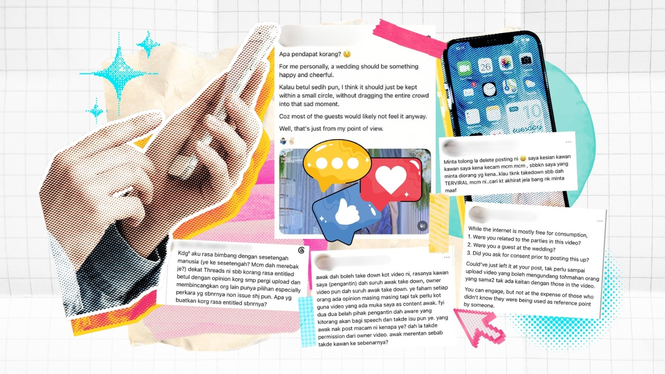
SHAH ALAM - Social media users are increasingly turning other people’s real-life moments into content designed to attract views, followers and likes.
Photos and videos are reposted with captions inviting users to react, speculate or discuss what happened, turning personal experiences into public entertainment.
For some accounts, high engagement can also have commercial value by growing followers, attracting collaborations or directing users to affiliate links.
The trend has raised concerns over where the line should be drawn when a person’s worst or most vulnerable moment becomes someone else’s content, particularly when they never agreed to have it repackaged or have asked for it to be removed.
Universiti Teknologi Mara (UiTM) Shah Alam social media analyst Associate Professor Dr Sara Chinnasamy described the behaviour as context collapse and digital exploitation.
"Another person’s emotionally vulnerable or private moment is taken out of its original context, repackaged as content and circulated primarily for attention, engagement or financial gain," she told Sinar Daily.
She said the focus on engagement had changed how users viewed content online.
"Social media has created an attention economy in which visibility itself has economic value. Views, shares, followers, engagement and affiliate revenue can create incentives for users to turn almost any emotionally powerful moment into content," she said.
This has shifted the question from whether something is appropriate to share to whether it is likely to perform well.
"We are therefore seeing a shift from ‘is this appropriate to share?’ to ‘will this perform well?’ That is a significant ethical change in digital culture," she said.
Content showing people crying, arguing, grieving or going through difficult situations can attract strong reactions, while algorithms may reinforce the behaviour by rewarding high interaction.
"When users repeatedly see emotionally charged content receiving thousands or millions of interactions, they learn that human vulnerability can perform well as content.
"Some may then deliberately search for, repost or frame such moments because they know they are likely to generate engagement," she said.
As a result, another person’s vulnerability can become a form of digital currency, while the person at the centre has little control over how their image or story is used.
Sara said one problem was the assumption that anything available online was automatically free for others to use.
"’It is already online’ is increasingly being interpreted as ‘it is free for anyone to use’. But accessibility does not equal consent," she said, adding that a person may have agreed to share a photograph or video with a particular audience or for a particular purpose, but not to have it downloaded, edited, given a new caption and redistributed to a much larger audience.
Recently, a wedding video went viral after a repost showing only girls crying, captioned “Let’s discuss this,” sparked speculation.
The couple, people featured in the video, their friends and families, as well as the videographer, asked personally and publicly for it to be removed.
The user refused, later arguing that the video was already in the public sphere and therefore for public consumption.
Sara said there was an important distinction between public interest and public curiosity.
"The fact that something is visible online does not automatically mean that everyone has an ethical licence to reproduce, monetise or sensationalise it.
"The ethical boundary becomes particularly clear when the people involved have asked for the material to be removed," she added.
At that point, she said, the issue was no longer simply about sharing content, but it becomes a question of respecting individual dignity, autonomy and digital boundaries.
Sara said not every unauthorised repost should automatically be classified as cyberbullying or harassment.
"If the content is repeatedly circulated after the person has objected, is intended to humiliate, shame or distress them, or encourages others to ridicule or target the individual, it can move beyond ordinary sharing into harassment or cyberbullying," she said.
This distinction matters because an act can be insensitive or exploitative without necessarily meeting the legal threshold for an offence.
Meanwhile, lawyer Nizam Bashir said users should not assume publicly available content can be freely copied and reused.
"A photo or video being available online does not mean anyone owns it or can use it however they wish," he said.
He said reposting could become unlawful if it damages someone’s reputation, amounts to harassment, exposes identifying information in harmful circumstances or infringes copyright.
Editing a video or changing its caption to create a misleading impression could also have legal consequences.
However, Nizam said a lack of consent alone did not automatically make every repost unlawful.
"The content, context, purpose and applicable legal exceptions matter," he said.
Depending on the circumstances, legal protections relating to bullying and harassment, online communications, defamation and copyright may apply.
Nizam said the issue becomes more serious when reposted content exposes identifying information in circumstances that could put someone at risk.
Under Section 507E of the Penal Code, sharing identifying information can be an offence where a person intends to cause harassment, distress, fear or alarm, or knows — or ought to know — that this is likely.
Identifying information can include a photograph and is not limited to a home address or telephone number.