Caveat : I am not a medical expert in any form nor am I a nutritionist. I write this article to share my logical conclusion of my understanding of sugar and simple carbohydrates from listening and reading various sources, and my knowledge of human biology.
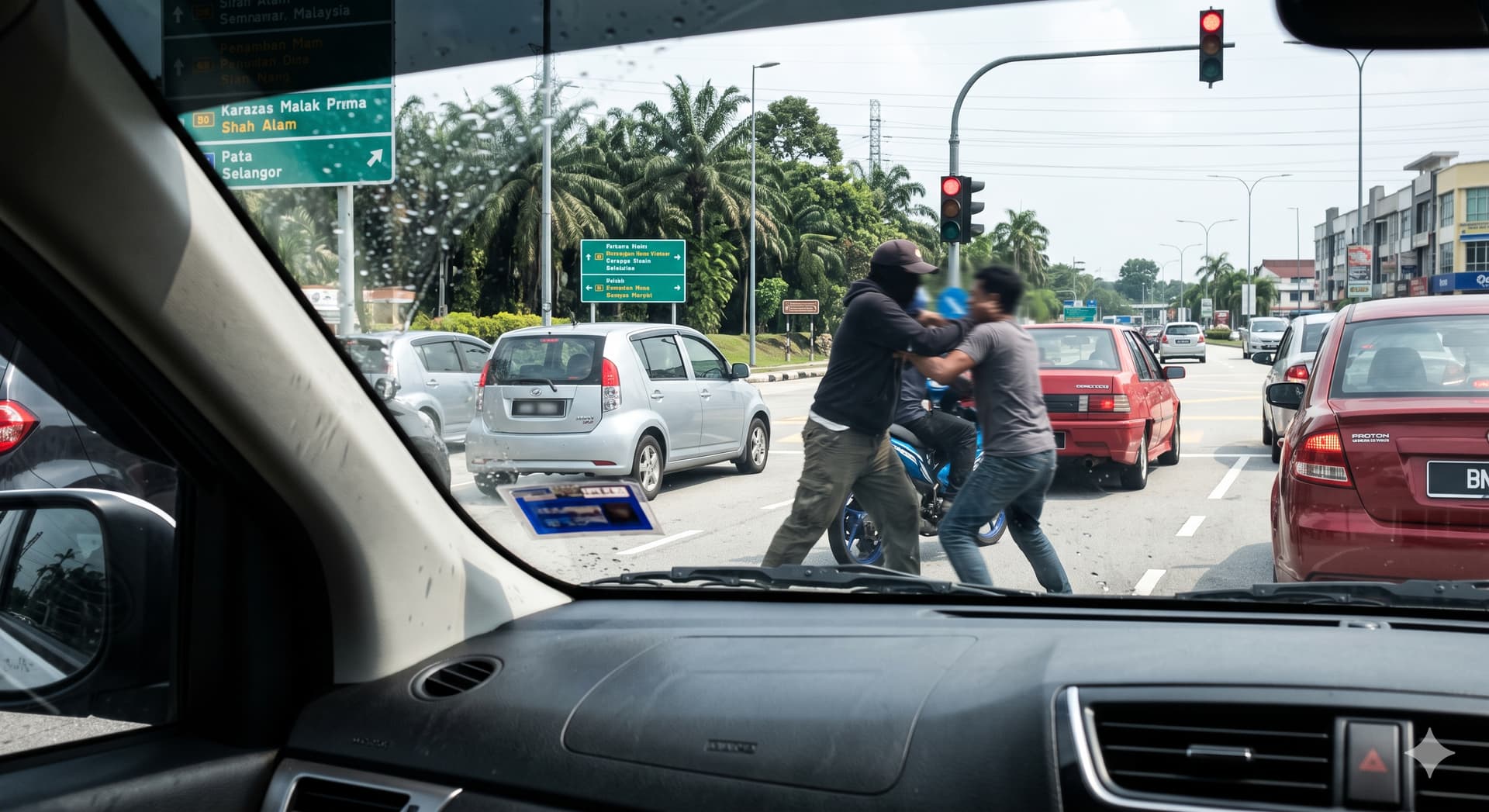
Our news feeds have no shortage of viral news about road rage brawls, street brawls, shop brawls, and even domestic violence.
In fact, we each would have personally encountered situations where something small (which we realised on hindsight) gets escalated into getting our “blood to go up-stairs.”
With everyone around us seems to be easily triggered, we now mostly feel that it is best not to say or do anything lest some hyper emotional situation gets triggered in response.
Why have we become such an angry lot?
Externally, it is the high stress environment we now live in and our hyper connected world.
Internally, it is our continuous sleep deprivation and, the refined sugar and simple carbohydrates (carbs) that we consume multiple times in a day.
This article is about our consumption of refined sugar and simple carbs since it is the lowest hanging fruit amongst all factors to address and, is within our control.
Most of us do these - first thing in the morning, we consume teh tarik or kopi susu kurang manis. Then or concurrently, we either have some nasi lemak or roti banjir (the two most popular) for breakfast. Lunch is rice with dishes or some noodles. And, not to forget, the mid-morning or the tea-time kuih-muih and, other sweet or savoury snacks.
Let us take a step back and consider what happens inside our body after consuming these.
Refined sugar and simple carbs digest so quickly that the glucose gets to our blood stream quickly too. This causes a spike in our blood glucose levels. High glucose levels in the blood stream can be highly toxic to our blood vessels and nerves.
Our body is a complex ecosystem that works to keep things in balance. When there is an imbalance or something is out of the norm, or sense of “danger” to one part of the ecosystem, multiple functions will start to work to correct these.
So, to correct this spike, our pancreas will produce and dump a large amount of insulin to clear the sugar and move them to our body cells – muscle cells, fat cells, and liver cells.
However, this is often an over-correction. Clearing the blood stream of glucose so quickly causes our blood sugar to drop as rapidly as it spiked and, not enough glucose in the blood stream to feed the brain.
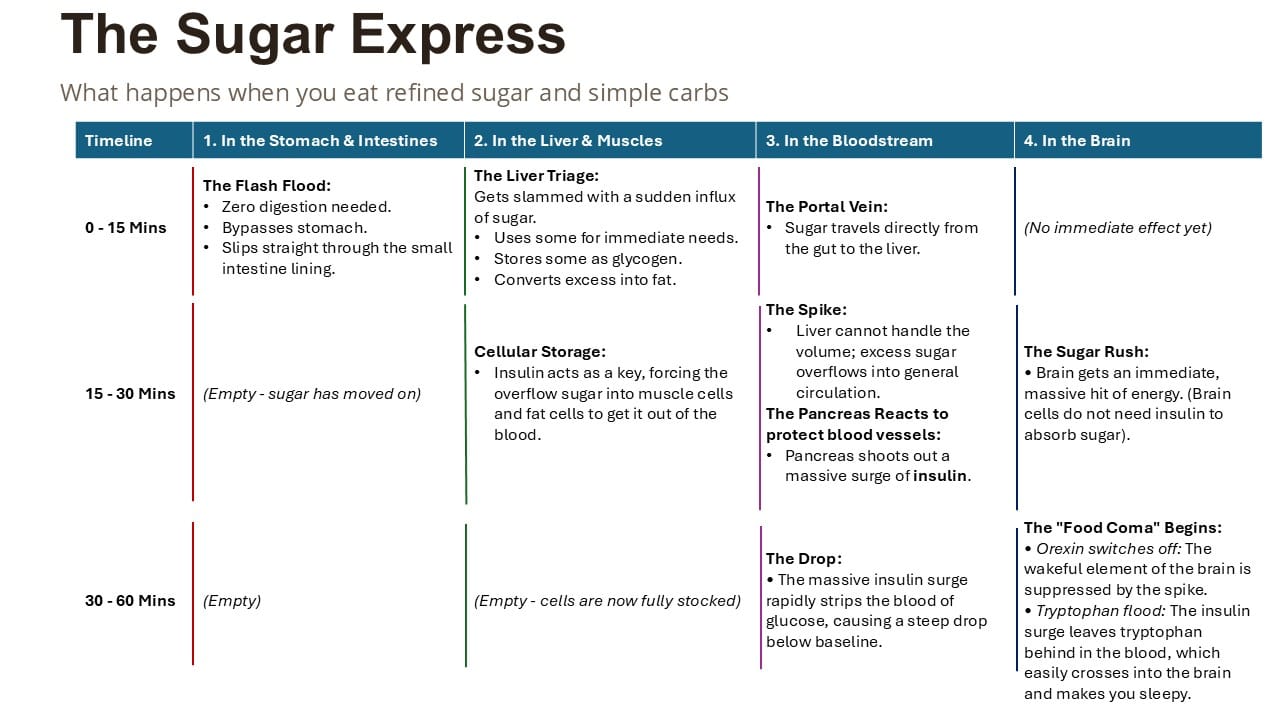
Our brain is an organ that pulls glucose from the blood stream for it to function. To the brain, when there is not enough glucose in the blood stream to feed the brain, 2 situations are happening:-
Situation 1 is that there is starvation. Situation 2 is that there is a life-threatening event.
To address Situation 1 (starvation):-
- The brain “tells” the stomach there is a shortage of glucose.
- Stomach produces hunger hormone – Ghrelin.
- Ghrelin goes back to the brain to stimulate appetite and makes us feel hungry.
- The brain need is glucose. So it releases a chemical (Neuropeptide Y) to stimulate cravings for simple carbs and sugar.
This is how we feel hungry and start craving for sweet stuff or roti canai.
To address Situation 2 (life-threatening):-
- Activate production of adrenaline and cortisol – aka stress hormones.
- Adrenaline tells the liver to break-up stored glycogen and dump glucose back into the blood stream. It also tells the rest of our body cells to stop taking any glucose and reserve them solely for the brain.
- Cortisol tells the liver to produce new glucose molecules using proteins and fats so that the brain has enough “fuel” to function.
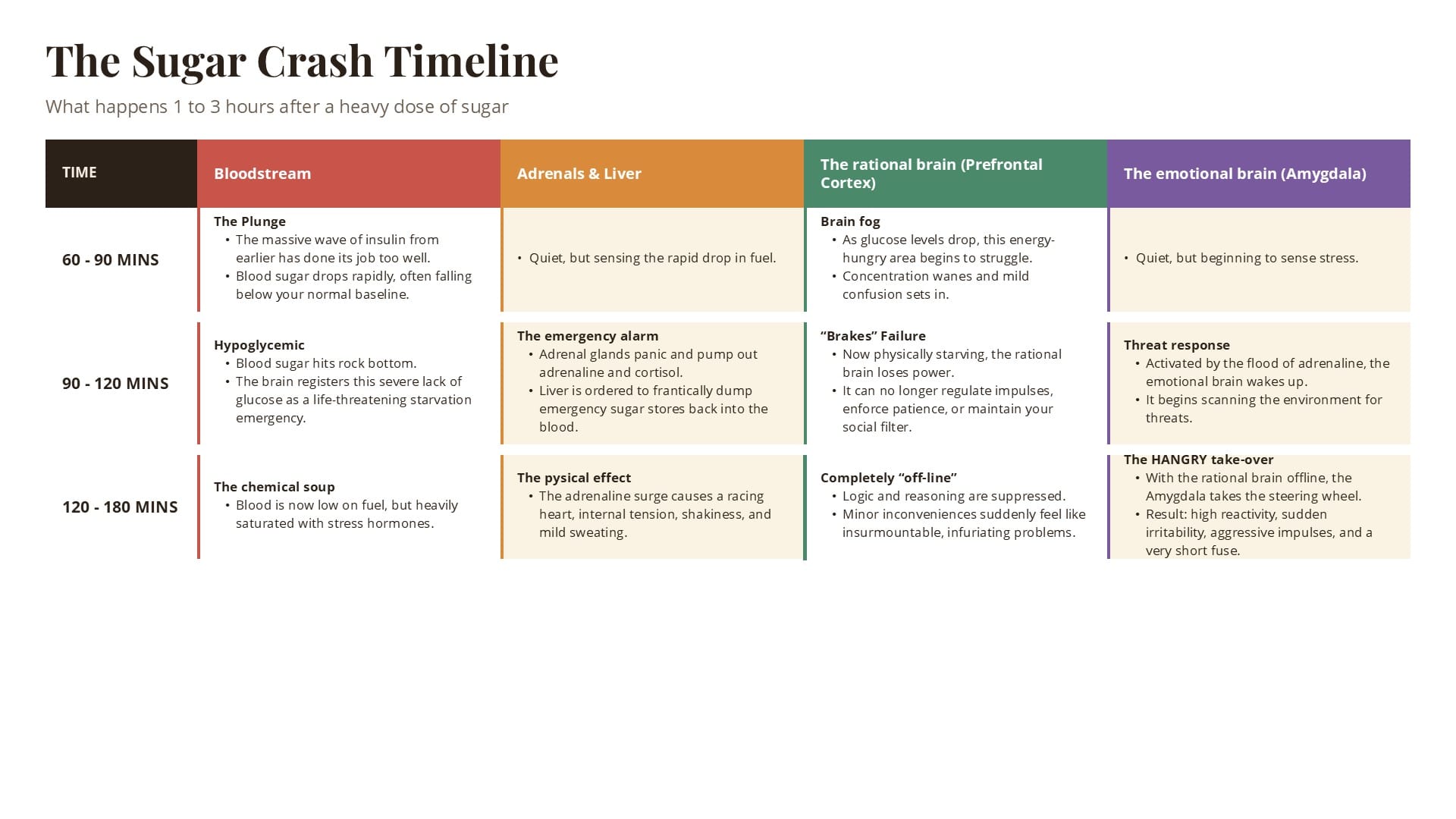
But here is the problem, to the nervous system, the adrenaline and cortisol mean a life-or-death situation. That is why when there is a sugar crash, we end-up with a racing heart, shaking hands, internal tension, and a highly reactive and irritable temper.
Ghrelin, adrenaline and cortisol combined causes a situation known as “HANGRY” – hungry and angry.
And when we are in this “Hangry” mode we can easily be triggered with the external high stress environment that we live in.
When triggered, we lose all our ability to rationalise because the rational part of our brain is “starved” of glucose letting the emotional part of our brain to take over.
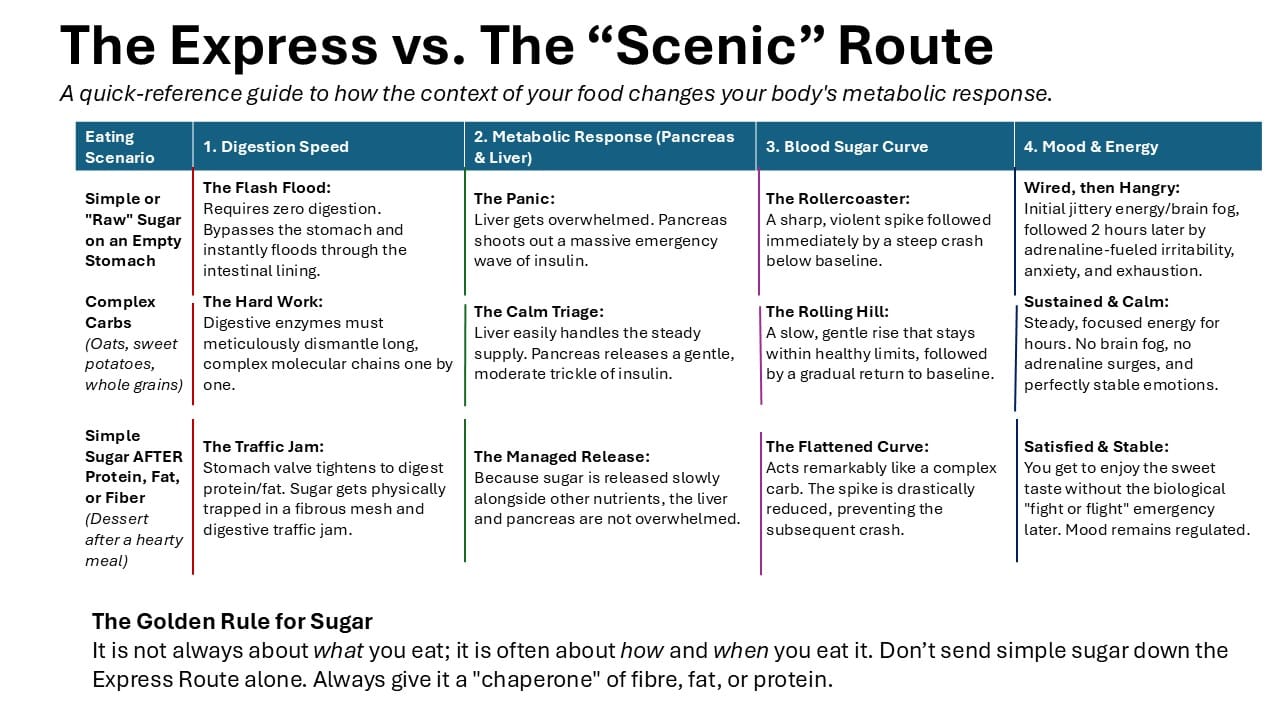
We can slow down the glucose spike in our blood stream – by consuming protein and/ or vegetables before sugar and simple carbs:-
- In the stomach, protein needs more time and effort to digest creating a digestive “traffic jam.”
- This effectively puts the sugar that we consume later in a queue. As a result, the sugar gets released into the small intestine slower.
- Vegetables fibre travels to the small intestine and coats the walls, forming a thick viscous gel.
- This gel which is like a sticky mesh net forces the sugar we later consume to seep slowly out of the small intestine. As a result, sugar trickles slowly into the blood stream.
The glucose curve stays completely flat, which means there is no massive insulin dump, no rapid drop in blood sugar, no adrenaline-to fuel anger, and no starving of the rational part of our brain.
We cannot control the high-stress environment, the hyper-connected world, or the traffic jams.
But if we change how and when we eat our sugar and simple carbs, we prevent that massive glucose spike and the subsequent crash. And when a reckless driver suddenly cuts us off, the external trigger is still there. But internally, we have the biological "brakes" to handle it. We might get annoyed, but our rational brain has the energy to process the situation, stopping us from getting our "blood to go up-stairs" and escalating it into a physical brawl.
By simply managing our sugar crashes, we raise our tolerance to stress, keep our rationality intact, and take a massive step back from being such an angry lot.
Perhaps, ultimately creating a more patient and tolerant society.
(sources researched to form this article are https://drandrewneville.com/adrenal-fatigue-low-blood-sugar/ and predominantly from https://www.youtube.com/@DrAlexWibberley)
Coco Nut (anitadharam@yahoo.com) is a content creator under the Newswav Creator programme, where you get to express yourself, be a citizen journalist, and at the same time monetize your content & reach millions of users on Newswav. Log in to creator.newswav.com and become a Newswav Creator now!
The User Content (as defined on Newswav Terms of Use) above including the views expressed and media (pictures, videos, citations etc) were submitted & posted by the author. Newswav is solely an aggregation platform that hosts the User Content. If you have any questions about the content, copyright or other issues of the work, please contact creator@newswav.com.