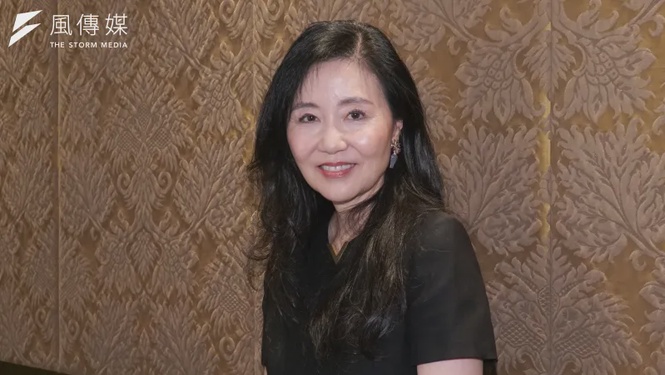
Jeannie Cho Lee spent years preparing to become Asia's first Master of Wine while working full time as a journalist and raising four young children, squeezing her studying into naps, bedtimes and the gaps in between.
In 2008, Jeannie Cho Lee became the first person from Asia to earn the title of Master of Wine (MW), one of the most exclusive professional credentials in the global wine industry. The qualification is awarded by the London-based Institute of Masters of Wine (IMW) to candidates who pass a blind-tasting exam, five theory papers and an independent research dissertation. Fewer than a few hundred people hold the title worldwide.
It is a professional qualification rather than a university degree. Once a candidate passes and agrees to the institute's code of conduct, they may add the letters "MW" after their name. In an exclusive interview with Storm Media's English-language site and 1%Style, Lee walked through what the exam actually demands, and why the credential remains so rare more than seventy years after it was first offered.
Blind Tasting 36 Wines Tests More Than Instinct
The MW program unfolds in three stages. Candidates who clear the first stage, a blind-tasting exam covering 12 wines plus two written essays, move on to a second stage that triples the tasting load: three separate blind-tasting papers of 12 wines each, 36 in total, alongside five theory exams.
Unlike a typical tasting event, where drinkers already know what is in the glass, MW candidates receive no label and no name. They must work backward from aroma, texture and structure alone to identify the likely grape variety, region, winemaking technique, quality level and even how the wine is positioned commercially, then defend that reasoning in writing, under time pressure, with no reference materials at hand.
The same grape can look entirely different depending on climate, soil, harvest timing or winemaking choices, so there is no shortcut to memorize. Candidates have to draw on years of accumulated tasting experience and lay out a reasoned, evidence-based analysis on the page, with nothing but what is in the glass to go on.
A Syllabus Spanning Vineyard To Global Market
The five theory papers in the second stage cover viticulture, winemaking and pre-bottling processes, wine handling and storage, the business of wine, and contemporary industry issues. A wine's character can trace back to a vineyard's climate and a winemaker's choices in the cellar; its price on a shelf can trace back to yield, cost, distribution and consumer demand. The exam asks candidates to connect knowledge that, in most careers, stays siloed in separate jobs.
Climate change and shifting consumption habits have only widened that syllabus. A sommelier who knows a wine list inside out still has to master viticulture and cellar technique, and a winemaker who has spent years at one estate still has to learn how wine moves through international markets far from home. Even after clearing the tasting and theory exams, candidates face a third stage: an independent research dissertation of roughly 6,000 to 10,000 words that poses an original question about the wine industry and argues it with evidence.
She Studied Only After Her Children Fell Asleep
Lee has said she never set out to become the first Asian Master of Wine. She recalled that several Japanese candidates she knew had entered the MW program five or six years before she did, and she assumed they would qualify first. Her own preparation was squeezed into whatever time was left once her four children were asleep and her newsroom shift was done.
It was only after she passed, she said, that the significance of the achievement became clear to her, through the reactions of other Asian and female wine professionals who told her the milestone mattered to them too. The MW exam itself dates to 1953, when 21 candidates first sat it and six passed; those six went on to found the IMW two years later, turning a credential rooted in the British wine trade into an international one.
Master Of Wine Differs From Master Sommelier
The MW title is often confused with Master Sommelier (MS), a separate credential with its own examination body. The two overlap in places but are not sequential steps on the same ladder. MS training centers on wine service in a dining setting: service technique, pairing and floor-level tasting. MW candidates are tested on that same tasting skill but also on production, commerce and the wider industry, capped by original research.
Not every MW works in a restaurant. Titleholders go on to work as winemakers, buyers, educators, consultants, researchers and wine journalists. Lee's own path started in writing rather than the cellar or the trade floor; what drew her into wine, she has said, was the history and craft behind each bottle, and the chance to explain that story to a wider audience.
Lee still sometimes finds herself the only Asian, or the only woman, in a room at international wine events. What matters to her now, she said, is less the "first" in her title and more what happens when the next Asian wine professional walks into that same room.
英文站酒類文章文末 警語Social Media Links & Editor Tag - Penny