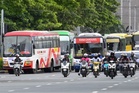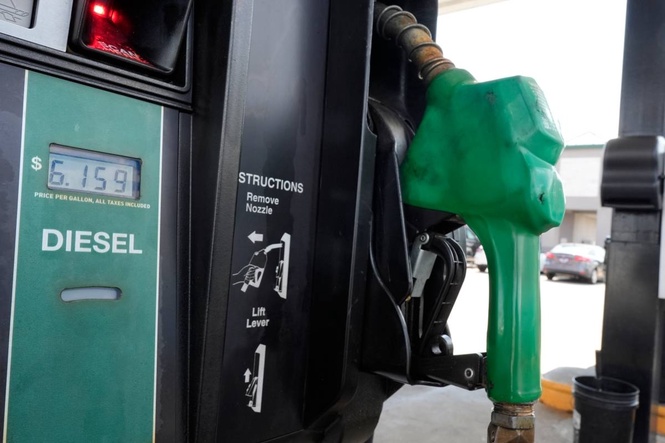
MALACAÑANG on Tuesday said the call of transport groups to increase fares will be the “last resort” as bus operators pressed President Ferdinand Marcos Jr. to let them raise ticket prices, arguing that soaring fuel costs from the Middle East war threatened to make operations “impossible.” The cost of diesel, which powers most of the Southeast Asian country’s buses, has effectively doubled since the first US-Israeli strikes on Iran in February triggered the conflict.
The Land Transportation Franchising and Regulatory Board (LTFRB) approved a fare hike in March, only for Marcos to quash the move a day later.
Ticket prices have remained static ever since.
On Tuesday, the per-liter price of diesel jumped another P8.82.
“This is a notice that operations may soon become impossible,” a group of companies representing bus lines across the country of 116 million said in a statement.
“Fuel prices have reached levels that our operations can no longer afford,” it read.
“We are not asking the government for ayuda,” the statement added, using a Filipino term meaning handout.
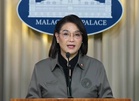
“We are asking for a fair and sustainable fare that reflects the real cost of operating public transportation.” But in a press briefing, Palace Press Officer Claire Castro said they are not inclined to increase fares and prefer to deliver targeted state subsidies rather than shifting rising operational costs onto passengers.
“If raising fares can be avoided, hopefully it will be our last resort,” Castro said in Filipino.
“The government is trying to squeeze every available resource to assist drivers and transport operators without passing the burden to commuters,” she added.
Millions of Filipinos use buses to get to and from work each day, with prices for a ride ranging from P13 to P15 for the first five kilometers, then jumping about P3 for each subsequent kilometer.
The Transportation Department pointed to a Saturday statement saying it “hoped to arrive at a positive decision” on a rate hike in coming days.
The import-dependent Philippines declared a national energy emergency in March and has been forced to cast an ever-wider net for fuel, including purchases of oil from Russia.
Unlike neighbors including Indonesia, Malaysia and Thailand, fuel prices in the Philippines are unregulated, leaving local transport firms to deal with market fluctuations.
The Marcos administration gave bus operators a one-off subsidy in March of P10,000 for each of their vehicles.
Separate handouts have been given to transport workers including drivers of taxis and jeepneys.
But the transport group Manibela held another transport strike on Sept. 21 and 22, continuing their call for a provisional fare increase.
The bus company Victory Liner, meanwhile, appealed to President Marcos, saying that the provincial bus industry is bleeding. “We ask for a fare that will keep public transportation moving,” the company said in a statement.
‘Not shutting the door’
“Right now, the administration is not inclined to raise fares for our countrymen, but we are not shutting the door,” Castro clarified.
“As long as we can sustain direct assistance to drivers without increasing fares, that will be the priority. However, studies are ongoing because we do not want the transport sector to suffer excessively.” Addressing announced transport strikes, the Palace acknowledged their right to protest.
Castro said the government will continue to provide aid to vulnerable sectors, which include fuel discount programs, targeted financial aid through the Assistance to Individuals in Crisis Situations (AICS) program, toll exemptions for provincial buses, extended terminal fee waivers at the Parañaque Integrated Terminal Exchange (PITX), and terminal fee exemptions across 86 public transport terminals nationwide.
“The president is preparing for further contingencies because we do not control events in the Middle East that affect global oil supply,” Castro noted.
“What the administration can control is how we assist our citizens,” she added.
She also revealed that the Department of Energy (DOE) is finalizing a recommendation for Marcos regarding the potential suspension or reduction of fuel excise taxes.
The DOE previously certified that crude oil prices had breached the $80-per-barrel statutory threshold required to trigger an official review of excise tax rates.
“We were provided an update that their recommendation is almost complete, and most probably by this week it will be submitted to the president,” Castro said, adding that Marcos is prepared to act swiftly if economic conditions require intervention.