.jpg)
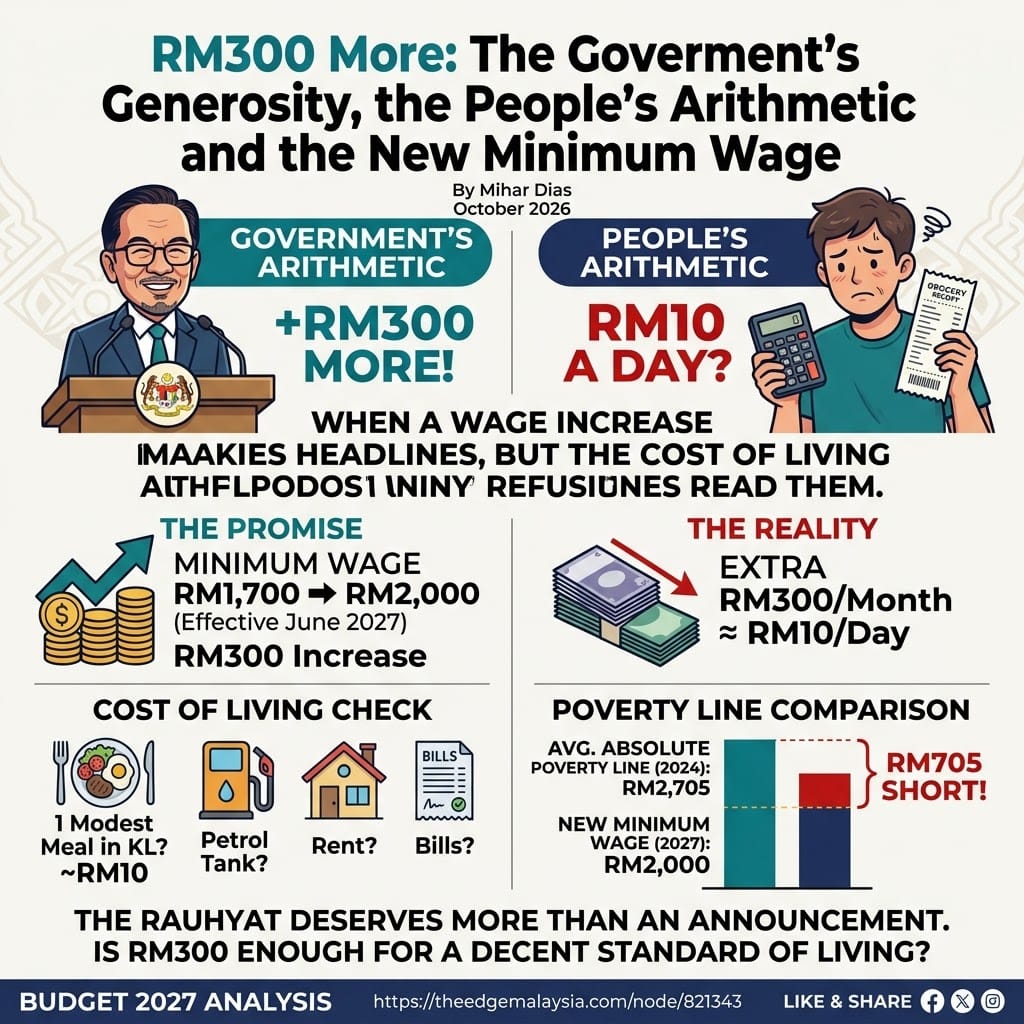
By Mihar Dias October 2026
When a wage increase makes headlines, but the cost of living refuses to read them.
There are occasions when the government announces a policy and expects the rakyat to applaud. There are other occasions when the rakyat should first take out a calculator.
Budget 2027 has given us one such occasion.
Prime Minister Anwar Ibrahim has announced that Malaysia’s minimum wage will rise from RM1,700 to RM2,000 a month, effective June 2027.https://theedgemalaysia.com/node/821343
More than four million workers are expected to benefit, although micro, small and medium enterprises with annual sales below RM50 million are exempted from the new requirement. The government has also announced a RM2,500 minimum wage for semi-skilled workers and new graduates, subject to implementation details.https://theedgemalaysia.com/node/821343
The increase of RM300 sounds respectable when delivered from a parliamentary rostrum. It sounds less impressive when examined from the perspective of someone who must buy groceries, pay rent, fill a petrol tank, settle utility bills and somehow survive until the next payday.
Three hundred ringgit more a month works out to RM10 a day.
Ten ringgit.
In Kuala Lumpur, that might buy a modest meal, provided one does not mistake a restaurant menu for a financial document. It will not necessarily buy breakfast, lunch and dinner. It certainly will not pay the rent, electricity, transport and other bills waiting patiently to consume the remainder of a worker’s salary.
But let us not be ungrateful. RM10 a day is better than nothing. The question is whether it is enough to justify the fanfare.
The poverty figures tell another story
The Department of Statistics Malaysia (DOSM) reported that the national relative poverty line stood at RM3,509 a month in 2024.https://www.dosm.gov.my/portal-main/release-content/poverty-in-malaysia-2024
Relative poverty is measured at half the median gross household income. DOSM also reported an average absolute poverty line income of RM2,705 a month for 2024, with 5.1 per cent of Malaysians living in absolute poverty. https://www.dosm.gov.my/portal-main/release-content/poverty-in-malaysia-2024
These are different measures, and neither should be confused with the minimum wage.
Nevertheless, the comparison raises an uncomfortable question.
A worker earning the proposed RM2,000 minimum wage would still receive RM705 less than the average absolute poverty line income, even before we consider whether that worker is supporting a family.
Of course, there is an important statistical distinction: the official poverty line applies to household income, while the minimum wage applies to an individual worker. They are not identical measures. But that distinction does not make the problem disappear. It makes the problem more revealing.
A household may have more than one income earner. A minimum-wage worker may also be single, married, supporting children or helping elderly parents. The same salary can produce very different realities depending on the household’s circumstances.
And if we look at the relative poverty threshold of RM3,509, the RM2,000 wage is RM1,509 short.
The screenshots circulating online also cite RM5,117 as a Kuala Lumpur relative poverty threshold and RM5,800–RM6,100 as an estimated monthly budget for a family of four to live decently in an urban centre. Those latter figures should not automatically be attributed to DOSM without checking their original sources. But anyone who has tried to maintain a household in the Klang Valley will understand why such estimates deserve serious consideration.
The government may celebrate a wage increase. The supermarket cashier, meanwhile, is unlikely to offer a discount because the Prime Minister has announced one.
The mathematics of political generosity
Let us give credit where it is due. A minimum wage increase can help workers, particularly those who have little bargaining power. RM300 more is real money to someone living on RM1,700. Dismissing the increase as worthless would be as insensitive as pretending it solves everything.
But the increase is about 17.6 per cent over the existing minimum wage. That is a substantial percentage on paper. The trouble is that workers do not buy groceries in percentages. They pay in ringgit and sen.
A percentage increase in salary does not automatically translate into a comparable improvement in purchasing power. That depends on what happens to prices, housing costs, transport expenses and other essential outgoings.
Nor is an announced increase the same as money already in a worker’s pocket. The new minimum wage takes effect only in June 2027. Until then, the worker must continue making ends meet on the existing rate.
The calendar, unfortunately, does not accept promises as payment.
And there is another complication. Employers operating on thin margins may face higher wage costs. Some may absorb them through improved productivity and better management. Others may raise prices, reduce working hours, delay recruitment or reconsider hiring. The extent of these effects will depend on the business, the industry and how the policy is implemented.
That is why a wage increase should not be treated as a magic wand. It must be accompanied by policies that help businesses improve productivity without making low-paid workers bear the cost of every adjustment.
A minimum wage is a floor, not a living standard
Perhaps this is where the debate has become confused.
A minimum wage is intended to establish a legal floor below which covered workers should not be paid. It is not necessarily the amount required for a decent life. Confusing the two is like assuming that because a house has a floor, it must also have a roof.
The government itself appears to recognise the distinction. Budget 2027 includes a proposed RM2,500 minimum wage for semi-skilled workers and new graduates, while the living-wage benchmark for government-linked investment companies and government-linked companies is being raised from RM3,100 to RM3,400 a month. These are separate measures, not interchangeable entitlements for every worker.
Yet the broader question remains: what should a Malaysian worker reasonably expect to earn to live with dignity?
Not merely to avoid starvation. Not simply to keep a roof over the family’s head while postponing medical care, education expenses, savings and every small pleasure that makes life worth living.
A decent living should allow a person to work, meet essential expenses, support dependants where necessary and put something aside for emergencies. Otherwise, employment becomes an elaborate exercise in moving money from one creditor to another.
We should also stop pretending that every worker has the same needs. A single person living with parents has a different cost structure from a single mother renting a flat and raising two children. A national minimum wage is administratively convenient, but it cannot, by itself, reflect every household’s circumstances.
That is precisely why wage policy must be supported by affordable housing, accessible public transport, childcare, healthcare, skills development and targeted assistance for households that need it.
The rakyat deserves more than an announcement
There is a familiar ritual in politics. A policy is announced, a headline is produced, the figures are repeated, and the government’s generosity is duly recorded.
The next morning, the rakyat wakes up to the same rent, the same grocery bill and the same school expenses.
The challenge for the MADANI government is not merely to announce that wages will rise. It is to demonstrate that ordinary Malaysians can actually afford a better life.
That requires more than a salary figure. It requires transparent monitoring of the cost of essential goods, credible measures of living standards, stronger enforcement of wage regulations and a serious effort to ensure that productivity gains reach workers rather than accumulating exclusively at the top.
It also requires the government to explain what the increase is expected to achieve, how its effects will be measured and what further action will follow if wages continue to lag behind the cost of living.
Otherwise, the RM300 increase risks becoming a public-relations achievement rather than a lasting improvement in household welfare.
Let us not begrudge workers an extra RM300. They deserve every sen of it.
But let us not confuse a little more money with financial security, or a higher minimum wage with a decent standard of living.
A government can announce a wage increase in seconds. A worker must make that money last for thirty days.
And that, tuan-tuan dan puan-puan, is the difference between political arithmetic and household arithmetic.
In Putrajaya, RM300 more may look like progress.
At the kitchen table, it may simply mean deciding which bill can wait until next month.
The government has raised the minimum wage. The cost of living has yet to receive the memo.

Have a take on #Budget2027? Turn your perspective into content, join the conversation, and stand a chance to win exciting cash prizes! Find out how to join here. T&Cs apply.
Mihar Dias (mihardias@gmail.com) is a content creator under the Newswav Creator programme, where you get to express yourself, be a citizen journalist, and at the same time monetize your content & reach millions of users on Newswav. Log in to creator.newswav.com and become a Newswav Creator now!
The User Content (as defined on Newswav Terms of Use) above including the views expressed and media (pictures, videos, citations etc) were submitted & posted by the author. Newswav is solely an aggregation platform that hosts the User Content. If you have any questions about the content, copyright or other issues of the work, please contact creator@newswav.com.