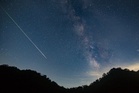
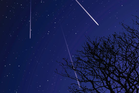
One of three separate meteor showers in October is set to peak tonight, delivering an unusually early display of shooting stars.
Unlike other meteor showers that appear in the early morning hours, the Draconids are best obeserved in the evening right after dusk.
The Draconids meteor shower is active from 6 to 10 October, with the maximum peak occurring on the evening of 8 October 2026.
The best viewing window in the UK will be on Thursday night, starting right as night falls at around 7pm.
The actual peak will be around 2am BST (9 Octber), which is 9pm on the east coast of America – making it the perfect time to view the spectacle without having to stay up all night.
The shooting stars that appear are a result of the Earth traveling through a cloud of debris from the comet 21 P/Giacobini-Zinner.
Particles as small as a grain of sand can create the bright streaks that light up the sky, with the Draconids appearing to originate from the constellation of Draco.
Nasa refers to the Draconids as an “occasional” shower due to the variability of the shooting star display.
“They are either in outburst, with a fair number of meteors, or are so few the casual observer would not notice them,” the US space agency notes.
“The faintness of the Draconids is due in part to the fact that they are very slow for meteors, about 40,000 mph. As a consequence, it takes a larger Draconid to produce enough light to be really noticeable (the brightness of a meteor is related to both its size and speed), and there are few of those unless the shower is in outburst.”
Astronomers are predicting a modest display in 2026, averaging about five to 10 meteors per hour during their peak.
The latest weather forecast from the Met Office suggest there will be significant cloud cover over southern parts of the UK, with northerly areas offering the best viewing opportunities.
Advice from the Royal Observatory Greenwich is to avoid areas with light pollution and to not look at screens or other bright lights.
“Make sure there are no direct sources of light in your eyes, so that you can fully adapt to the local conditions and ensure that fainter meteors become visible,” Royal Museums Greenwich noted in a blog post about the Draconids.
“There’s no advantage to using binoculars or a telescope; just look up to take in the widest possible view of the sky.”
The Draconids will be followed by the Orionids, which peak on the night of 21-22 October, and the Taurids.
Read MoreAstronomers find mysterious signal coming to us from the early universe
Scientists discover unique ‘phoenix’ planet that was born from a dying star
Strange hole found on moon could lead to future astronaut shelter