By Mihar Dias October 2026
At 80, I have discovered that keeping the body moving is only half the battle. The other half is finding people worth sitting down with.
by Rahim Said
Approaching 80, I have discovered that staying fit is not quite what the fitness industry would have us believe. You do not necessarily need an expensive gym membership, a personal trainer who looks as though he was assembled from spare muscles, or some nutritional supplement promising to reverse the ageing process.
If any of these could make us young again, the manufacturers would have found a way to sell immortality by the bottle.
I still play tennis occasionally, provided I can find a doubles partner. That qualification is important. At my age, finding someone willing to play may be a greater challenge than finding the energy to do so. I have also taken to pickleball, the fashionable new kid on the sporting block. Apparently, even old age must keep up with trends.
But my most dependable exercise is cycling for at least an hour a day. I do it to keep my knees working and the rest of me from becoming a permanent fixture on the sofa. There is something reassuring about pedalling away without having to chase a ball, dodge an opponent or pretend that my reflexes are still what they were 40 years ago.
For those who cannot manage tennis, pickleball or outdoor cycling, there are alternatives. Walking in a swimming pool and gentle water exercises can be kinder to ageing joints. Stationary cycling in a gym is another option. You get the cardiovascular exercise without getting wet, unless the gym's air-conditioning has given up the ghost.
Naturally, anyone with health concerns should choose an activity suited to their condition and abilities. The objective is to keep moving, not to win a medal for stubbornness.
Yet, after years of watching people discuss fitness, I have come to believe that many exercise programmes overlook something rather fundamental.
Physical fitness is important, but social fitness may be what gives us a reason to maintain it.
The body needs exercise. The mind needs company.
We are constantly reminded to watch our weight, monitor our blood pressure, strengthen our muscles and keep our cholesterol under control. We are encouraged to count our steps, measure our heart rate and record the calories we burn.
Apparently, modern civilisation has made it possible to measure almost everything about the human body except the number of meaningful conversations we have in a day.
How many fitness programmes ask whether you have anyone to have coffee with after your workout? How many personal trainers prescribe an hour of companionship alongside 30 minutes on the treadmill?
We have become very efficient at exercising our bodies while occasionally neglecting the human relationships that make life worth living.
No man is an island, as the saying goes. Unfortunately, some people seem determined to become one, particularly after retirement. They stop going to work, lose their daily contact with colleagues, see their children less frequently and gradually discover that their social calendar has become as empty as their office desk.
At first, retirement feels like freedom. No meetings, no deadlines, no boss asking where the report is. You can wake up whenever you like and do absolutely nothing.
The trouble begins when doing nothing becomes your principal occupation.
Days turn into weeks. Conversations become fewer. The telephone remains silent unless someone wants to sell you insurance, ask for a donation or inform you that your bank account is in danger of being emptied by a mysterious stranger.
Loneliness is not simply a matter of having nobody in the room. You can be surrounded by people and still feel isolated. What matters is having regular human contact, a sense of belonging and people with whom you can exchange ideas, jokes, complaints and the occasional piece of gossip.
Social relationships do not replace physical exercise, a balanced diet or proper medical care. But they can give us another reason to get dressed, leave the house and participate in the world.
That, to me, is an essential part of staying fit in old age.
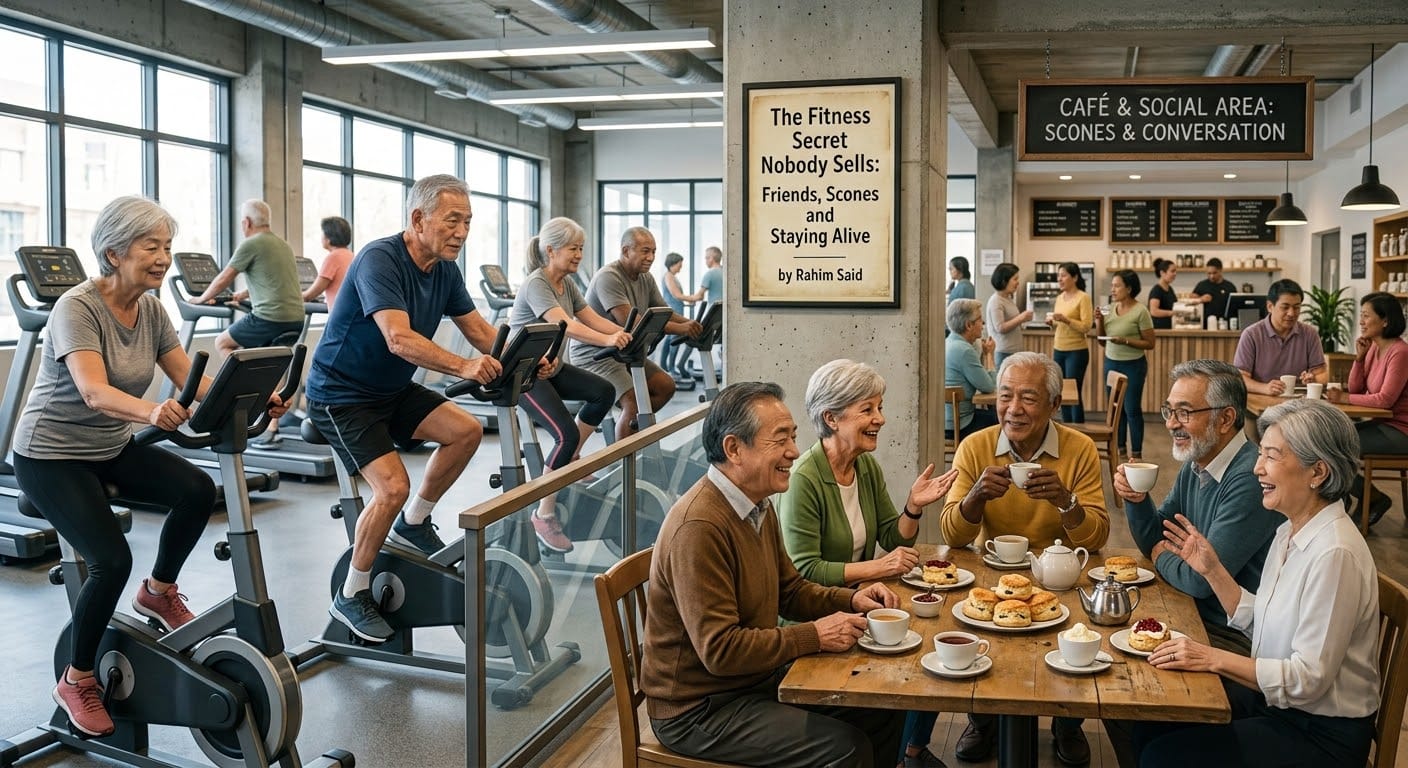
My gym has scones and conversation
I am fortunate to live in a residential complex with plenty of cafés and restaurants. They offer more than food and coffee. They provide places where people can linger, meet acquaintances and turn an ordinary afternoon into a small social occasion.
After my cycling session, usually around five in the afternoon, I head downstairs to a café specialising in scones.
There, I find elderly men and women who appear to have discovered something the fitness industry has yet to package attractively: the pleasure of sitting together and talking.
Nobody is checking our body fat percentages. Nobody is asking us to demonstrate our abdominal muscles. Nobody is timing how quickly we can get out of our chairs.
We sit, talk, laugh and exchange stories. Sometimes the conversation is about family, sometimes about the news, and sometimes about nothing of particular importance. At our age, even an argument about the price of groceries can provide welcome entertainment.
The scones help, of course. It is easier to persuade people to socialise when there is something on the table besides good intentions.
I am not suggesting that scones should replace a sensible diet. Nor am I proposing that every senior citizen should consume pastries in the name of preventive medicine. Moderation remains useful, although it is a word most of us prefer to apply to other people's appetites.
What matters is the ritual. You exercise, shower, get dressed and make your way downstairs. You know there will probably be someone to talk to. You become part of a familiar little community.
The café becomes a destination. The people become a reason to go there.
And that is rather different from sitting alone at home, watching television and waiting for the next advertisement to tell you that ageing is a disease that can be cured with the right product.
The loneliness nobody puts on the fitness poster
The fitness business is remarkably good at selling us the fear of physical decline. It shows us toned bodies, gleaming equipment and smiling people who appear to have never experienced a stiff knee or a bad night's sleep.
But there is little commercial glamour in showing an elderly person sitting alone at home, wondering whom to call.
There is no dramatic before-and-after photograph of loneliness. No supplement bottle promises to give you a friend. And no treadmill comes with a companion who remembers your stories and laughs at your jokes, even when you have told them before.
Yet social isolation and loneliness are recognised as important concerns for older people's well-being. Regular contact with others can support emotional health, while meaningful relationships can provide a sense of purpose and belonging.
The answer is not to force elderly people into noisy gatherings or assume that everyone wants to join a club. Some people enjoy solitude. Others prefer a small circle of friends to a room full of strangers.
The objective is not to turn introverts into social butterflies. It is to ensure that solitude remains a choice rather than becoming a prison.
We should also recognise that social fitness does not happen automatically. It requires effort. Someone must make the first phone call, suggest the lunch, invite the neighbour for coffee or persuade a friend to join a walk.
Friendship, like muscle strength, can deteriorate through neglect.
An exercise prescription for the elderly
If I were designing a fitness programme for older people, I would certainly include walking, cycling, strength exercises, balance training and activities appropriate to individual abilities.
But I would add another recommendation: schedule human contact as deliberately as you schedule physical exercise.
Find a walking companion. Join a recreational sports group. Visit a café regularly. Volunteer for something useful. Attend a community activity. Reconnect with old friends. If mobility is limited, arrange telephone or video conversations, or invite people to visit.
And if you have an elderly neighbour or relative, do not assume that silence means contentment. Make contact. Ask how they are doing. More importantly, listen to the answer.
A brief conversation may seem insignificant to someone with a busy schedule. To a person whose days have become monotonous, it may be the most meaningful part of the afternoon.
Residential developers, too, could think beyond swimming pools, gyms and landscaped gardens. Shared spaces that encourage residents to meet, sit and talk can be just as valuable. A pleasant café, shaded benches, accessible walking routes and community activities may help turn a collection of apartments into a neighbourhood.
Of course, architecture alone cannot manufacture friendship. But it can make friendship easier to cultivate.
Staying alive is not the same as living
As I approach 80, I have no illusions about turning back the clock. I am not trying to compete with 30-year-olds, and I have stopped expecting my knees to behave as though they still belong to their previous owner.
My objective is simpler: to remain mobile, independent, mentally engaged and interested in the world around me for as long as circumstances permit.
Cycling helps me maintain my physical fitness. The occasional game of tennis or pickleball keeps me active and gives me something to look forward to. But the prospect of meeting people afterwards adds another dimension to the routine.
There is a difference between keeping a body functioning and giving its owner a reason to get out of bed.
We can become so obsessed with extending life that we forget to make life enjoyable. We count our steps but forget to count our friends. We monitor our calories but neglect our conversations. We spend money strengthening our muscles while allowing our social relationships to atrophy.
Perhaps it is time for the fitness industry to broaden its definition of a healthy lifestyle.
An hour on a bicycle is useful. A walk with a friend is useful. A lively conversation over coffee can be useful, too, even if it does not register on a smartwatch.
And if that conversation happens over a scone, so be it. At 80, one learns to distinguish between the things that matter and the things that merely look good in a fitness advertisement.
My prescription is uncomplicated: keep moving, keep thinking, keep meeting people and keep finding reasons to laugh.
Because the real challenge of old age is not merely to stay alive for as long as possible.
It is to avoid becoming a spectator in your own life.
And if a bicycle ride followed by a scone and a good conversation helps me do that, I shall consider the afternoon well spent.
Just don't ask me to cycle faster to burn off the scone. I have already done my hour, and I have earned the right to enjoy my company.

Share your fitness and healthy lifestyle stories through #JomFit and stand a chance to win cash prizes worth up to RM2,300!
Find out how to join here. Don't miss out! T&Cs apply.
Mihar Dias (mihardias@gmail.com) is a content creator under the Newswav Creator programme, where you get to express yourself, be a citizen journalist, and at the same time monetize your content & reach millions of users on Newswav. Log in to creator.newswav.com and become a Newswav Creator now!
The User Content (as defined on Newswav Terms of Use) above including the views expressed and media (pictures, videos, citations etc) were submitted & posted by the author. Newswav is solely an aggregation platform that hosts the User Content. If you have any questions about the content, copyright or other issues of the work, please contact creator@newswav.com.