Malaysian politics has always had a peculiar relationship with unity.
Every political generation speaks about it. Every coalition promises it. Every party claims to be defending it. Yet somehow, the closer politicians move toward "unity," the more political parties seem to appear.
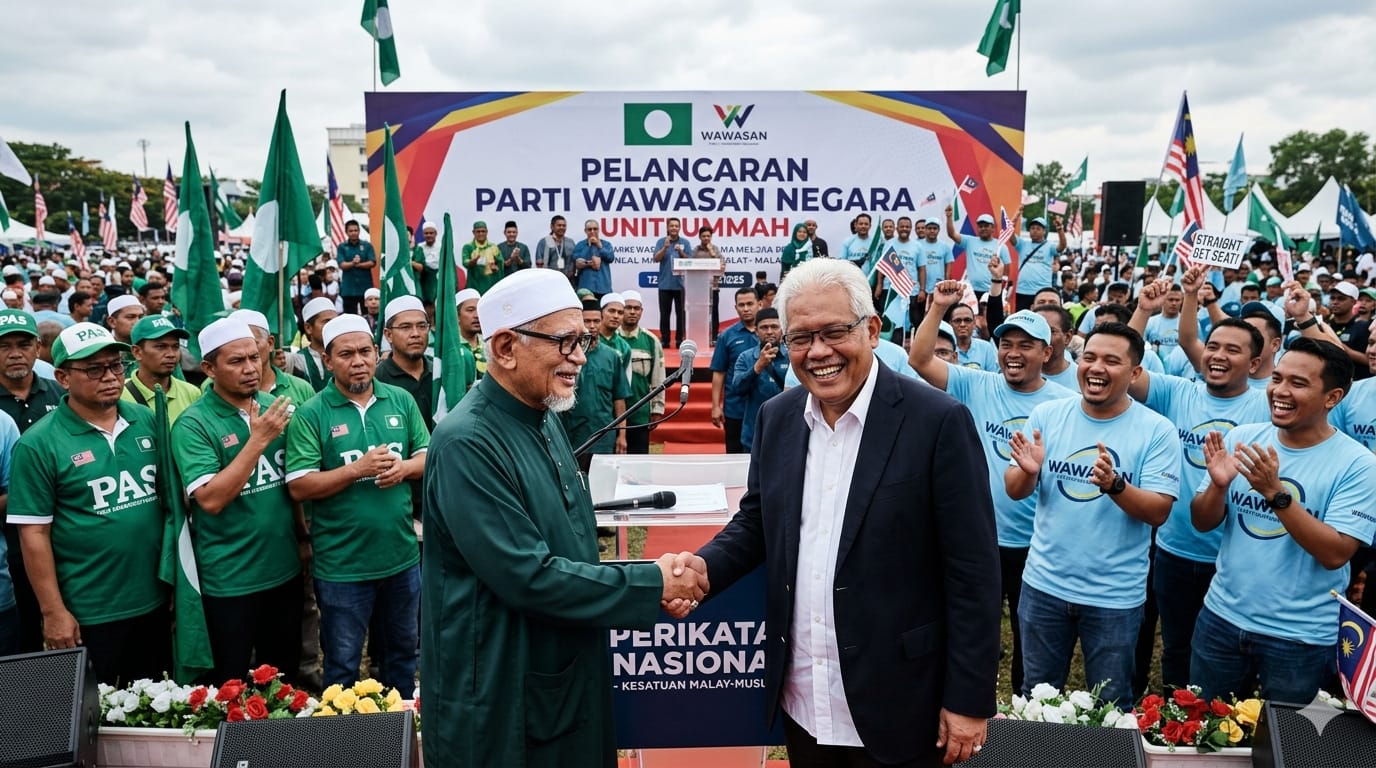
The latest example comes from PAS president Tan Sri Abdul Hadi Awang's support for the formation of Parti Wawasan Negara by Opposition Leader Hamzah Zainudin. What made the development particularly interesting was Hamzah's revelation that the party's name itself was suggested by Hadi.
At first glance, the move appears contradictory.
For years, PAS has championed Malay-Muslim unity as a political necessity. If unity is truly the objective, many ordinary Malaysians would naturally ask a simple question: Why create another party?
Why not simply absorb Hamzah and his supporters into PAS?
Why build another political house when the stated goal is to gather everyone under one roof?
The answer lies in understanding the difference between political slogans and political strategy.
What appears contradictory to voters often makes perfect sense to strategists.
The formation of Parti Wawasan Negara may not represent a division of power at all. Instead, it may represent an attempt to widen the opposition's political reach.
For decades, PAS has possessed a loyal and disciplined support base. Its strength in the east coast states is undeniable. Its grassroots machinery remains among the most organised in the country. The party has successfully cultivated a loyal voter base that sees PAS as the most consistent defender of Malay-Muslim interests.
Yet PAS also understands its own limitations.
There remains a significant segment of Malay voters who may appreciate PAS's commitment to Islamic principles but are reluctant to vote directly for an Islamist party. These include urban professionals, middle-class corporate executives, former UMNO supporters, retired civil servants, and moderate conservatives who prioritise economic management and governance experience alongside religious values.
Hamzah Zainudin occupies a different political space.
He is viewed less as a religious figure and more as an administrator. His appeal lies not in religious authority but in governance credentials, ministerial experience, and political pragmatism.
Placing Hamzah directly into PAS would risk limiting that appeal.
Allowing him to lead a separate party creates a different dynamic altogether.
Instead of asking voters to enter PAS's house, PAS may be trying to build another house next door and invite different groups of voters into the same neighbourhood.
Viewed from this perspective, Parti Wawasan Negara becomes less of a rival and more of a complementary vehicle.
It allows PAS to maintain its ideological identity while simultaneously reaching voters who may never feel comfortable supporting PAS directly.
Political strategists sometimes describe this as a "big tent" approach.
Rather than forcing every voter into a single political identity, the coalition creates multiple entry points.
PAS attracts religious conservatives.
Wawasan targets disillusioned nationalists and moderate Malays.
Other coalition partners attempt to appeal to different demographic segments.
Different brands. Same coalition.
Different doors. Same destination.
It is a strategy that may appear fragmented on the surface but is designed to maximise electoral reach.
However, every strategy carries risks.
While leaders at the national level may view Wawasan as an asset, grassroots members may see something entirely different.
For local PAS divisions that have spent years building constituencies, nurturing voters, organising campaigns, and cultivating local influence, the arrival of another Malay-Muslim party raises immediate concerns.
The question is not ideological.
The question is practical.
Which seats will Wawasan contest?
Who will surrender those seats?
Who decides?
These questions have historically caused more political damage than ideological disagreements.
Political unity often survives lofty speeches. It frequently struggles when candidate lists are announced.
A local PAS branch that has spent a decade building support in a constituency may not welcome being told to step aside for a newcomer, regardless of how strategically important that newcomer appears to national leaders.
This is where memories of previous political fractures become relevant.
PAS veterans remember the painful split that led to the formation of Amanah in 2015. While the circumstances are different today, the lesson remains the same: when grassroots members feel ignored, resentment accumulates.
The danger may not come from public rebellion.
It may come from something far more subtle.
Reduced enthusiasm.
Passive resistance.
Silent dissatisfaction.
Election campaigns are powered by volunteers, not press conferences.
A coalition can possess the most sophisticated strategy in Kuala Lumpur and still struggle if local machinery loses motivation.
Yet perhaps the most fascinating aspect of the current situation is how it contrasts with UMNO's own approach to Malay-Muslim unity.
Both PAS and UMNO now speak about the importance of consolidating Malay political strength.
But they are pursuing remarkably different paths.
UMNO's strategy resembles a fortress.
The party seeks to bring former members, traditional supporters, and old allies back into a single institution. The objective is consolidation. One party. One structure. One command centre.
PAS appears to be experimenting with something different.
Instead of one large house, it is constructing a political neighbourhood.
Each party serves a different purpose. Each appeals to a different audience. Yet all remain connected through the same coalition framework.
One model seeks strength through concentration.
The other seeks strength through diversification.
Both claim to represent unity.
The irony is that both strategies may ultimately face the same challenge.
Modern Malaysian voters are becoming increasingly impatient with political engineering.
Young Malaysians entering the workforce are worried about housing affordability, wages, artificial intelligence, automation, and economic competitiveness.
Business owners worry about investment confidence and economic stability.
Parents worry about educational opportunities.
Professionals worry about career progression and future industries.
Against this backdrop, discussions about coalition structures, party formations, and political realignments often feel disconnected from everyday concerns.
This does not mean political strategy is unimportant.
Far from it.
Political structures determine who governs and how policies are implemented.
But voters increasingly expect political manoeuvres to lead somewhere meaningful.
The creation of a new party must eventually produce more than a new logo, a new flag, or a new leadership structure.
It must answer a more difficult question.
How does this improve governance?
How does this strengthen the economy?
How does this create opportunities for ordinary Malaysians?
Ultimately, Hadi Awang's support for Parti Wawasan Negara may represent political foresight.
It may also represent political insurance.
If Bersatu weakens, Wawasan provides an alternative vehicle.
If the opposition coalition expands, Wawasan broadens its appeal.
If certain segments of Malay voters become disillusioned with existing political options, Wawasan offers another choice within the same political ecosystem.
From a strategist's perspective, it is an elegant solution.
From a grassroots perspective, it is a source of uncertainty.
From a voter's perspective, however, the judgment will be much simpler.
Voters will not evaluate the brilliance of coalition architecture.
They will evaluate results.
Because in the end, Malaysians are less interested in how many political houses are built than in whether the people living inside them can actually govern the country.
Annan Vaithegi writes about politics, power, and the gap between political strategy and political reality.
Annan Vaithegi (annanvaithegi@icloud.com) is a content creator under the Newswav Creator programme, where you get to express yourself, be a citizen journalist, and at the same time monetize your content & reach millions of users on Newswav. Log in to creator.newswav.com and become a Newswav Creator now!
The User Content (as defined on Newswav Terms of Use) above including the views expressed and media (pictures, videos, citations etc) were submitted & posted by the author. Newswav is solely an aggregation platform that hosts the User Content. If you have any questions about the content, copyright or other issues of the work, please contact creator@newswav.com.