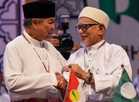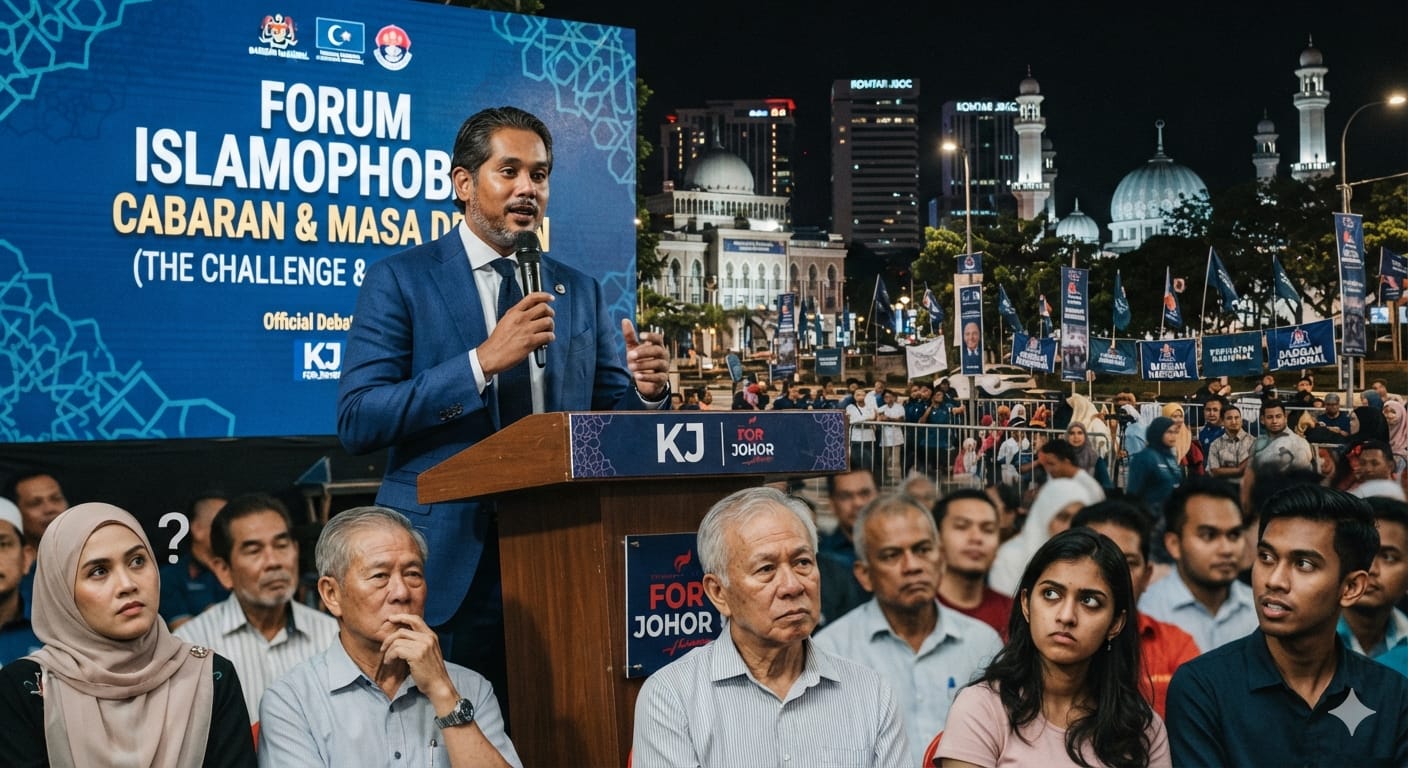
Every election seems to produce a new political buzzword. Yesterday it was race. Then it became corruption. Later it was "tebuk atap." Today, the latest campaign currency is "Islamophobia."
It is a powerful word. It should never be thrown around lightly because genuine Islamophobia exists in many parts of the world and deserves to be confronted wherever it appears. But that is precisely why Malaysians should be careful whenever politicians begin using the term as an election slogan rather than a serious description of discrimination. Once every political disagreement is branded Islamophobic, the word itself begins to lose its meaning, and public debate becomes the first casualty.
Khairy Jamaluddin's recent criticism of Pakatan Harapan's "Green Wave" campaign as Islamophobic deserves closer examination. Is Harapan criticising Islam itself, or is it criticising PAS as a political party? Those are two very different things. A democracy that cannot distinguish between religion and politics risks silencing legitimate discussion. Criticising PAS is not automatically criticising Islam, just as criticising UMNO is not attacking Malays, and criticising DAP is not an attack on Chinese Malaysians, Malays within DAP, or the broader Indian and Chinese Malaysian communities. If politicians deliberately blur these lines, then they are not defending religion they are manipulating public perception.
Malaysia's institutional reality also deserves recognition. Islam is not a vulnerable faith struggling for survival in this country. The Federal Constitution recognises Islam as the religion of the Federation. Every state has Islamic religious departments, Syariah courts, mosques, suraus, Islamic schools and publicly funded institutions dedicated to Islamic administration and development. Friday sermons continue every week, Islamic education receives substantial public support, and religious programmes remain part of national life. The institutional foundation of Islam is firmly embedded within the country's constitutional framework.
That is not to say Islam should never be defended. Every religion deserves respect, and genuine religious hatred should be rejected firmly. But defending Islam should never become an excuse to shield politicians from legitimate scrutiny. Malaysians have also witnessed outspoken Islamic preachers and religious personalities speaking passionately even controversially in defence of Islam. Their presence itself demonstrates that Islamic discourse remains vibrant and influential. The question therefore is not whether Islam has a voice. The question is whether politicians are using Islam's voice to strengthen the nation or merely strengthen their own electoral position.
Perhaps the more uncomfortable truth is that this debate is not really about Islamophobia at all. It is about political convenience. For decades, UMNO accused PAS of being too extreme, warning Malaysians about divisive religious politics. Today, parts of UMNO welcome PAS support where electoral arithmetic demands it. On the other side, Pakatan Harapan now warns voters about the "Green Wave," despite having once worked together with PAS under the Pakatan Rakyat banner. The actors have changed positions, but the script remains remarkably familiar. Yesterday's partner becomes today's threat. Yesterday's threat becomes tomorrow's ally.
Reading through hundreds of public comments beneath political news reveals something even more revealing than the headlines themselves. Many Malaysians are no longer debating who is right. Instead, they increasingly believe that every coalition eventually reaches for the same toolbox: race, religion, fear and selective memory. Some accuse BN of hiding behind PAS while denying formal cooperation. Others argue that PAS should be criticised as a political movement without automatically invoking Islam. Still others believe Pakatan Harapan also uses fear of conservative politics to consolidate support among its own voters. Whether these perceptions are entirely fair is almost beside the point. Once citizens begin believing that every politician changes principles according to political convenience, rebuilding trust becomes far more difficult than winning the next election.
The irony is that while politicians argue about the Green Wave, ordinary Malaysians are confronting very different realities. Artificial intelligence is transforming industries faster than governments can regulate them. Graduates worry about employability more than ideological labels. Small businesses worry about rising costs, shrinking margins and global competition. Families worry about housing affordability, wages and whether their children will inherit a better Malaysia than the one they grew up in. Algorithms do not ask whether someone voted for PAS, UMNO or Pakatan Harapan. Investors do not choose countries based on campaign slogans. The global economy rewards innovation, productivity and talent not political branding.
This is where Khairy Jamaluddin could make a genuinely meaningful contribution. Few politicians communicate as effectively as he does. His podcast reaches hundreds of thousands of Malaysians, particularly younger audiences who are searching for thoughtful discussions beyond daily political quarrels. Imagine if that same platform were used to explain how Malaysia could become the regional leader in halal technology, Islamic finance innovation, artificial intelligence, cybersecurity, biotechnology and digital entrepreneurship. Imagine if every week Malaysians heard practical conversations about producing world-class Muslim scientists, engineers, innovators and entrepreneurs instead of endless debates over who is more Islamic or who is more offended.
That is the political mileage many Malaysians are waiting to see.
A confident Islamic civilisation has never been built merely by declaring itself under siege. It has been built through scholarship, scientific discovery, trade, justice, education and intellectual confidence. The greatest Islamic civilisations did not become respected because they won election campaigns. They became respected because they advanced knowledge, governed fairly and contributed to humanity.
Perhaps Malaysia's political class should adopt three simple principles. First, replace religious fear with measurable performance. Let political parties compete over who delivers better Islamic education, stronger halal exports, higher youth employment, greater research output and more successful Muslim entrepreneurs. Second, frame Islamic governance through universal values that Islam itself emphasises justice, integrity, transparency, compassion and economic opportunity because these strengthen society as a whole rather than dividing it into competing camps. Third, institutionalise genuine interfaith engagement while fully respecting the constitutional position of Islam, so that confidence replaces suspicion and dialogue replaces endless political accusations.
The greatest danger facing Malaysia today is not Islamophobia. It is the normalisation of fear as a political strategy. Fear of losing race. Fear of losing religion. Fear of losing rights. Fear has become easier to sell than vision because vision requires hard work, measurable outcomes and long-term thinking. Fear requires only a microphone.
Malaysia deserves better.
A confident Islam does not fear political debate. A confident democracy does not fear criticism. And a confident nation does not need politicians constantly inventing new anxieties to justify why voters should choose them.
Instead of asking Malaysians what they should fear next, perhaps it is finally time for every political leader including Khairy Jamaluddin to answer a far more important question.
What extraordinary future are you building that will make Malaysians fear less because they are capable of achieving more?
Annan Vaithegi craft politically reflective and socially grounded opinion columns that critically examine leadership, institutions and the evolving direction of Malaysia through evidence, history and the everyday realities of ordinary Malaysians.
Annan Vaithegi (annanvaithegi@icloud.com) is a content creator under the Newswav Creator programme, where you get to express yourself, be a citizen journalist, and at the same time monetize your content & reach millions of users on Newswav. Log in to creator.newswav.com and become a Newswav Creator now!
The User Content (as defined on Newswav Terms of Use) above including the views expressed and media (pictures, videos, citations etc) were submitted & posted by the author. Newswav is solely an aggregation platform that hosts the User Content. If you have any questions about the content, copyright or other issues of the work, please contact creator@newswav.com.