TL;DR: This article explores why socialisation of higher education would be a net positive on the economy and students alike.
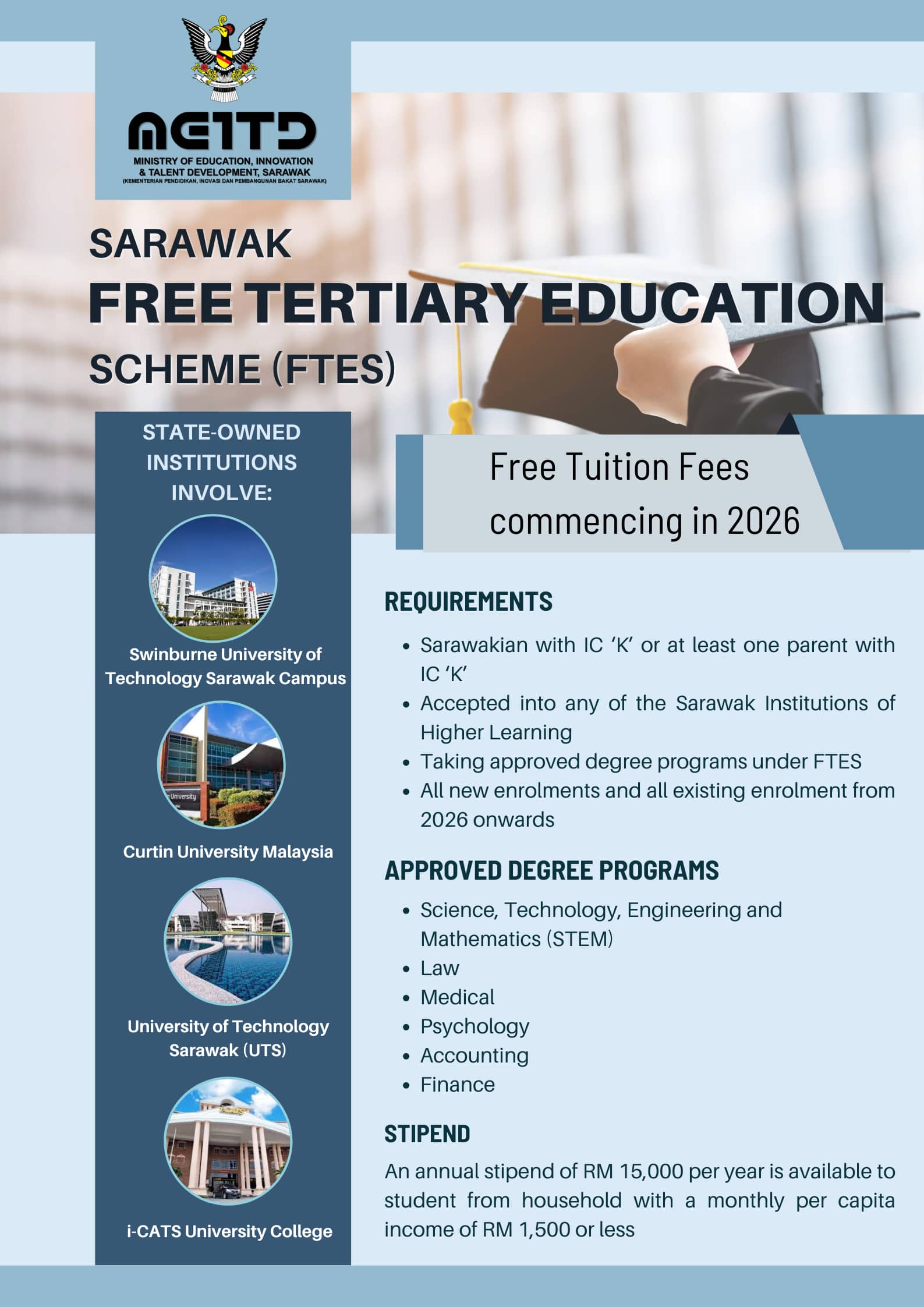
As a tribute to the growing number of Sarawakian friends that I do have, I have decided to write, on their recommendation, some articles on the interesting initiatives that the Sarawak State Government has rolled out while commenting on their projected impacts, and whether such policies should be rolled out nationwide. One such policy that has been talked about is the Free Tertiary Education Scheme [FTES] that was introduced. The FTES, which was rolled out in January this year, had four stated aims, according to one of its participating universities, Curtin University Malaysia:
- Provide equal access to higher education;
- Develop a highly skilled and educated workforce;
- Reduce financial constraints on students and families;
- Encourage continuous learning and academic excellence;
In short, we are dealing with a practical example of the socialisation of education - which got me thinking: Would Public Universities up and down the country improve with socialisation and more importantly, would a better and more equitable society be produced thanks to this socialisation programme if it were emulated nationwide?
Defining Socialisation
One of the words I would be using continuously throughout this article is the word: "Socialisation", or, to give it its full phrase, "Socialisation of Education". In this context, the word and/or its equivalent phrase would bear the notion that "education is a public good, where the benefits spread across society in terms of employment, economic prosperity, health and social cohesion" - as described by the Australian Centre for Student Equity and Success. In essence, the socialisation of education does not seek to privatise profit, but rather the opposite - to socialise benefits.
For all intents and purposes for this article, the socialisation of education can include expropriation - which is defined as "the action of the state in taking or modifying the property rights of an individual (as by eminent domain) in the exercise of its sovereignty" by the Merriam-Webster Dictionary, the deprivatisation of internal services, or simply outcompeting private education - that is, to make public education [or, in this case, higher education institutions] the primary choice for students in a modern environment.
The Case for Socialisation
Obviously, as this is the inaugural year of the FTES, no such research article exists on the impacts of the FTES. However, there is no doubt that there is a case for the socialisation of higher education, and it rests on four pillars: Economics, Professional Development, Democracy and Civic Education and Student Debt.
Equitable Economic Growth
First, equitable economic growth. The goal of the socialisation of higher education is not just economic growth, but equitable economic growth. In the paper entitled "The Concept of Public Goods, the State, and Higher Education Finance: A View from the BRICS", the paper argues that socialisation beats private ownership in higher education insofar as it analyses how equitably public money is allocated within the system. Economic Growth is well and all, but what use would it be if the gap between the haves and the have-nots keeps widening or if the economic growth is solely private, while the rest of society does not have the chance to better their living conditions? Indeed, the economy only works well and fairly if it is inclusive, rather than exclusive. One such realisation that private ownership in higher education - and education more broadly is not ideal is Chile in the Augusto Pinochet era, brought about by the 1973 military coup against Salvador Allende with CIA interference. In the paper entitled "The Contraction of Higher Education in the Early Years of the Pinochet Regime", Luis Martínez writes that the regime drastically reduced government funding for tertiary education, which led to worse labour market outcomes throughout their working lives, including lower labour force participation and higher unemployment - with the student movement proving pivotal in toppling the Pinochet regime. All this to conclude that education is the great equaliser - for it does not matter if one is wealthy or not, but more education, especially in the current K-economy (knowledge economy), is crucial to building a strong and stable economy and, therefore, we will foster a stable social order where antisocial behaviour is minimal because everyone can take part in society, and it ensures that talent, rather than wealth, dictates who enters high-value industries, ultimately growing the broader economy and increasing tax revenues - thereby leading to a stronger economy because it is a self-affirming loop.
Professional Development & Social Mobility
Next, professional development. I do believe that it is a universal perception of higher education - by college graduates and non-college graduates alike - that the ultimate goal of higher education is to become a high-earning member of society, working in a white-collar job in general. However, an oft-forgotten situation that many overlook is that connections and wealth are so important that many low-income students are locked out. A research paper entitled Mobility Report Cards: The Role of Colleges in Intergenerational Mobility showed that the top 1% of the income distribution are 77 times more likely to attend an Ivy League college than those whose parents are in the bottom income quintile - significantly limiting upward mobility and, in general, hindering professional development, since Ivy League colleges are known to have plenty of networking events to ease students' transition from the classroom to the industrial workspace, creating a systematic wealth gap, which was further explained in Pedigree: How Elite Students Get Elite Jobs. In an ideal vision of Malaysia where there is universal socialised higher education, students from disadvantaged backgrounds can have the same access as those who have plentiful resources, allowing them to have the same opportunities to succeed. Access to a higher education of good quality should not be contingent on how deep the pockets are, but rather a question of merit and the equality of opportunity.
A Democratic Society
Thirdly, the question of democracy and civic education. The paper entitled Role of Higher Education in Shaping Public Discourse and Smart Communication could not make it any clearer when it mentioned that by "equipping individuals with the tools to think critically, engage ethically, and communicate effectively, they contribute to the development of a more informed, inclusive, and resilient society." Universities and Higher Educational Institutions are not - what the anti-intellectuals claim - as "woke" as what they've done in Australia and other Anglosphere countries, but they allow students to think for themselves and critically to solve and articulate complex issues that may or may not have a straight binary answer: Yes/No or Right/Wrong. A stronger and more resilient society will strengthen public participation in politics and improve voter turnout, which is a generally good indicator of a stronger democracy. Electiondata.com has a very interesting dashboard where they track turnout as a percentage of the available voting population, and it has to be noted that we usually hit 70-75%, with unusual highs of voter turnout in 2013 and 2018, where it exceeded the 80% mark - in recent times, anyway. A bit of an anecdote here: many of my peers who are around my age are simply disinterested in politics - either they are completely politically apathetic, or they think they will have a better life elsewhere when they "immigrate", wherever and whenever that is - and I do believe this is due to a lack of civic education in Malaysian democracy in higher education and in the education system as a whole. A socialised higher education system that is inclusive and teaches about local civic democracy will strengthen the question of democracy in Malaysian society today.
Student Debt
Lastly, the student debt crisis. People tend to forget that the idea of student debt has only been a thing in Malaysia for approximately 30 years, established on 1st November 1997, as the Government of the day was trying to do its best Margaret Thatcher impression - and did a huge privatisation programme of higher education institutions, as was reported in a Focus Malaysia Article, which led the state to create the National Higher Education Fund Corporation or PTPTN, as it is more commonly known. A New Straits Times article reported that PTPTN loans were disproportionately taken out by students coming from B40 families [bottom 40% of Malaysian income earners] - and that while it does ease the financial burden of students, it brings the risk of debt after graduation, which adds to the already increasing economic burdens on fresh graduates - in an environment where stagnant wages and job mismatch, which have been happening for over a decade, result in pushing youth into more debt. Students of all backgrounds must have the ability and the propensity to succeed no matter their financial background so that everyone starts on equal footing, where each gives to their community and country according to their ability and, in return, they get back according to their needs - in order to foster stronger socio-economic status for the general public.
Conclusion
In conclusion, the socialisation of higher education by the State of Sarawak is a good first step in showing the federal government the benefits of proper legislation of Sozialpolitik [German for Social Politics - the politics of reducing systemic and major social inequalities] based on four key arguments: a more equitable economy, better professional development, a stronger democratic Malaysia and the elimination of student debt, which emancipates the proletariat and allows them to utilise the positive liberties to their fullest effect - regardless of pre-determined socio-economic status. The Socialisation of Higher Education is a good first step in building a modern economy that works for the many, not for the few!
Timothy (timothytanyeantim@gmail.com) is a content creator under the Newswav Creator programme, where you get to express yourself, be a citizen journalist, and at the same time monetize your content & reach millions of users on Newswav. Log in to creator.newswav.com and become a Newswav Creator now!
The User Content (as defined on Newswav Terms of Use) above including the views expressed and media (pictures, videos, citations etc) were submitted & posted by the author. Newswav is solely an aggregation platform that hosts the User Content. If you have any questions about the content, copyright or other issues of the work, please contact creator@newswav.com.

.jpg)