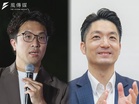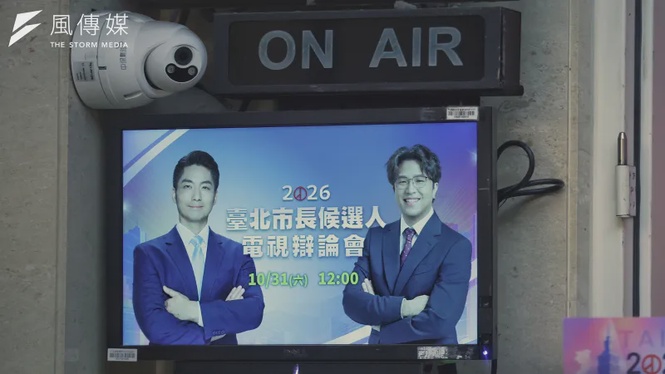
Taipei Mayor Chiang Wan-an of the opposition Kuomintang (KMT) and his challenger, Puma Shen of the ruling Democratic Progressive Party (DPP), faced off on October 31 in the only scheduled televised debate of the Taipei mayoral race, one of the most closely watched contests of the 2026 Taiwan local elections on November 28.
The debate, held at noon at the TVBS building and co hosted by TVBS and SET, showed two very different strategies. Chiang, seeking a second term, built his case on data and achievements from his four years in office and repeatedly pointed to Shen's past remarks to question his consistency. Shen kept returning to what he would do in his "first 100 days," pressing the city government on procedures and implementation details. Their clashes ranged from urban renewal, school lunches, street trees and childcare staffing to how a mayor should run city hall, and national issues such as the Taipei Shanghai Twin City Forum and the law governing how tax revenue is shared between central and local governments.
Shen, who by draw gave both the opening and closing statements, began by thanking Chiang for agreeing to debate and wishing him a quick recovery from a recent illness. On the 171st day of his campaign, he said, the debate was not about winning or losing but about showing voters each candidate's positions and values.
Chiang stressed that he "delivers on his promises," listing the completion of the Taipei Dome, Nvidia's decision to locate its overseas headquarters at the Beitou Shilin Technology Park, free fresh milk for students and free first 30 minutes on YouBike rental bikes. He cited the demolition of the Gongguan traffic circle, finished in 17 days instead of the planned 65, with traffic accidents down 52%. He accused Shen of offering empty slogans without plans. Responding to jibes that his record amounts to "Nvidia, the Dome and milk," he said: "I'm not angry. Actually, I'm a little proud!"
Urban Renewal: More Projects Or Stalled Projects?
On urban renewal, Chiang presented the city's "7599 project," under which the city steps in to help with cost estimates once 75% of residents agree, lowering the threshold for government led redevelopment. He said the number of urban renewal cases during his term was 2.4 times higher than before, with long stalled projects such as Xinwei public housing and Nanjichang making progress.
Shen took a different angle, noting that more than 70 approved urban renewal projects in Taipei had not broken ground after more than five years. He proposed a "support mechanism," including an old homes service team, a 20% increase in the public housing fund with more staff, a single service window and public disclosure of building earthquake safety data, so that these "zombie" projects could be cleared out.
In cross examination, Chiang cited cases in Datong and Neihu and asked whether Shen understood why urban renewal was so hard to push forward. Shen replied that one should look not only at applications and approvals but at actual construction and completion. Chiang accused him of giving irrelevant answers, noting that one project had already signed developers and that some old homes in Neihu face height limits because of Songshan Airport. Shen countered that those limits are exactly why the city should explain them to residents early on.
After the debate, Shen's talk of "support" drew criticism. He wrote on Facebook that his opponents had taken him out of context, arguing that projects stall for many reasons, from resident consensus and review delays to developer finances, construction costs and resettlement, and that the city needs solutions for each.
School Lunches: Quality After Making Them Free
After Taipei made school lunches free, whether quality could be maintained became a flashpoint. Chiang said free does not mean lower quality, noting that the city kept its procurement process, that a lunch committee oversees quality and that Taipei offers the highest subsidy in Taiwan, which even DPP Tainan Mayor Huang Wei-che had followed. He also highlighted a program that lets students redeem fresh milk at convenience stores with digital student cards, saying the city stepped in because a central government milk program fell short.
Shen was not convinced, saying that even after extra funding, tenders for school lunches repeatedly failed before the semester began, leaving some schools close to running out of meals. He said redemption rates for the milk program had been falling, especially among disadvantaged students. He promised to pass a city ordinance within his first 100 days so lunch budgets rise with prices, and to scrap the weighing of food waste that burdens teachers.
The exchange grew heated. Chiang accused Shen of opposing free lunches for electoral reasons and of claiming a mass food poisoning at Jinhua Junior High School and other schools, although later inspections found no problems. "How many students, children, parents, schools and teachers did you hurt? You won't even apologize," Chiang said. He also noted that Shen had misstated the name of Taiwan's food safety certification labels. Shen said no one opposed free lunches and that the goal was a good system to maintain quality, adding that he had only called for quick testing and never said there was food poisoning.
Street Trees: A Wrongly Felled Tree Resurfaces
The loss of trees in Taipei also came up. Shen pledged that his first act as mayor would be to plant trees, backed by a dedicated agency, law, budget and expertise, to restore public trust. He asked what had gone wrong in the city's procedures when a Bischofia tree at Dongmen Market was mistakenly cut down.
Chiang did not answer directly at first, accusing Shen of spreading false claims and saying the city had already clarified the matter. Shen said he had cited Academia Sinica data on tree cover in Songshan District and never claimed the city cut the trees, noting the losses could be due to private or construction work. Chiang replied that lost tree cover is mostly on private development sites, centrally managed land and university campuses, and that the city had planted 42,250 trees in four years, with 40,000 more planned. Only in his closing remarks did Chiang say the city had severely disciplined the parks department chief and the contractor over the Dongmen Market tree.
Childcare: Where Will The Staff Come From?
On childcare, Chiang went on the offensive. He noted that the city had doubled the birth subsidy for a first child from NT$20,000 to NT$40,000 and launched a free ride service for pregnant women. He questioned Shen's plan for four hours a week of free temporary childcare for children up to age 6, saying the city would be four times short of staff even if every licensed nanny took part, and that Shen's plan for two homeroom teachers per class faced similar shortages.
Shen said the temporary care plan would start with children up to 2 years old and then expand facilities and training step by step. The two teacher model, he said, was based on a school in New Taipei and would be piloted in Taipei first to ease pressure on frontline teachers.
How A Mayor Should Lead City Hall
Shen used meeting attendance records to attack Chiang's leadership, saying the mayor had skipped the childcare management committee, attended fewer than 10% of meetings on drug prevention and child welfare, and missed all 18 interagency meetings on making Taipei smoke free. He accused Chiang of not mastering procedures, saying the smoke free policy launched before assessments were complete, leaving civil servants to count cigarette butts, and that the budget for a shade umbrella program jumped from NT$14 million to more than NT$50 million in its final three months.
Chiang said city government works through delegation and teamwork, with special meetings convened for major incidents. He personally chaired four meetings on the death of a toddler in foster care known as the Kai Kai case, and he presides over the city's public security, traffic safety and public safety meetings. A mayor should set the overall direction, he said, and it is unrealistic to dwell on attendance at every working meeting.
"Who Said This?": A Barrage Over Past Remarks
The most politically charged moment came when Chiang repeatedly asked "Who said this?" about a series of past remarks, including that the Twin City Forum was "a breach for infiltration," that a NT$10,000 universal cash handout was the Communist Party's way of "impoverishing Taiwan and then unifying it," that TSMC could not have expanded globally without the "Bluebird" protest movement, and that Taipei should one day hold an independence referendum. He argued that Shen's past views did not match his current image. He also said Shen once called the revised revenue sharing law a way to "impoverish Taiwan," yet many of his policies now depend on the extra revenue it brings.
Shen said Chiang seemed very interested in his past, digging up posts from 10 or 15 years ago that would take half an hour to explain, and that apart from the Twin City Forum they were almost all national issues. "If Chiang is that interested, maybe he should go back to being a legislator and let me be Taipei mayor. That might be faster," he said.
On the Twin City Forum, Shen said that given Chinese military aircraft harassing Taiwan, the forum should be reconsidered, and revealed that the "breach" remark had in fact been made by Chiang himself in 2022. Cities can still have exchanges, he said, but after Chiang's last trip to the forum Taiwan faced large scale Chinese military drills. "This is not about whether it is a breach. This is national security," he said. On the revenue sharing law, Shen said his article had not linked the revision to China but argued that relying on borrowing was wrong and that responsibilities should be transferred along with revenue, which is why his policies use the funds mainly for capital spending rather than hiring.
What Each Would Do First
Looking ahead, Chiang listed his achievements, from the Taipei Dome and Nvidia to doubled birth subsidies and free school lunches. In a second term, he said, he would push to relocate Songshan Airport, build an AI park and continue the Wanda MRT line, self driving buses and a points system on seniors' transit cards.
Shen repeated his three priorities for his first 100 days: planting trees, tackling child abuse and backing frontline social workers, and improving school lunches. He also proposed easing pressure on civil servants, using AI to analyze complaints to the city's 1999 hotline and holding a "city debugging hackathon" to gather public input. With just over 20 days left in the campaign, he said his team would keep releasing policies until the last day.
Closing Statements: Packaging Versus Substance
Chiang framed the election as "a choice between packaging and substance." Nvidia, milk and the Taipei Dome were achievements he earned step by step, he said, accusing Shen of relying on promotion from the presidential office, cabinet and ruling party. "I may not be the best speaker, but I am genuine," he said in Taiwanese. He thanked past mayors of all parties, including Huang Ta-chou, Chen Shui-bian, Ma Ying-jeou and Hau Lung-bin, and singled out former Mayor Ko Wen-je, founder of the Taiwan People's Party, for laying the groundwork for the Taipei Dome, social housing and the technology park. He said Ko's emphasis on fiscal discipline had guided his own term, during which the city cut its debt by more than NT$40 billion.
Shen responded that Chiang had spent much of his closing time on data and experience, but that those numbers were like the reading on a thermometer, not the temperature people actually feel. On urban renewal, he said, many residents are still waiting. "You keep rushing to say Chiang Wan-an did nothing wrong, but I want to tell you what Puma Shen would do," he said. He stressed that he was running a positive campaign, with no negative attacks and no talk of family, and wanted residents to be the stars of the city.
After the debate, Shen said voters would judge the performance, but regretted that his opponent kept attaching negative labels to him and did not directly answer his questions on procedures and attendance. He confirmed that during a commercial break he had gone over to check on Chiang's health and again suggested exchanging LINE contacts, but Chiang politely declined, saying they had many friends in common. Asked about Chiang thanking Ko Wen-je, Shen said his campaign does not divide people by party and that he wants to win over voters no matter whom they supported before.
Where The Race Stands
The debate comes as the race tightens. A poll released on October 20 by the Xinmin Cross-Strait Research Association put Shen at 50.3% and Chiang at 33.3%, though other surveys have shown a closer contest.