Chinese leader Xi Jinping has stopped naming US arms sales to Taiwan in Beijing's public accounts of his talks with President Donald Trump, a shift that points to a quiet understanding to delay new weapons deals, a Taiwanese scholar said on November 23. But a new Democratic-controlled Congress could drag the issue back into the open in 2027, the year Xi least wants a fight.
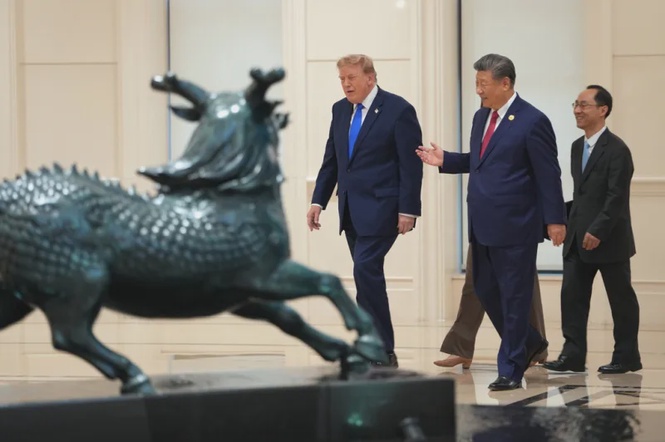
Ma Chun-wei, an assistant professor at Tamkang University's Graduate Institute of International Affairs and Strategic Studies, made the case at a seminar in Taiwan on US-China competition after the Asia-Pacific Economic Cooperation (APEC) summit. Xi and Trump met on November 19 on the sidelines of APEC in the southern Chinese city of Shenzhen, their third face-to-face meeting this year.
Two Words Vanished From Beijing's Readouts
In February, Beijing was blunt. During a February 4 phone call, Xi told Trump that "the U.S. must handle the issue of arms sales to Taiwan with prudence," according to the Chinese Foreign Ministry's readout.
By the time the two leaders met in person, the words "arms sales" were gone. At their Beijing summit on May 14, Xi warned that Washington "must exercise extra caution in handling the Taiwan question," the ministry said. In Washington on September 24, he asked the US to oppose Taiwan independence and "handle the Taiwan question with caution," according to the Chinese readout. In Shenzhen, Xi said only that the US "should keep doing the right thing" on Taiwan, the ministry reported.
Ma said the change from "handle arms sales to Taiwan with prudence" to "handle the Taiwan question" suggests that Washington and Beijing may have reached some backroom understanding on postponing arms sales to Taiwan.
| US-CHINA RELATIONS | TAIWAN ARMS SALESHow Xi Talked to Trump About Arms Sales to TaiwanFebruary to November 2026 | Four Key Exchanges | |
| Xi and Trump have spoken repeatedly this year, from a February phone call to three formal summits. Beijing's public records describe US arms sales to Taiwan differently each time.The question: did Xi explicitly tell Washington to be careful with arms sales to Taiwan? | |
| FEB 04FebruaryPhone CallNamed Directly | Xi: The US must handle arms sales to Taiwan with prudence"The Taiwan question is the most important issue in China-U.S. relations... The U.S. must handle the issue of arms sales to Taiwan with prudence."Official readout: names US arms sales to Taiwan directly.Source: Chinese Foreign Ministry readout of the February 4, 2026 call |
| MAY 14MayBeijing SummitRevealed Afterward | Xi: Taiwan is the most important issue in China-US relationsThe readout urged extra caution on the Taiwan question but did not mention arms sales.Trump said afterward: the two leaders did discuss arms sales to Taiwan.Trump said Xi felt very strongly about Taiwan, but that he made Xi no commitment on arms sales.Sources: Chinese Foreign Ministry, Trump's remarks to reporters, CNA |
| SEP 24SeptemberWashington SummitNot Named | Xi: The US should oppose Taiwan independenceXi asked Washington to adhere to opposing Taiwan independence and to handle the Taiwan question with caution.Official readout: no direct mention of US arms sales to Taiwan.Note: Before the summit, Reuters reported that Xi was expected to press Trump to halt arms sales to Taiwan. |
| NOV 19NovemberShenzhen SummitNot Named | Xi: The US should keep doing "the right thing""On the question of Taiwan, the U.S. side should keep doing the right thing and avoid major setbacks in China-U.S. relations."Official readout: no direct mention of US arms sales to Taiwan.Source: Chinese Foreign Ministry readout of the November 19, 2026 meeting |
| Four Exchanges at a GlanceFebruary: Xi names arms sales to Taiwan directly. May: Trump confirms afterward that arms sales were discussed. September: The readout does not mention arms sales. November: The readout does not mention arms sales.Xi's direct references to arms sales have faded from Beijing's public summit records.Note: A topic left out of a readout may still have been discussed behind closed doors. | |
Trump has confirmed the subject did come up in private. After the Beijing summit, he told reporters that he and Xi "talked a lot about Taiwan" and that "Taiwan, he feels very strongly. I made no commitment," the Washington Examiner reported. Days before that trip, his administration had paused a roughly $14 billion arms package for Taiwan, The Star reported, and Trump later called the sale "a very good negotiating chip," according to The Boston Globe.
US-China Calm Hangs on Two Men
Ma argued that the relationship now depends almost entirely on Trump and Xi personally. Both leaders, he said, leave their officials too afraid to act, because any misstep can be punished, so bureaucrats on each side have little room to talk to each other on their own. Any improvement in ties hinges on how the two men get along.
That made 2026 an unusual year. The two leaders met in Beijing, Washington, and Shenzhen, and a fourth meeting is expected at the Group of 20 (G20) summit in Miami on December 14 and 15. In 2027, Ma noted, there is no obvious venue for them to meet between January and November. Without that top-level channel, he warned, the many frictions between Washington and Beijing carry real risk. "2027 is the year we need to watch," he said.

A Democratic Congress Wants to Move Faster
The wild card is Capitol Hill. Democrats won control of both chambers in the 2026 US midterm elections, and the new Congress takes office in January, Storm Media reported. Ma said lawmakers from both parties now intend to push the executive branch to move ahead with arms sales to Taiwan.
Congress, however, is slow. Ma pointed to past pro-Taiwan laws: the Taiwan Travel Act took 411 days to pass, the Taipei Act 293 days, and the Taiwan Assurance Act 270 days. From the moment a committee starts drafting a bill that orders the administration to act, he said, it typically takes 10 to 14 months to clear both the House and the Senate. That means a congressionally forced arms sale could not be locked in until the end of 2027 at the earliest.
Xi's Party Congress Is the Red Line
That timeline matters because of China's own calendar. The Chinese Communist Party holds its 21st National Congress in the fall of 2027, a once-every-five-years meeting that sets the party's top leadership and is central to Xi's political plans.
Ma said his guess is that Washington and Beijing share a tacit understanding that any new arms sale must not land before that congress. "If the US insists on poking this hornet's nest, for Xi Jinping it would mean a rupture, a falling-out," he said. "The constructive strategic stability relationship you built up before would collapse completely."
He was referring to the "constructive China-U.S. relationship of strategic stability" that Xi says the two leaders agreed to build in May, according to the Chinese readout of the September summit.
Arms Will Still Flow, Just Later
Ma does not expect Washington to stop arming Taiwan. "The US will still sell weapons to Taiwan, but it can choose the timing," he said. Even with pressure from Congress, he added, the sales will basically continue, though they may be delayed.
For Taiwan, that points to a familiar trade-off: the weapons are likely to keep coming, but their schedule may be set as much by Xi's political calendar as by Taiwan's defense needs.