.png)
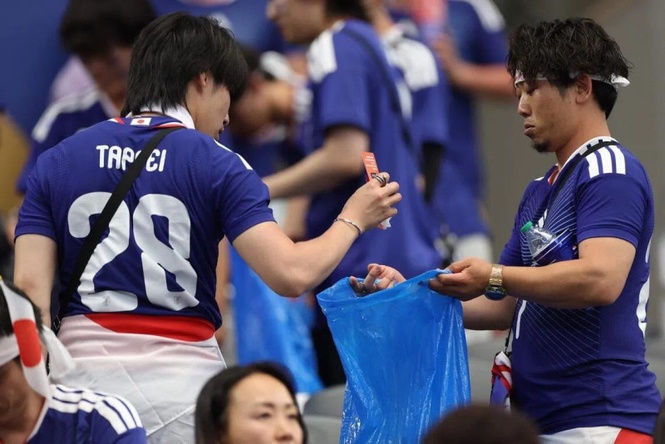
JAPANESE football supporters have once again captured international attention for cleaning up their section of a stadium following their national team's World Cup match against the Netherlands on 14 June, but the widely praised display of civic responsibility has also triggered renewed scrutiny of gender roles within Japanese society.
A viral social media meme has shifted the focus from the stadium to the home, questioning why many Japanese men are celebrated for public acts of cleanliness while contributing comparatively little to unpaid domestic work.
The image, which has been shared widely on social media platform X and reposted more than 13,000 times, parodies Tokyo Metro's well-known etiquette campaign.
It juxtaposes a photograph of a Japanese football supporter tidying the stadium with an illustration of a woman washing dishes at home while a man wearing the national team's Samurai Blue jersey relaxes on a sofa behind her.
The accompanying caption reads: "Please do it at home."
Bloomberg reported that the meme resonated with many users because it highlights a longstanding social issue in Japan, where women continue to shoulder the overwhelming majority of unpaid household responsibilities despite increasing participation in the workforce.
According to data from the Organisation for Economic Co-operation and Development (OECD), Japanese men perform among the lowest levels of unpaid domestic labour—including housework, shopping and childcare—across the organisation's member countries.
Although participation by men has gradually increased over recent years, a Japanese government survey conducted in 2021 found that men spent an average of just 51 minutes a day on unpaid household work, compared with three hours and 24 minutes for women.
The online discussion also broadened beyond gender roles, with some social media users arguing that the popular perception of Japanese public cleanliness is not always reflected domestically.
Several commentators noted that litter is often visible on streets after large public gatherings and weekend events, as well as in less-frequented areas, suggesting that exemplary behaviour displayed overseas does not always extend to everyday life within Japan.
The viral image itself draws inspiration from Tokyo Metro's famous yellow-and-black etiquette posters, created by artist Bunpei Yorifuji. The long-running campaign humorously encourages commuters to avoid inconsiderate behaviour such as applying make-up, making telephone calls or playing loud music while travelling on trains.
While Japanese football supporters continue to receive worldwide admiration for voluntarily cleaning stadiums after international matches, the latest viral debate suggests that many at home believe the same spirit of shared responsibility should extend beyond public spaces and into everyday family life. - June 18, 2026