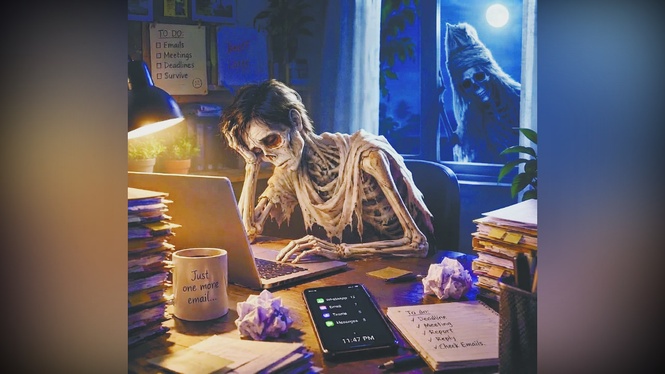
Hantu jerangkong had it easy. Modern workers have deadlines
IF you were a ghost in 19th-century Malaya, life was simple. You die, get hit with some sketchy black magic that nobody had bothered to read the terms and conditions for, and boom – you were a hantu jerangkong (skeletal ghost).
Job description: float around as a glowing skeleton, rattle your vertebrae outside a kampung house at 2am and generally make sure nobody got a good night’s sleep.
There were no performance reviews. No key performance indicators, no Zoom calls. No “quick” meetings that somehow lasted 90 minutes. Lucky jerangkong.
People respected the hustle. Villagers would shriek, throw salt and write folk songs about you. You were a legend.
Fast-forward to 2026 and frankly, being a skeletal spirit in the modern era is an absolute logistical nightmare.
Why? Because these days, you don’t have to die to become one. You just have to be tired enough.
The hantu jerangkong is one of those wonderfully macabre creatures in Malay folklore that sounds terrifying until you stop and think about what it actually is – a skeleton, stripped of everything except the bones.
Which, if you have spent the last few weeks surviving on coffee, deadlines and the vague promise that things will calm down “after this week”, may sound less like supernatural folklore and more like a fairly accurate description of your current condition. We may not glow in the dark. But some mornings, we certainly feel like we could rattle.
The jerangkong, in traditional tales, is associated with death, wandering and the consequences of dark practices. It is a creature that has been reduced to its most basic physical remains.
Humans have invented a modern version. We call it burnout. The difference is that the jerangkong is dead and knows it.
We are alive and have another deadline at 5pm. That may actually be worse.
There is something oddly democratic about exhaustion. It does not care whether you are a CEO, journalist, teacher, hawker, parent or the person who keeps saying: “I’m fine”, while staring blankly into a third cup of coffee.
Almost everybody has days when the body is present but the rest of us are somewhere else. You get up. You go to work. You answer messages. You attend meetings. You nod at things. You say: “Sure, no problem”. Inside, however, there is a small, extremely tired skeleton lying flat on the floor. And it has had enough.
Perhaps that is why the hantu jerangkong feels oddly contemporary. We live in an age that has made exhaustion almost aspirational.
Being busy is a status symbol. Being tired is evidence that we are productive. Saying “I’m swamped” can sound suspiciously like a humblebrag. We wear our lack of sleep like a badge.
“How many hours did you get?” “Four.”
“Luxury. I got three.”
And somewhere, presumably, a jerangkong is rattling its bones and thinking: Amateurs!
Our ancestors at least had the decency to put their supernatural creatures to work at night. We have created a world in which humans are expected to be permanently available.
Messages arrive at midnight. Emails wait impatiently. Phones buzz. Notifications multiply.
Even our holidays come with photographs, itineraries and the occasional work WhatsApp message beginning with the deceptively innocent words: “Sorry to disturb you …”
The jerangkong had one job: haunt people. We have somehow managed to become the haunted ones.
Haunted by deadlines, bills, unfinished work and the nagging feeling that we should be doing something else even when we are doing nothing.
Perhaps there is another lesson buried beneath all those rattling bones. A skeleton is what remains when everything unnecessary has fallen away.
Exhaustion does something similar to us. When we are stretched too thin for too long, the extras disappear first – patience, humour, curiosity, enthusiasm. Next, sleep. Then the ability to remember why we walked into a room.
Eventually, we become the human equivalent of a jerangkong: still moving, functioning and getting things done, but with very little left in the tank.
The irony is that the folklore creature is supposed to frighten us. But perhaps the modern jerangkong should be a warning.
Not that ghosts will come for us, but that we might work ourselves into something resembling one.
So perhaps, every now and then, we should do something profoundly unproductive.
Stare out of a window. Sit under a tree. Say no. Leave something unfinished. Let the world wait.
The hantu jerangkong had no choice but to wander endlessly through the night. We do. That’s the difference between being a ghost and being human.
A ghost gets no rest. A human is supposed to.
The next time you hear a strange rattling sound outside at 2am, grab a blanket. Make coffee, masala tea or some other comfort beverage – but leave the phone.
Because probably it isn’t the hantu jerangkong. It’s just someone who forgot what rest feels like.
Go to bed. Sleep. Tomorrow is another day.
Editor’s Note:
The views and experiences shared by contributors are their own and do not necessarily reflect those of theSun.
Stories involving the paranormal, folklore and unexplained phenomena are published for readers’ interest, and are not presented as verified fact. Have a ghost story or paranormal experience? We’d love to hear it. Email us at booandbeyond.thesun@gmail.com. Selected stories may be featured in Boo! and Beyond.