

Watershed Moment for Nuclear Power
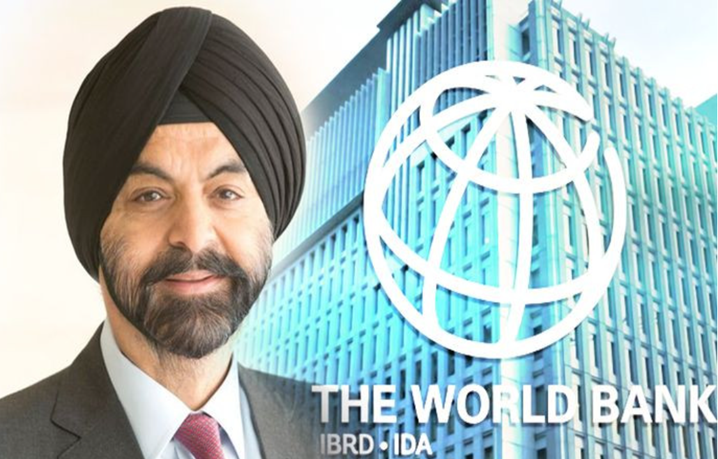
10 June 2025 had ushered in a watershed moment for nuclear power, when at the Board Meeting of The World Bank, after its President Ajay Banga ( Fig 1) had presented an Energy proposal to the Board, the Board members agreed to lift the bank’s decade-long ban on financing nuclear power.
Fig 1: Ajay Banga , President The World Bank
Reuters had reported on 12 June 2025 that Banga has championed a shift in the bank’s energy policy since taking office in 2023, advocated that The Bank should pursue an “ all of the above approach” to help countries meet rising energy needs and advance developmental goals. ( https://www.reuters.com/sustainability/climate-energy/world-bank-end-ban-nuclear-energy-projects-still-debating-upstream-gas-2025-06-11/#:~:text=WASHINGTON%2C%20June%2011%20(Reuters),Ajay%20Banga%20said%20on%20Wednesday.)
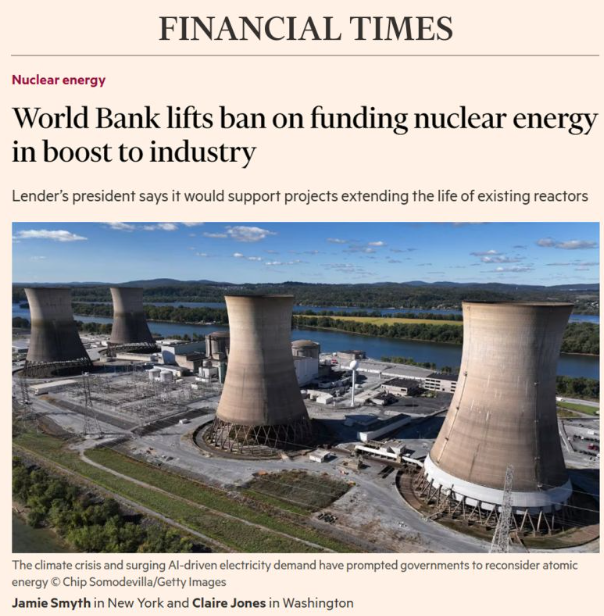
FT had reported that the World Bank is lifting its decades-long ban on financing nuclear energy, in a policy shift aimed at accelerating development of low emissions technology to meet surging electricity demands (Fig 2)
Fig 2: Report on Financial Times on The World Bank lifts ban on funding nuclear energy in boost to industry
The World Bank – A Brief Overview
In July 1944 – one year before the end of World War II – delegates from 44 countries met for the United Nations Monetary and Financial Conference held at the Mount Washington Hotel in Bretton Woods, New Hampshire. The conference aimed to create the framework for post-war international economic cooperation and reconstruction. The intellectual leaders at the conference were John Maynard Keynes (Adviser to the Treasury in the United Kingdom), and Harry Dexter White (Assistant Secretary of the Treasury in the United States). (https://www.worldbank.org/en/archive/history#:~:text=JULY%201944%20BRETTON%20WOODS%20CONFERENCE&text=While%20the%20conference%20resulted%20in,was%20not%20the%20primary%20focus.)
The Bretton Woods Agreement created a collective international monetary system, the IBRD ( The World Bank), and the International Monetary Fund (IMF) (https://www.investopedia.com/terms/w/worldbank.asp)
International Bank for Reconstruction and Development (IBRD) was established in 1944 to help rebuild Europe and Japan after World War II. When it first began operations in 1946, it had 38 members. Today, most of the countries in the world are members. (https://www.worldbank.org/en/news/feature/2012/07/26/getting_to_know_theworldbank#:~:text=The%20World%20Bank%20was%20established%20in%201944)
The IBDR better known as The World Bank , headquartered in Washington, D.C. finances projects that enhance the economic development of member states. and is the largest source of financial assistance to developing countries. (https://www.britannica.com/topic/World-Bank)
The World Bank, an international organization dedicated to providing financing, advice, and research to developing nations to aid their economic advancement. The World Bank supplies qualifying governments with low-interest loans, zero-interest credits, and grants to support the development of individual economies. Debt borrowings and cash infusions help with global education, healthcare, public administration, infrastructure, and private-sector development. (https://www.investopedia.com/terms/w/worldbank.asp)
The World Bank's only loan for new nuclear capacity was USD40 million in 1959 for Italy's first nuclear power plant
The Report and Recommendations of the President to the Executive Directors on a Proposed Loan of USD$ 40 million to the Cassa for the Construction of a Nuclear Power Plant in Southern Italy dated September 4, 1959 ( Fig 3) had outlined that the Bank has been actively considering the application of nuclear power on a commercial scale since 1955. ( Fig 3) [chrome-extension://efaidnbmnnnibpcajpcglclefindmkaj/https://documents1.worldbank.org/curated/en/698201468285875405/pdf/Italy-Senn-Nuclear-Power-Plant-Project.pdf]
Fig 3: The Report and Recommendations of the President to the Executive Directors on a Proposed Loan of USD$ 40 million to the Cassa for the Construction of a Nuclear Power Plant in Southern Italy dated September 4, 1959

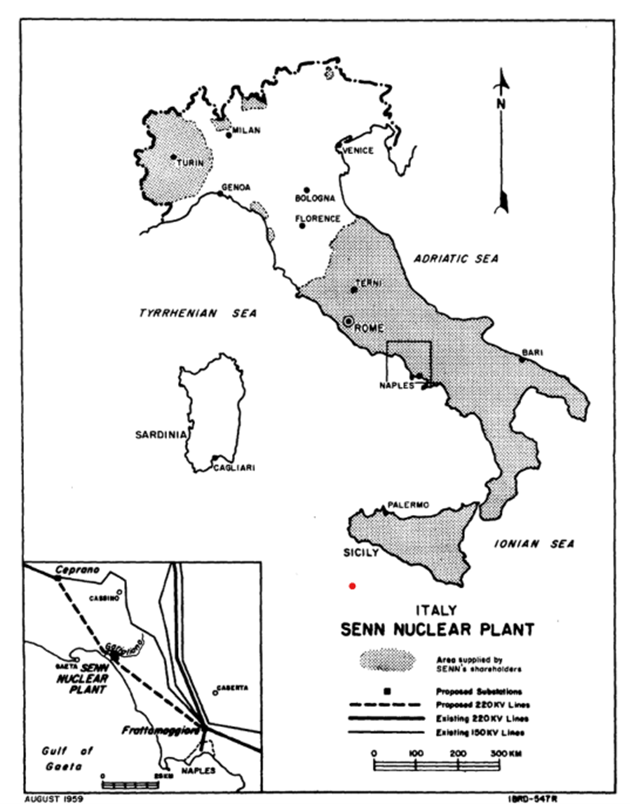
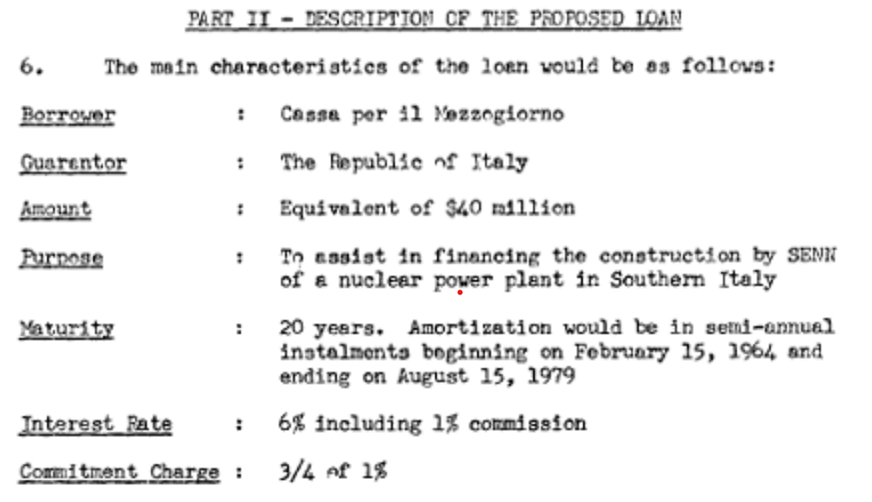
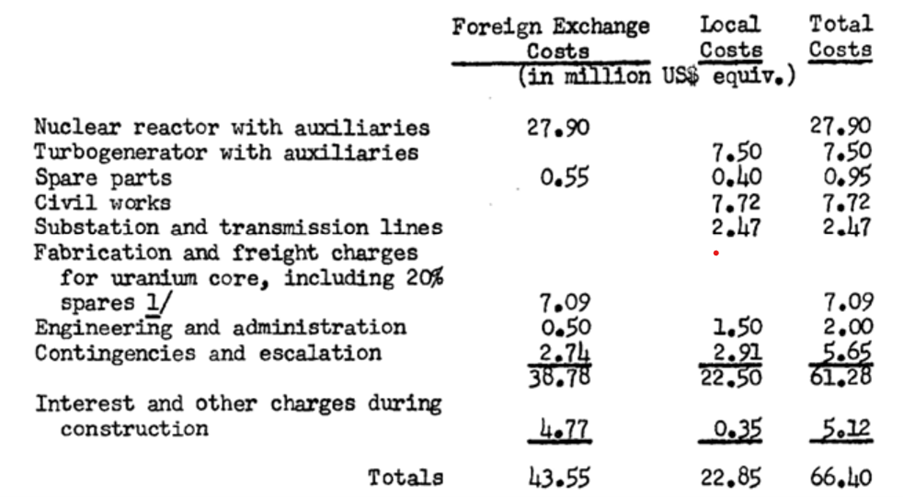
The World Bank’s ( International Bank for Reconstruction and Development) Appraisal of Italy’s First Nuclear Power Plant-SENN NPP dated 4 September 1959[chrome-extension://efaidnbmnnnibpcajpcglclefindmkaj/https://documents1.worldbank.org/curated/en/377991468262473745/pdf/Italy-Senn-Nuclear-Power-Plant-Project.pdf] ( Fig 4) had highlighted that the Italian Government has asked the Bank for a loan in connection with the construction of a 160 MW nuclear power plant to be located on the Garigliano River about midway between Room and Naples (Fig 5) and 100 kilometers of transmission lines connecting the plant with existing substations. . The proposed loan of USD$ 40 million ( Fig 6) equivalent would cover 60% of the total estimated cost of USD$ 66.4 million equivalent ( Fig 7). The Loan covers a term of 20 years with a grace period of 4-1/2 years
Fig 4: The World Bank’s ( International Bank for Reconstruction and Development) Appraisal of Italy’s First Nuclear Power Plant-SENN NPP
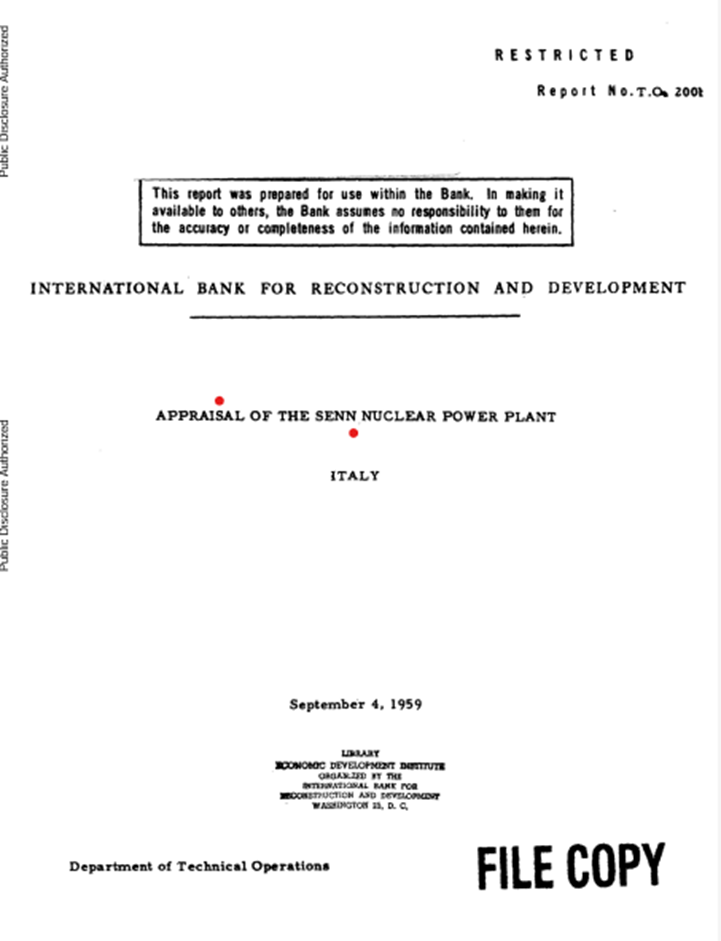
Fig 5: Location of Italy’s first nuclear power plant in Garigliano River between Rome and Naples
The borrower of the Loan will be Cassa per iL Mezzogiorno ( or Cassa) (Fig 6) which would re-lend the proceeds of the proposed loan to Societa Elettronucleare Nazionale (SENN) which was established in March 22, 1957. SENN, which is largely owned by a group of public utility companies would build , own and operate the project. In 1958 these companies accounted for about 36% of total electric energy requirements in Italy ( Fig 7) (Source: chrome-extension://efaidnbmnnnibpcajpcglclefindmkaj/https://documents1.worldbank.org/curated/en/377991468262473745/pdf/Italy-Senn-Nuclear-Power-Plant-Project.pdf)
Fig 6: Description of the Proposed Loan of USD$ 40 million for Italy’s SENN Nuclear Power Plant
As the total cost of the plant is estimated to be $66.4 million. ( Fig 7) SENN plans to raise the remaining amount equivalent of about $26.4 million in about equal proportions by the issue of shares and by shareholders' advances, subordinated to its loan from the Cassa per il Mezzogiorno (chrome-extension://efaidnbmnnnibpcajpcglclefindmkaj/https://documents1.worldbank.org/curated/en/698201468285875405/pdf/Italy-Senn-Nuclear-Power-Plant-Project.pdf)
Fig 7: Estimation of the Cost of the Project
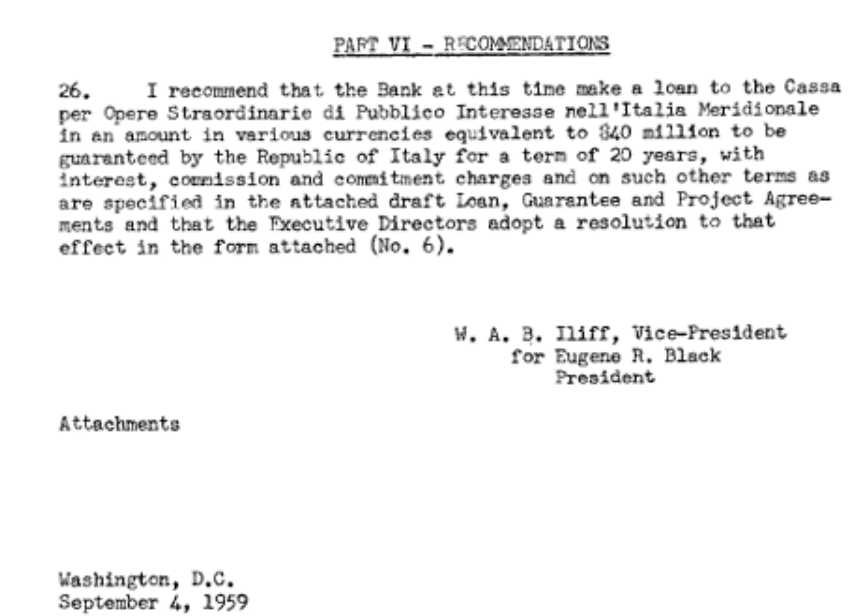
Recommendations to provide the loan for Italy’s First Nuclear Power Plant (Source: chrome-extension://efaidnbmnnnibpcajpcglclefindmkaj/https://documents1.worldbank.org/curated/en/698201468285875405/pdf/Italy-Senn-Nuclear-Power-Plant-Project.pdf)
The Report and Recommendations of the President to the Executive Directors on a Proposed Loan of USD$ 40 million to the Cassa for the Construction of a Nuclear Power Plant in Southern Italy dated September 4, 1959 had underscored that W.A.B Jliff Vice President of the Bank had recommended on behalf of Eugene R Black the President of the Bank to approve the $40 million loan requested by the Government of Italy ( Fig 8)
Fig 8: Recommendation of The Bank to approve the loan requested to build Italy’s first nuclear power plant
International Tenders
An invitation to bid was sent in October 1957, to seventeen firms which had indicated interest in tendering for the project. The firms included eight American, five British, two French, one Canadian and one Belgian-American. Fifteen firms confirmed in December 1957 their intention to submit bids.
Concurrently with the preparation of the invitation to bid, work proceeded on the selection of a site for the nuclear plant, to determine the gological, hydrological, seismological and meteorological conditions. The services of Italian and foretgrfcnsultants were retained to assist in this work. As a result of these investigations, SENN prepared a detailed report on site selection in January 1958, and forwarded it to the bidders.
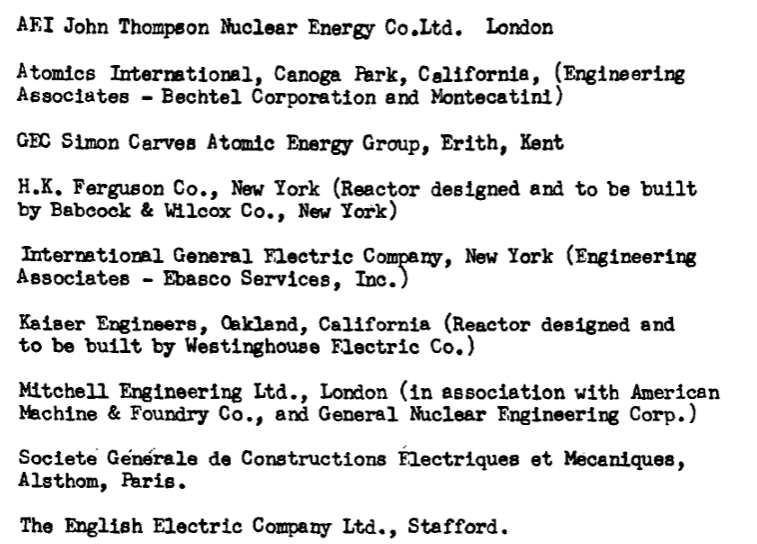
By April, 1958, the final closing date, the following nine companies or groups of companies had submitted tenders to SENN (Fig 9)
Fig 9: Nine Companies had submitted tenders to Italy's SENN NPP
Review of the Tenders
The Working Group of Project ENSI examined all tenders, prepared an estimate of the civil works cost of each and made a technical tabulation of each proposal. Under agreements between the Bank and United Kingdom Atomic Energy Authority (UKAFA) and United States Atomic Energy Commission (USAEC) the technical aspects of the tenders for gas-cooled graphite-moderated natural uranium reactors were reviewed by the Industrial Group of UKAEA and, concurrently, the tenders for enriched uranium systems, i.e., pressurized water, boi3ing water and organic-moderated reactors, were reviewed by Argonne National Laboratory of MSAED.
Selection of the Tender
On the basis of all information available to it, SENN selected the tender of International General Electric Company , U.S.A., a division of the General Electric Company.
The World Bank ban on Nuclear Power
Nuclear Engineering International (NEI) had reported on 18 June 2025 that the 2011 Fukushima Daiichi accident resulted in the World Bank imposing a de facto ban on nuclear funding and this was then formalised in 2013. (https://www.neimagazine.com/news/world-bank-lifts-nuclear-funding-ban/)
American Nuclear Society highlighted that the bank's formal ban on nuclear funding was not put in place until 2013. (https://www.ans.org/news/article-7111/world-bank-to-fund-smrs-and-nuclear-life extensions/#:~:text=The%20last%20time%20the%20World,put%20in%20place%20until%202013.)
World Bank’s Rationale for Change on Financing Nuclear Power (https://www.world-nuclear-news.org/articles/world-bank-agrees-to-end-ban-on-funding-nuclear-energy)
World Nuclear News (WNN) had reported on 12 June 2025 that Ajay banga had set out the rationale for change, saying that "electricity is a fundamental human right and the foundation of development and further articulated that “goal is to give countries the flexibility to choose how to deliver the reliable energy needed to meet their development goals, especially with electricity demand in developing countries expected to more than double by 2035, which the World Bank thinks will require "investment in generation, grids, and storage to rise from USD280 billion today to roughly USD630 billion". (https://www.world-nuclear-news.org/articles/world-bank-agrees-to-end-ban-on-funding-nuclear-energy)
In an email to its staff, seen by WNN, Ajay Banga had underscored that "what’s new is that, for the first time in decades, the World Bank Group will begin to reenter the nuclear energy space". Working in partnership with the International Atomic Energy Agency (IAEA) and other partners "we will support efforts to extend the life of existing reactors in countries that already have them, and help support grid upgrades and related infrastructure. We will also work to accelerate the potential of Small Modular Reactors (SMRs) - so they can become a viable option for more countries over time".
Energy Transition (https://ourworldindata.org/nuclear-energy)
Our World in Data had dovetailed that as the world attempts to transition its energy systems away from fossil fuels towards low-carbon energy sources, we have a range of energy options: renewable energy technologies such as hydropower, wind, and solar, as well as nuclear power. Nuclear energy and renewable technologies typically emit very little CO2 per unit of energy production and are also much better than fossil fuels at limiting local air pollution.
However, while some countries invest heavily in increasing their nuclear energy supply, others are shutting down their plants. Therefore, nuclear energy's role in the energy system is very specific to each country.
Nuclear Power Plants help avoid 70 Gigatonnes of CO2 in the past 5 decades since the 1970s: August 2023 (https://www.sciencedirect.com/science/article/abs/pii/S014919702300207X)
The Role of Energy in Carbon Neutrality Goal in the Progress in Nuclear Energy Vol: 162 publication of Elsevier had outlined that The IAEA estimated that over 70 gigatonnes (Gt) of carbon dioxide (CO2) have been cumulatively prevented from being emitted in the past 50 years, contributed by the nuclear power plants. (Fig 10)
Fig 10: Carbon Dioxide Avoided by Nuclear Power since the 1970s
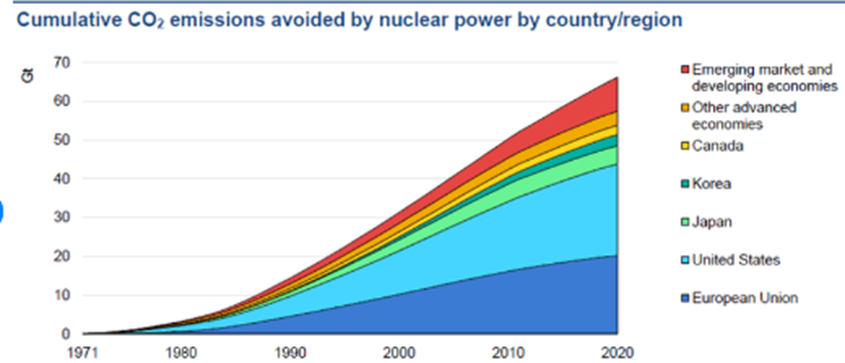
The existing nuclear power reactors continue reducing more than 1 Gt CO2 emission yearly
Because of the low carbon emission advantages, countries like China, the United States of America (USA), Canada, Russia, and many other countries consider nuclear energy as an essential part of their efforts to achieve the carbon-neutral goal
To continue reading, check out: Part 2, Part 3, Part 4, Part 5, Part 6
Sheriffah Dato Syed (sheriffahkhamseah@gmail.com) is a content creator under the Newswav Creator programme, where you get to express yourself, be a citizen journalist, and at the same time monetize your content & reach millions of users on Newswav. Log in to creator.newswav.com and become a Newswav Creator now!
The User Content (as defined on Newswav Terms of Use) above including the views expressed and media (pictures, videos, citations etc) were submitted & posted by the author. Newswav is solely an aggregation platform that hosts the User Content. If you have any questions about the content, copyright or other issues of the work, please contact creator@newswav.com.

