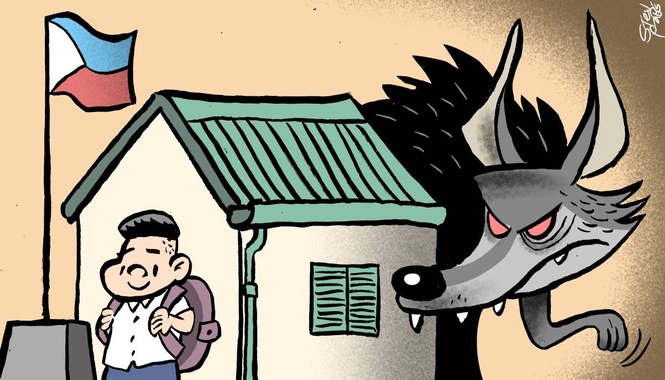
ANOTHER tragic school shooting incident was reported on Sept. 18, 2026, leaving three students dead, including the gunman, and six others wounded. President Ferdinand Marcos Jr. has instructed the Department of Education, the Department of Interior and Local Government, and the Philippine National Police to report on measures implemented to prevent similar incidents. According to the president, school shootings should not be normalized, and children should have the right to study in a safe environment without having to fear for their lives. In this interagency order, the president couldn’t overemphasize the urgency. Hopefully, this will lead to long-term security measures in communities with both public and private schools.
Local government units are endowed with police powers to promote the general welfare in their respective localities. This authority emanates from the general welfare clause under the Local Government Code. The president’s instruction should prompt local councils to enact ordinances addressing peace and order, gun control, and security in school communities as part of promoting the public interest of their inhabitants.
Since the recent incident involved public school students in a public school setting, this commentary will focus specifically on the policy environment in public basic education.
Each member of the school community must know their role in safety.
The challenges in addressing this wave of school violence in public schools are immense, and the Department of Education must be able to lead the members of the school communities to act in a coordinated way. The recent incidents require a deeper look at policy gaps directed at each member of the school community. A school community comprises students, parents, teachers and schools, and each has its own obligation for safety. As such, the DepEd can expand the scope of its issuances to address students, parents, and specific public schools directly. Unlike its mandate to reasonably supervise private schools, the DepEd has direct control over public schools, including their students and their parents. Thus, the DepEd can order parents of students in public schools to monitor and report their children’s off-campus activities as part of coordinated efforts to prevent violence, or order students to undergo guidance counseling or community service. But beyond moral pressure, the DepEd must use real consequences to compel students’ and parents’ compliance. After all, parents are duty-bound by law to coordinate and cooperate with schools in implementing policies.
Parents have the natural right and duty to rear their children. This duty makes them accountable and therefore liable for the damages caused by their minor children while living in their care. In Libi v. Intermediate Appellate Court, the parents were held liable by the court for damages resulting from the death of a student whom their son shot before the son turned the gun on himself. The court found the parents liable for damages due to their negligence in safekeeping the gun and their failure to monitor their son’s activities, which had shown his propensity for violence.
Teacher empowerment and protection
The DepEd must also revisit teacher empowerment and protection in exercising their right and duty to discipline students when they act in loco parentis. The government must shield public school teachers from administrative complaints from parents of students subject to legitimate disciplinary action. As persons in authority, teachers and public school officials must be protected against threats or intimidation. The DepEd must draw a clear line between discipline and abuse. Teachers should not always be on the defensive, especially since under the law, their liability for damages caused by students in their care is greater than parents’ liability.
On the other hand, public schools must pay as much attention to student formation and discipline as to child protection. To strengthen student formation and discipline in public schools, DepEd must revisit the discipline framework to balance authority and compassion, correction and care, and rights and rules. But there ought to be an administrative consequence for students who exhibit bad behavior if we want to eradicate school violence in public schools. Deterrence must be strong enough to discourage students from committing offenses.
Staying in school must remain the strongest motivation of students.
Ultimately, the State must teach students in public schools the value of their free education. Without appreciating its value, public education will remain something that students can claim as a matter of right but refuse or disregard as a matter of choice. In the private sector, the strongest compulsion for students to study hard and follow school rules is the risk of losing the right to stay in school. That compulsion is absent in a public school-student relationship, as it is viewed more as rights-based rather than contractual. It’s time to look at public education as a privilege the State grants through taxes paid by the people. While the State is constitutionally mandated to promote access to education, that access, when availed of, must entail duties and obligations for public school students and their parents. The State’s obligation to provide free public education necessarily implies students’ duty to study well and follow school rules and regulations.
If we are to truly make our schools safe as directed by the president, every member of the community — students, parents, teachers and officials — must recognize that rights come with responsibilities, and only by honoring both can we ensure that such tragedies never happen again.