Taipei Mayor Chiang Wan-an, a politician better known for caution than for surprises, has finally managed to surprise everyone. Whether voters will remember the moment as a pleasant surprise or a scare is still an open question.
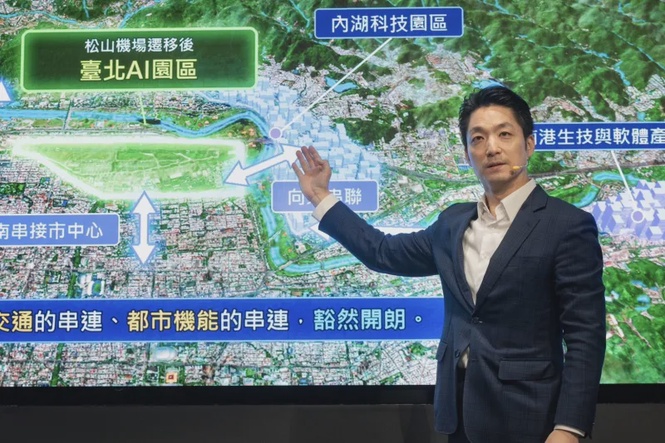
At a press conference on October 8 titled "Building an AI Golden Century and Unleashing the City's Full Potential," Chiang, of the opposition Kuomintang (KMT), announced that he wants to relocate Taipei Songshan Airport, the downtown airfield whose flight paths have capped building heights across much of the capital for decades. The idea is anything but new. It is one of the oldest unfinished files in Taipei's urban planning cabinet, and it has once again split the city: some residents mock it, some attack it, and frequent flyers protest that they would lose the convenience of taking off from the middle of town.
What makes this round different is who is standing where. Supporters and critics can be found in both major parties, but the parties have quietly swapped sides. The KMT, which once supplied most of the opposition to moving the airport, now largely backs it. The Democratic Progressive Party (DPP), Taiwan's ruling party, whose politicians almost always championed relocation, is now more likely to ridicule it.
The timing is no accident. Taipei elects its mayor on November 28 in the 2026 Taiwan local elections, and Chiang, seeking a second term, is in a far tighter race than anyone predicted in the spring. A TVBS poll earlier this month put Chiang at 49% and his DPP challenger, legislator Puma Shen, at 41%, a gap that stood at 28 points in May. A survey released on October 20 by the Xinmin Cross-Strait Research Association went further, showing Shen ahead with 50.3% to Chiang's 33.3%.
The one figure who has never wavered is Chang Jing-sen, a former minister without portfolio who ran Taipei's urban development department under then-Mayor Chen Shui-bian and sat on the city's original Songshan relocation task force. Casting himself as an aging palace maid recounting the court gossip of a vanished dynasty, a classic Chinese image for a veteran who has seen it all, Chang walked the public through 30 years of proposals that went nowhere. His verdict: "Songshan Airport's relocation has already missed its moment several times, but it is still worth discussing again." The real questions, he said, are how far Taoyuan International Airport can expand, whether it can absorb Songshan's traffic, how flights to Taiwan's outlying islands would work, whether the airport's national security and military roles can be replaced, and how much Taipei's development would actually gain.
Chiang's Own Timeline Pushes The Move Past His Next Term
Neither side needs to get too excited. To borrow the Chinese saying, let the bullets fly for a while, because these bullets will be in the air for a long time.
Chiang has sketched an appealing picture of "AI right at Taipei's front door." With NVIDIA's planned Taiwan headquarters anchoring the Beitou-Shilin Technology Park on the city's north side, the vision is not pure fantasy. Yet the AI Golden Century depends on something Taipei does not control: whether Taoyuan International Airport, about 40 kilometers west of the capital, can take over Songshan's traffic. Chiang's plan assumes that Taoyuan's Terminal 3 opens next year and its third runway is finished in 2033. He has said so himself: "There are roughly six years to begin full planning, assessment, and communication with the central government."
Six years means that by the time Chiang would leave office at the end of a second term, if he wins one, the city might have a complete plan, or it might simply have started planning and passed the baton to his successor. The generous reading is that the idea can be rolled out once more in the next mayoral race four years from now. The cynical reading is that nothing will happen to Songshan Airport in the next four years.
That raises an obvious question. Why stage such a production for a pledge that, by its author's own schedule, cannot be delivered this term? Perhaps Chiang wants it ready as ammunition for the mayoral debates against Shen. It is an awkward topic for Shen, since moving Songshan has been the shared dream of nearly every DPP candidate for Taipei mayor, with former Premier Su Tseng-chang the lone exception. But Chiang should not expect an easy win either. A pledge that has gone unfulfilled for 30 years has failed for structural reasons, not for lack of slogans.
Songshan's Fate Was Never Taipei's Decision Alone
Songshan is far more than a commuter airport. Besides domestic routes and a handful of regional services to cities such as Seoul and Tokyo, it is the base where the presidential aircraft and its backup helicopters are prepared and take off, a key transport hub for the security service that protects Taiwan's top leaders, a home for government executive flights and air rescue operations, and a staging point for evacuating foreign nationals in an emergency. Put simply, whether Songshan can be moved or shut down has never been something the Taipei City Government could decide on its own.
Even so, it would be unfair to dismiss Chiang's announcement as firing blanks. For nearly 60 years, every serious push to move the airport has come from Taipei City Hall.
How A 1968 Taipei Plan Gave Birth To Taoyuan Airport
The story begins with the Taipei Comprehensive Plan, published in October 1968. The city commissioned it from the Urban and Housing Development Committee (UHDC) of the Council for International Economic Cooperation and Development, a body under the Executive Yuan, Taiwan's Cabinet, and a forerunner of today's National Development Council. Drawing on advice from a team of United Nations experts, the plan recommended moving the airport to the Taoyuan tableland. That recommendation led directly to the construction of what is now Taoyuan International Airport, one of the Ten Major Construction Projects that powered Taiwan's industrialization in the 1970s.
In 1968, Yen Chia-kan was premier, Sun Yun-suan was minister of transportation, and Taipei was run by Kao Yu-shu, a rare mayor from outside the ruling KMT. Taipei had been upgraded to a special municipality under the Executive Yuan the year before, and Kao was determined to remake the "gateway to the capital." He succeeded in persuading Chiang Ching-kuo, then a rising power and later president, to move his official residence to the Qihai compound. He did not succeed in moving the airport, which stifled the city's growth and imposed strict height limits on surrounding land. The main obstacle was timing: Taiwan's economy was about to take off, and neither Taoyuan's capacity nor the transport links along the island's west coast were ready.
When the DPP's Chen Shui-bian became mayor in 1994, the plan drawn up under his non-KMT predecessor caught his eye again, and the city set up its Songshan relocation task force. Taipei put real energy into it, though the central government paid it little attention. The point was never whether the Executive Yuan would cooperate. The point was that Taipei had the nerve and imagination to picture its own future, just as Kao had once dared to ask the central government to step aside.
Songshan Became A DPP Obsession That Shen Has Dropped
By 2002, with Chen in the Presidential Office, DPP mayoral candidate Lee Ying-yuan campaigned on "trading the airport for a park." He lost, and even had he won, the transportation minister might have played along, but the defense minister almost certainly would not have. In 2006, Frank Hsieh argued that the airport cut through Taipei's transport links and urban fabric, and that the height restrictions around it held back the Nangang and Neihu technology parks; he proposed turning the site into parks, waterfront housing, and a business district. In 2018, Pasuya Yao made the most serious attempt of all with his "Central Park" plan, bringing a pop-up model book onto the stage at a policy presentation in a moment many voters still remember. In 2022, Enoch Wu proposed turning the entire site into parkland.
Relocating Songshan became something close to an obsession for DPP candidates in Taipei. Shen, curiously, seems to have forgotten it.
Instead, Shen has challenged Chiang's record, asking, "Over the past 10 years, what has Chiang stood for, and what does he actually want to do?" Former Transportation Minister Yeh Kuang-shih answered on Chiang's behalf, noting that Chiang, then a legislator, had asked questions about relocating Songshan as early as 2015.
Chiang is not unprepared, and neither were the DPP candidates who came before him. When Lee and Hsieh ran on the idea, one major factor beyond urban development and lifting height limits was that Taiwan's high speed rail was already under construction. In 2015, before he ever ran for mayor on the issue, Yao represented then-presidential candidate Tsai Ing-wen at a forum on the capital's future and proposed moving the airport by 2020. That was a pivotal moment: that same year, a TransAsia Airways flight that had just taken off from Songshan crashed into the Keelung River, bringing safety concerns about the downtown airport to the surface. Tsai later shelved the idea, which, in hindsight, was fortunate. The plan was not bad, but construction of Taoyuan's new terminal kept slipping.
A Future Premier Chiang May Have To Answer Mayor Chiang
During the eight years of KMT President Ma Ying-jeou, Songshan was developed into the most important airport for direct flights across the Taiwan Strait, in addition to its domestic routes. That is why almost no one in the KMT argued for moving it back then. Chiang raising the idea now is not the problem. Taipei needs a vision of its future.
The problem lies further down the road. If the KMT returns to power, say two or six years from now, how will a KMT central government respond to the call to move Songshan? And what if Chiang himself becomes premier one day? How would Premier Chiang answer Mayor Chiang's plan? This is not an absurd hypothetical. What makes politics so startling is that the "what if" can happen anytime, anywhere.
Before that day comes, Chiang might do well to pay a visit to the two men most devoted to this cause, Chang Jing-sen and Pasuya Yao. A little listening tour could serve him well before he faces Shen on the debate stage in the final weeks of the 2026 Taiwan local elections.
Social Media Links & Editor Tag - Penny