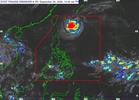
THE habagat or southwest monsoon season has ended, the Philippine Atmospheric, Geophysical and Astronomical Services Administration (Pagasa) said Monday.
“A gradual shift in the prevailing weather pattern has been observed over the past several days, such as the strengthening high pressure system over East Asia, the southward-migrating Intertropical Convergence Zone (ITCZ), and the notable weakening of winds and a decrease in rainfall associated with the southwest monsoon,” Pagasa said.
“Forecasts indicate that these conditions are expected to persist in the coming days. In view of this, the habagat season has officially ended,” it said.
“This also marks the termination of the rainy season over the western sections of Luzon and Visayas,” it said.
In the 5 p.m. weather update, Pagasa Weather Specialist Charmagne Varilla told the public to expect the transition to the easterlies.
“And there is also the decrease in rains, most especially in the west part of Luzon and Visayas,” Varilla said.
Pagasa Weather Specialist Leanne Loreto said that after the southwest monsoon season there will be a transition period towards the amihan or northeast monsoon.
She said that the northeast monsoon, “our cool and dry season,” could start in the second half of October. Because of El Niño, it was possible that temperatures would not be that cold compared with previous years, she said.
She said it was also possible that the country would get two more storms in October.