
Recognizing the allure of the Titanic, OceanGate started to offer Expeditions to the Titanic wreck starting 2021 with its most recent being the ill fated journey by its Titan Submersible on 18 June 2023.
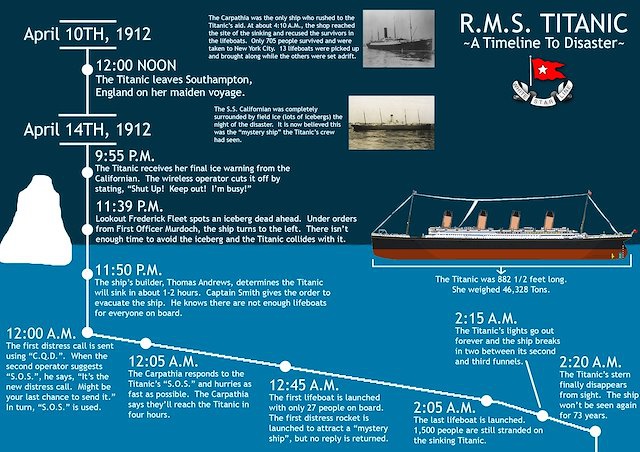
On April 14, 1912 the Titanic had received a number of ice berg warnings from other ships
The Titanic had received a number of iceberg warnings from other ships, including one at around 9:40 pm and another at 10:55pm. However, the Titanic continued to travel at full speed ahead.
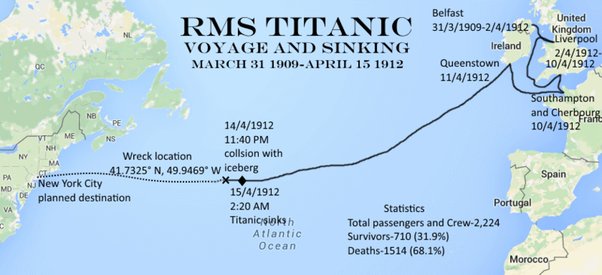
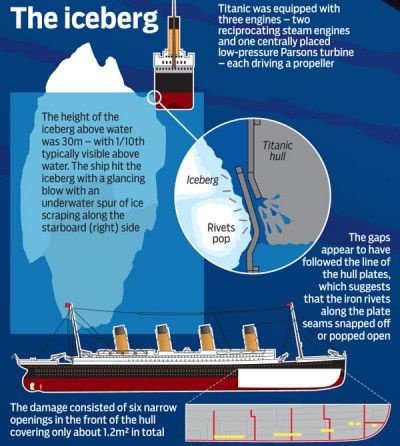
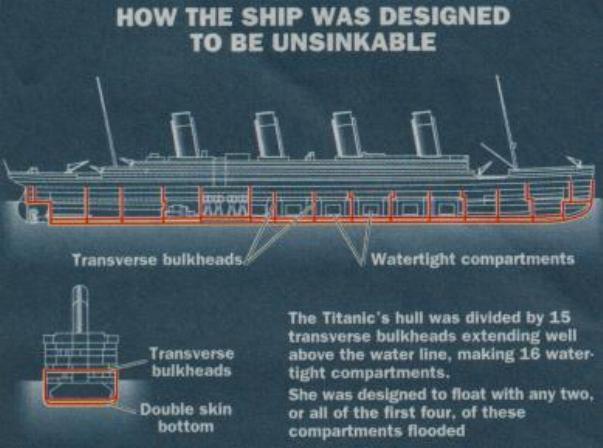
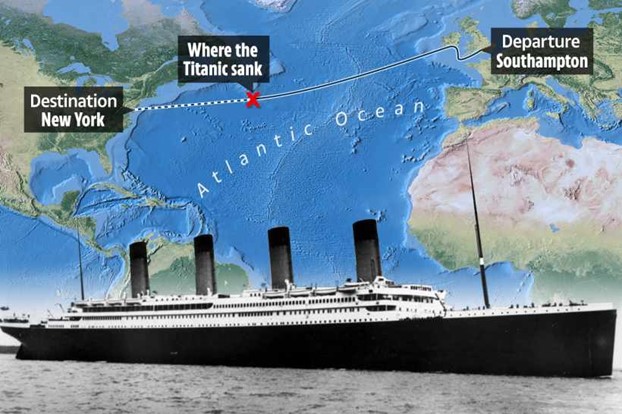
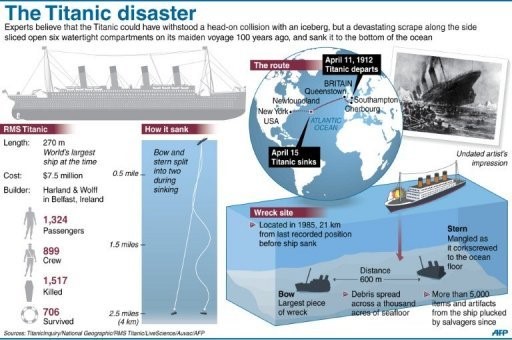
At approximately 11:40 PM, about 400 nautical miles (740 km) south of Newfoundland, Canada, (1,250 miles from its final destination), an iceberg was sighted, and the bridge was notified. (Fig 1 & Fig 2) First Officer William Murdoch ordered both the ship “hard-a-starboard”, a maneuver that under the order system then in place would turn the ship to port (left) and the engines reversed. The Titanic began to turn, but it was too close to avoid a collision. The ship’s starboard side scraped along the iceberg. At least five of its supposedly Watertight compartments toward the bow were ruptured. (Fig 3)
The ship had 15 bulkheads which divided the hull, the shell, of the ship into 16 sections. Titanic was designed so that any 3 sections could flood with water and the ship would remain buoyant.
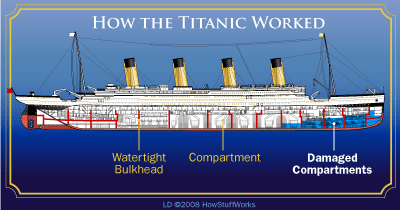
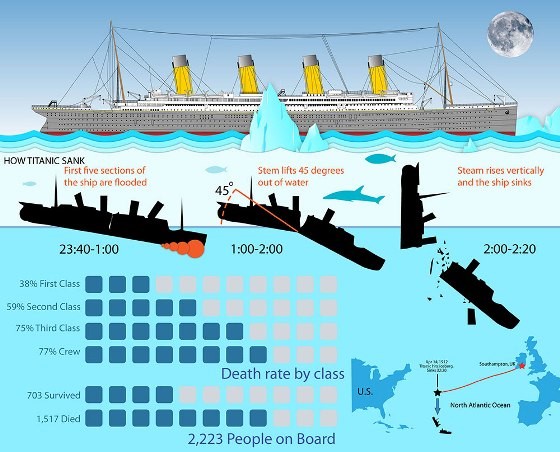
After assessing the damage, the Ship’s builder Thomas Andrews who was on board had determined that, as the ship’s forward compartments filled with water, its bow would drop deeper into the ocean, causing water from the ruptured compartments to spill over into each succeeding compartment, and that the ship would be able to stay afloat for only another hour and a half , thereby sealing the ship’s fate. (Fig 4)
The Titanic would founder. (By reversing the engines, Murdoch actually caused the Titanic to turn slower than if it had been moving at its original speed. Most experts believe the ship would have survived if it had hit the iceberg head-on.)
As the iceberg had punctured six of the Titanic's 16 water-tight compartments, the Titanic was quickly filled with water. Experts say they had only four compartments flooded, the ship would have stayed floating. The time between the first sighting of the iceberg and i mpact was a mere 37 seconds, with the ship sinking in 160 minutes.
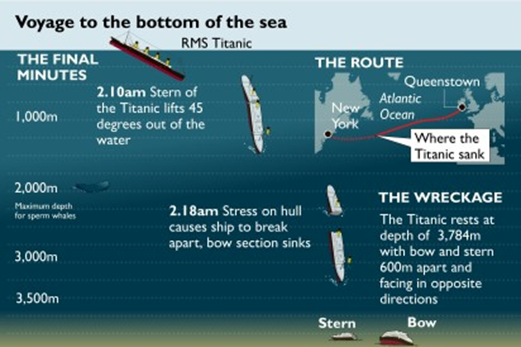
The sinking of the ship was sped up when, after around two and half hours after hitting the iceberg, the Titanic’s boat deck went under the water and, as its unsupported stern lifted out of the water, exposing the propellers, the Titanic split into two and sank around 2:20 a.m. On April 15 in the North Atlantic Ocean about 400 miles south of Newfoundland. Passengers were dumped into the frigid water - many dying from cardiac arrest and cold incapacitation. (Fig 5- Fig 7)
Tragically, despite receiving several iceberg warnings on April 14, as the Titanic’s captain, Edward Smith, continued to sail full-steam ahead, it was a deadly decision resulting in the loss of some 1,500 lives.
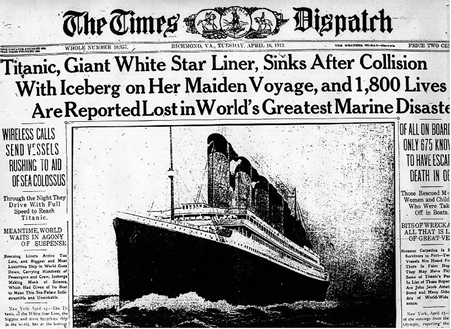
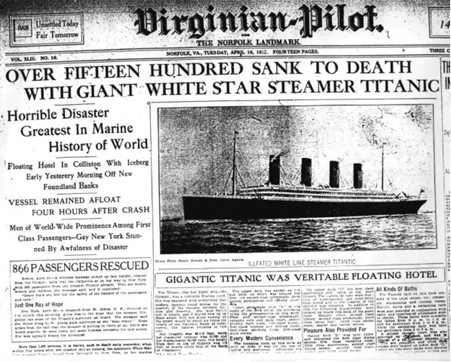
Those who were Saved
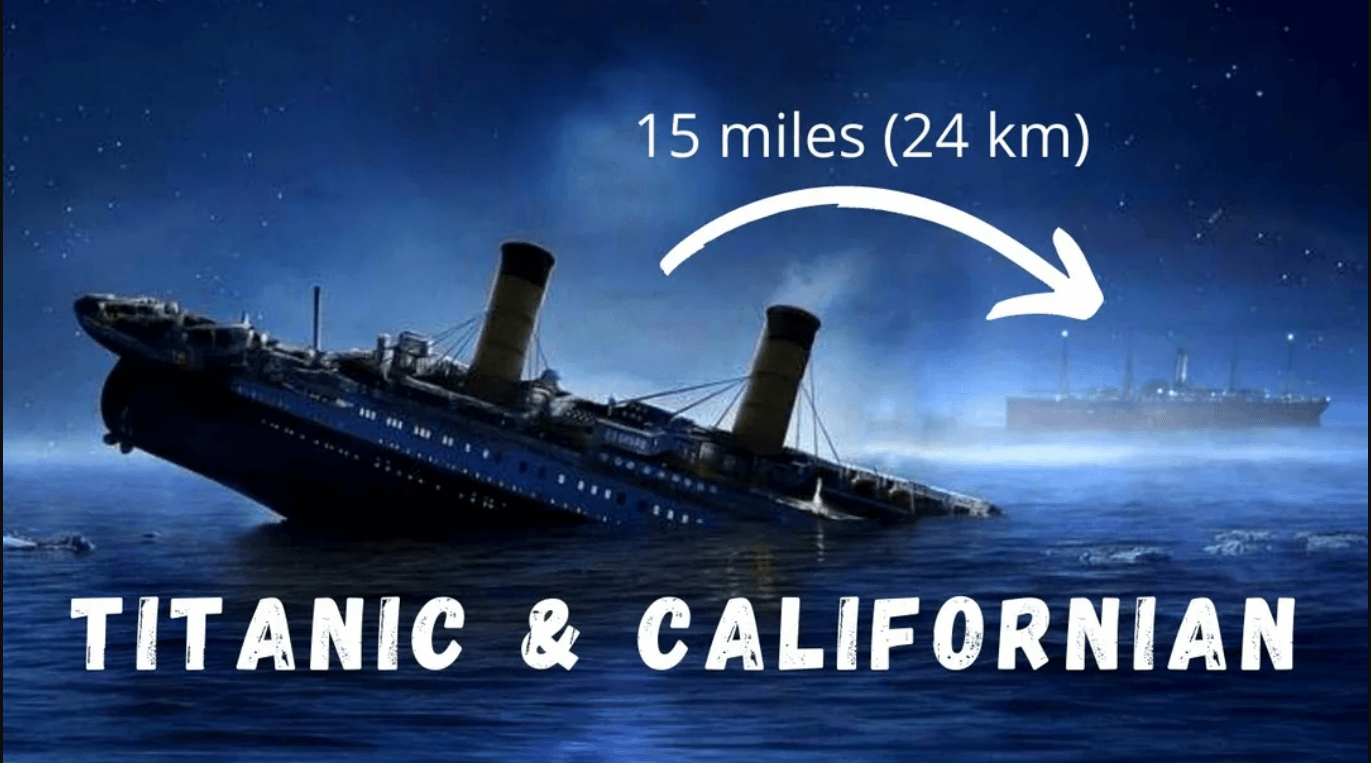
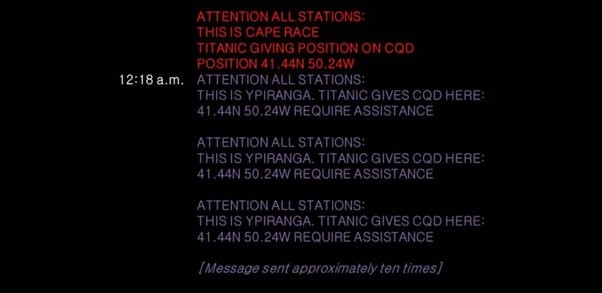
Smith ordered had Phillips to begin sending distress signals, (Fig 8 - Fig 12) one of which reached the Carpathia at approximately 12:20 AM on April 15, and the Cunard ship immediately headed toward the stricken liner. However, the Carpathia was some 58 nautical miles (107 km) away when it received the signal, and it would take more than three hours to reach the Titanic. Other ships also responded, including the Olympic, but all were too far away. A vessel was spotted nearby, but the Titanic was unable to contact it. The Californian was also in the vicinity, but its wireless had been turned off for the night.(Fig 11)
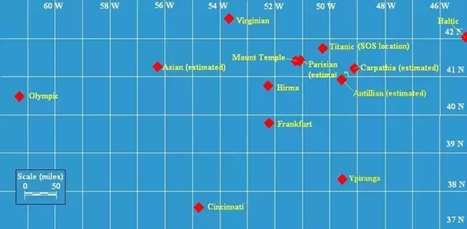
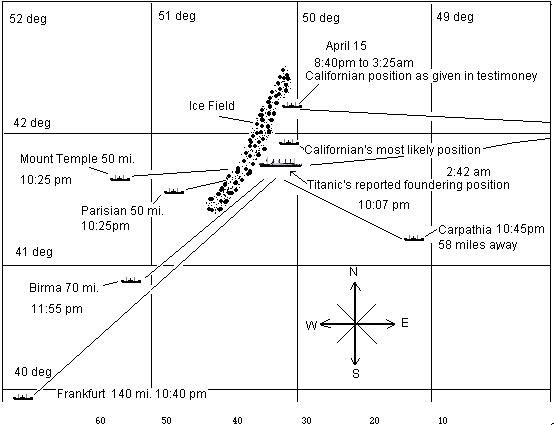
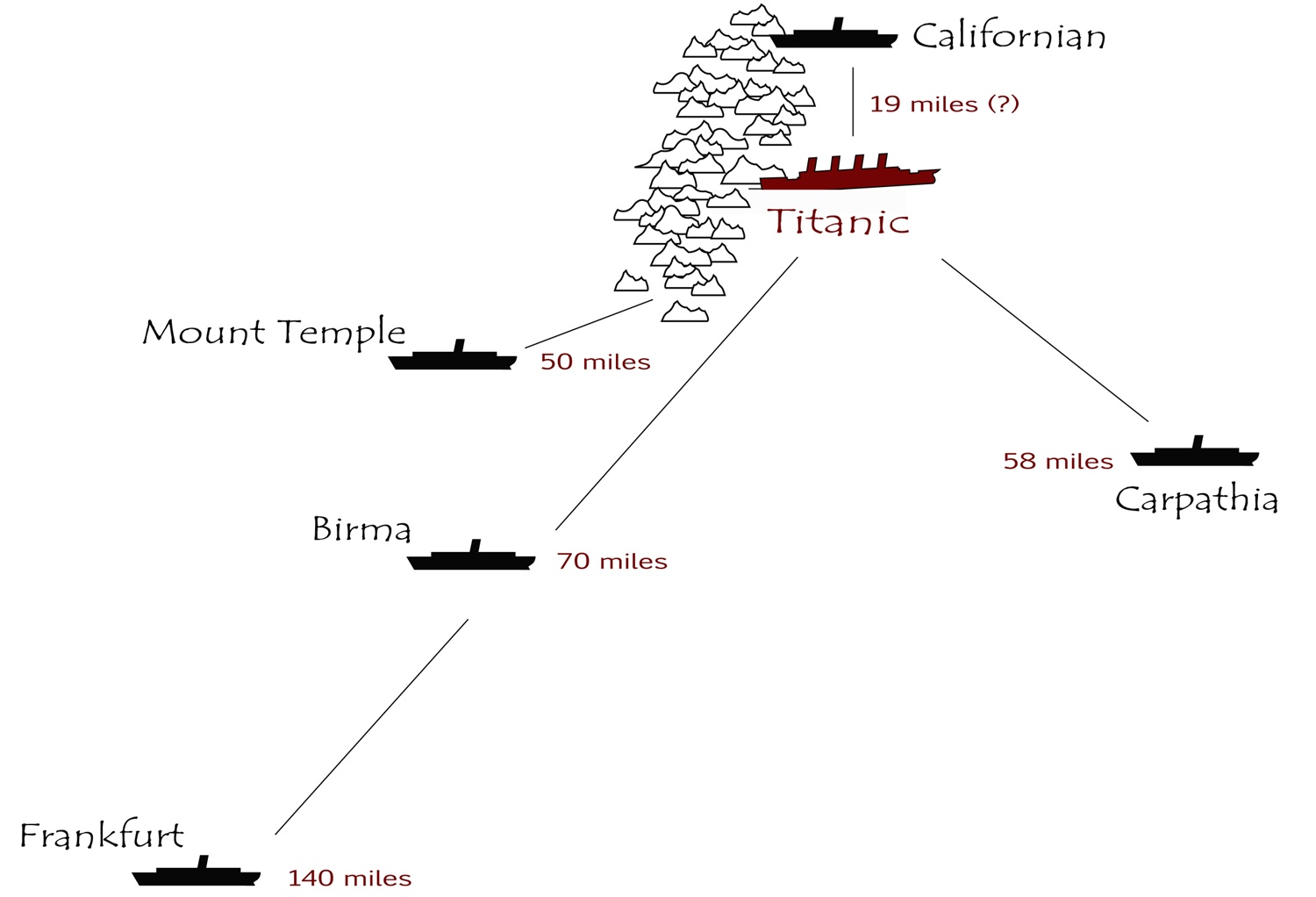
There were several ships that responded to titanics distress calls unfortunately as this shows none if them (aside from the Californian whose radio operator had gone to bed) were close enough to be of any help in saving those who couldn't find a place in a lifeboat. (Fig 11) The first to respond were the Frankfurt, the birma and the mount temple. but the Frankfurt was too far off to reach her position, the mount temple did make way towards titanic and may have got there before carpathia but found her way blocked by pack ice,( Fig 10) the Cape race land station and the ypiranga (Fig 10)
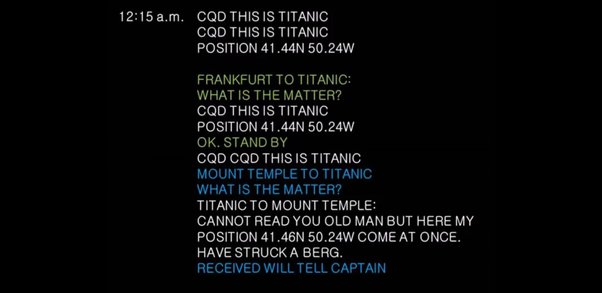
The Cape race land station and the ypiranga had also began relaying its message to any other ships in the area. (Fig 13)
As attempts were made to contact nearby vessels ( Fig 8 - Fig 16), the lifeboats began to be launched, with orders of women and children first. Although the Titanic’s number of lifeboats exceeded that required by the British Board of Trade, its 20 boats could carry only 1,178 people, far short of the total number of passengers. This problem was exacerbated by lifeboats being launched well below capacity, because crewmen worried that the davits would not be able to support the weight of a fully loaded boat. (The Titanic had canceled its scheduled lifeboat drill earlier in the day, and the crew was unaware that the davits had been tested in Belfast.) Lifeboat number 7, which was the first to leave the Titanic, held only about 27 people, though it had space for 65. In the end, only 705 people would be rescued in lifeboats.
Despite the presence of icebergs, the Carpathia under Captain Arthur Rostron traveled at top speed (some 17 knots), arriving at approximately 3:30 am. Though the Titanic had sunk more than an hour earlier but the Carpathia made a heroic effort and rescued 705 people in lifeboats. The ship returned to New York City on April 18 (Fig 14).
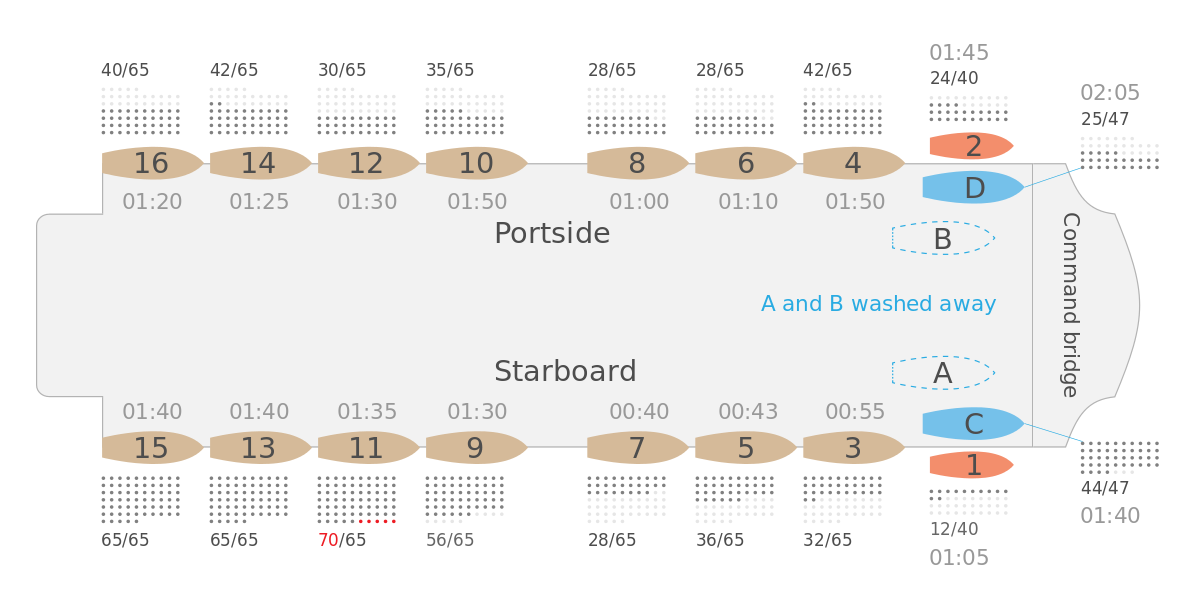
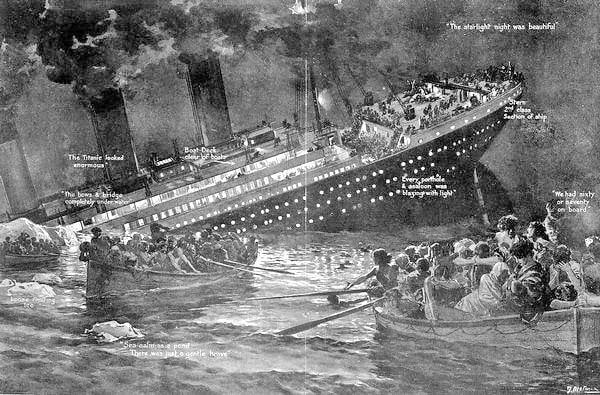
Photo Credit: Wikimedia Commons
After the Titanic foundered at roughly 2:20am on 15 April, the first lifeboat was picked up at 4:10am by the RMS Carpathia responding to the Titanic’s distress calls it had sent out earlier. (Fig 16) The Carpathia had managed to rescue 705 people from the lifeboats.
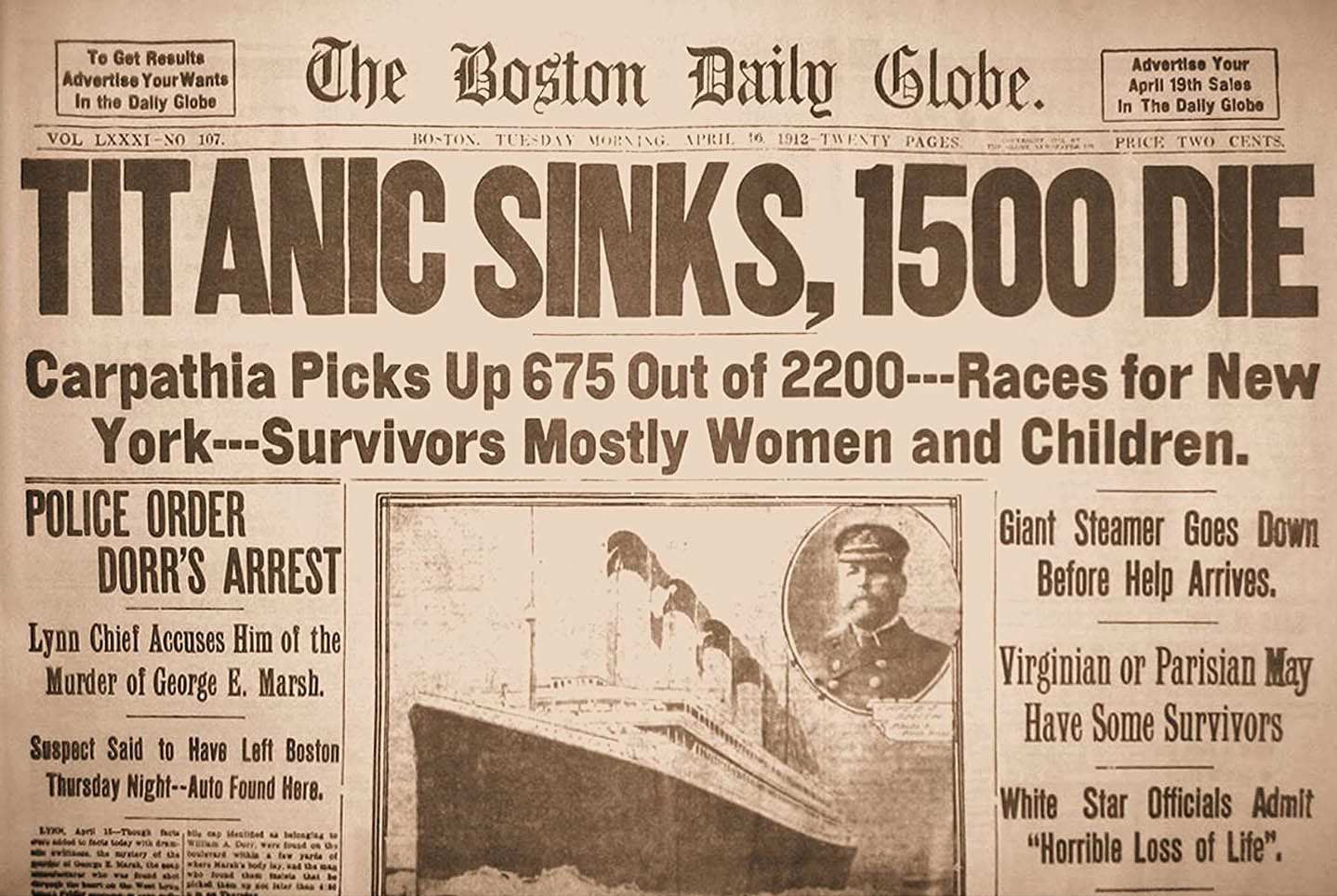
After Carpathia rescued the survivors, the Titanic's sister ship Olympic sent a message that it would be there soon and asked if Carpathia would like to transfer the survivors to her but Captain Rostrum decided that to put the people on a ship that looked almost exactly like the one they just saw sink might traumatize them even more.
Titanic Ship Wreck found
Efforts to locate and salvage the Titanic began almost immediately after it sank. But technical limitations as well as the sheer vastness of the North Atlantic search area—made it extremely difficult. American oceanographer and former Navy officer Robert D. Ballard, who was based out of the Woods Hole Oceanographic Institution in Massachusetts, led his first search expedition in 1977, which was unsuccessful.
In 1985, along with French oceanographer Jean-Louis Michel, Ballard again set out to locate the wreck, this time with an experimental, unmanned submersible called the Argo, developed by the U.S. Navy. The Argo traveled just above the ocean floor, sending photographs up to the research vessel Knorr. In the early morning of September 1, Argo was investigating debris on the ocean floor when it suddenly passed over one of the Titanic‘s massive boilers, lying at a depth of about 13,000 feet. (Fig 17)
The next day, the body of the ship was discovered nearby. It had split in two, but many of its features and interiors were remarkably well-preserved. Hundreds of thousands of bits of debris were scattered in a 2-square-mile radius around the ship. The wreck was subsequently explored by manned and unmanned submersibles, which shed new light on the details of its 1912 sinking.
The wreck lies in two parts, with the bow and the stern separated by about 2,600ft. A huge debris field surrounds the broken vessel. (Fig 18 – Fig 20)
Fascination with the Titanic Shipwreck
The Titanic continues to be an inspiration for many works including the highly acclaimed blockbuster movie Titanic by Producer James Cameron which elevated actor Leonardo DiCaprio and actress Kate Winslet, to instant stardom for their role as members of different social classes who fall in love during the ship's maiden voyage.
Part 4 shares Cameron's views on how the film has helped people remember and connect with the disaster, which is necessary if lessons are ever to be taken from it and several factors that may have caused the Titanic to sink.
Read all parts: Part 1, Part 2, Part 3, Part 4, Part 5, Part 6, Part 7, Part 8
Sheriffah Dato Syed is a content creator under the Newswav Creator programme, where you get to express yourself, be a citizen journalist, and at the same time monetize your content & reach millions of users on Newswav. Log in to creator.newswav.com and become a Newswav Creator now!
The User Content (as defined on Newswav Terms of Use) above including the views expressed and media (pictures, videos, citations etc) were submitted & posted by the author. Newswav is solely an aggregation platform that hosts the User Content. If you have any questions about the content, copyright or other issues of the work, please contact Newswav.
